
How Bitcoin ETFs Changed Who Owns Bitcoin
Since January 2024, US spot bitcoin ETFs have gathered about 6% of all bitcoin. Who holds them, why custody is concentrated and what it means for the market.
Bitcoin ETF ownership moved a large share of bitcoin into regulated funds held through ordinary brokerage accounts. Since US spot bitcoin ETFs launched on January 11, 2024, they have accumulated roughly 1.2 to 1.3 million BTC, about 6% of the total supply, with total assets passing $100 billion at times in 2026. BlackRock’s IBIT alone holds the majority.
Who bought
- Advisers and wealth managers adding bitcoin to client portfolios.
- Hedge funds, often for basis trades between ETFs and futures.
- Pension funds and endowments, in smaller amounts.
- Retail investors who prefer a brokerage account to a crypto exchange.
IBIT had 414 reported institutional holders in its first quarterly filing season, a record for a new ETF.
How the ETFs work
A spot bitcoin ETF holds actual bitcoin with a custodian and issues shares that trade on a stock exchange. Authorized participants, usually large trading firms, create new shares when demand rises and redeem them when it falls, and the fund buys or sells bitcoin accordingly. US spot bitcoin ETFs initially used cash creations and redemptions, with later moves toward in-kind processes. Arbitrage between the ETF price and bitcoin’s price keeps the two closely aligned. See what an ETF is.
ETF flows and the market, illustrated
Suppose ETFs see $500 million of net inflows in a day when bitcoin trades at $100,000. (Illustrative figures.) The funds need to acquire about 5,000 BTC, roughly ten days of new supply from mining after the 2024 halving cut issuance to about 450 BTC a day. Sustained inflows of that size can absorb far more bitcoin than miners produce, one reason analysts watch ETF flows closely as a driver of price. Large outflows work the other way.
How it changed the market
Concentration. A few funds now hold a large share of bitcoin; spot ETFs together hold more than any single private entity.
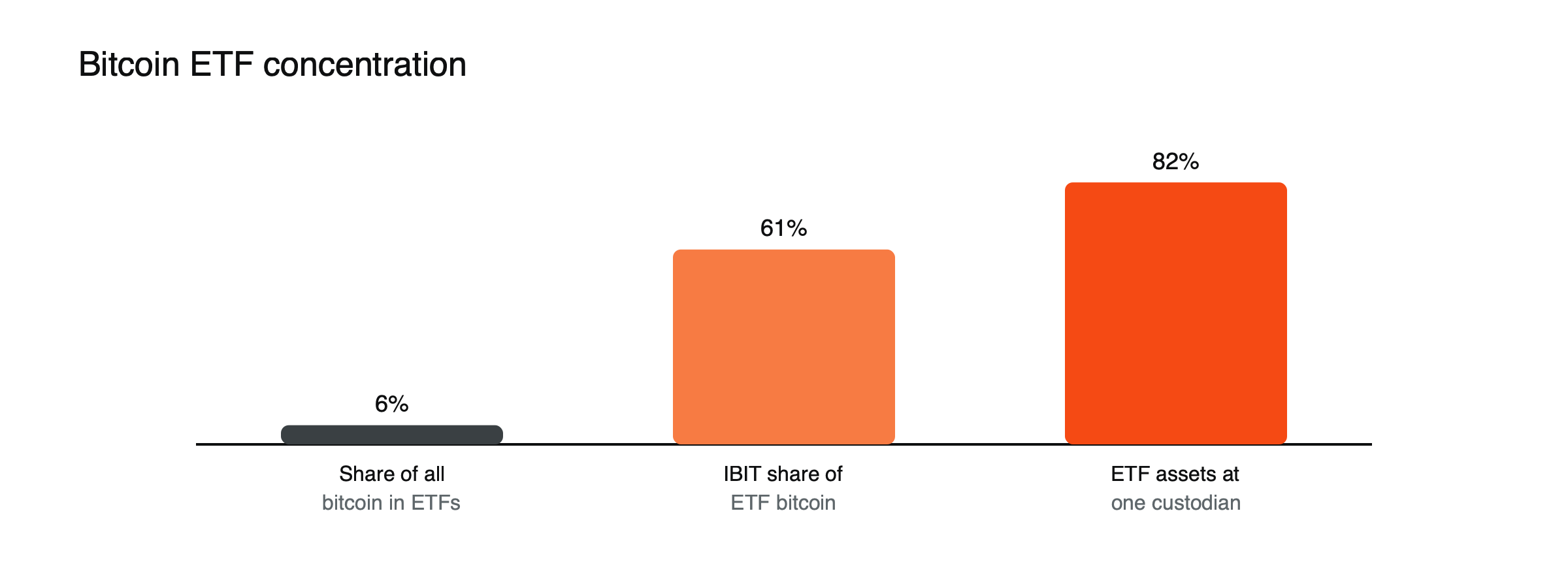
Figure: Concentration in the bitcoin ETF market. Sources: Crypto Briefing; Value the Markets; BIT.
Custody. Roughly 81% to 84% of US spot bitcoin ETF assets sat with one custodian, Coinbase, as of April 2026.
Flows as a price driver. Daily ETF inflows and outflows became one of the most-watched signals. Cumulative net inflows reached about $55 billion by September 2026.
Access without keys. ETF holders own shares, not coins; they cannot move bitcoin on-chain. See custodial vs non-custodial wallets.
IBIT’s dominance
BlackRock’s iShares Bitcoin Trust, IBIT, quickly became the largest bitcoin ETF, holding about 61% of all US spot ETF bitcoin by mid-2026. Its scale gives it deep liquidity and options markets, but it also concentrates a large share of ETF holdings in a single fund and custodian.
Fees and competition
Spot bitcoin ETFs compete on fees, with annual charges generally well below 1%, far lower than many earlier crypto investment products. Lower costs helped attract long-term investors who previously avoided crypto because of the cost and complexity of holding coins directly.
Risks
Heavy redemptions in a crisis could add selling pressure, and custody concentration creates a single point of failure.
See what crypto custody is and how ETFs changed price discovery.
Bitcoin ETF versus holding bitcoin directly
| Spot bitcoin ETF | Holding bitcoin directly | |
|---|---|---|
| Ownership | Fund shares | The coins themselves |
| Custody | Fund’s custodian | Self-custody or exchange |
| Trading hours | Exchange hours | 24/7 |
| On-chain use | None | Can transfer, use in DeFi |
| Account | Brokerage | Crypto wallet or exchange |
ETFs and price discovery
With a large share of trading now happening through ETFs during US market hours, some price discovery has shifted toward those hours. Bitcoin still trades around the clock, but ETF flows announced daily and options on the ETFs have become major influences. See how ETFs changed price discovery.
What it means for traders
ETF flow data have become a standard input for crypto traders, alongside on-chain data and derivatives positioning. Large outflows during market stress can add to selling, while steady inflows can support prices. Traders using bitcoin CFDs can watch ETF flows as one indicator of institutional demand. See what moves bitcoin’s price.
The road to approval
US regulators rejected spot bitcoin ETF applications for years, citing concerns about manipulation in underlying markets. A court ruling in 2023 found that the SEC had not adequately explained rejecting one application, increasing pressure for approval. Funds from several issuers were approved together and began trading on January 11, 2024. Surveillance-sharing arrangements with regulated markets were a key part of the approval. See how market surveillance catches manipulation.
The basis trade, illustrated
Suppose bitcoin futures expiring in three months trade at $102,000 while spot ETF shares imply bitcoin at $100,000. (Illustrative figures.) A hedge fund can buy ETF shares and sell futures, locking in the $2,000 difference, about 2% over three months, if held to expiry. Such basis trades explain part of ETF demand from hedge funds, and their unwinding can cause outflows unrelated to views on bitcoin’s long-term value.
Ether and other crypto ETFs
Spot ether ETFs followed in July 2024, and applications for funds on other crypto assets followed, broadening regulated access beyond bitcoin.
Advisers and model portfolios
Financial advisers have gradually added small bitcoin ETF allocations to client portfolios, often 1% to 3%, as research teams at large firms published guidance. Inclusion in model portfolios can create steady, recurring demand.
Common misreadings
- Assuming ETF inflows always reflect long-term buyers.
- Believing ETF shares can be redeemed for coins by retail holders.
ETFs versus earlier products
Before spot ETFs, US investors often used closed-end trusts or futures-based ETFs to gain bitcoin exposure. Trusts could trade at large premiums or discounts to the value of their bitcoin, and futures-based funds suffered from roll costs. Spot ETFs, with creation and redemption keeping prices close to net asset value and lower fees, largely replaced these products for many investors.
Companies holding bitcoin
Alongside ETFs, some listed companies built large bitcoin holdings on their balance sheets, offering investors another indirect route. Unlike ETFs, these companies may use debt or share issuance to buy bitcoin, adding leverage and company-specific risks. Comparing ETFs, company shares and direct holdings helps investors choose the exposure that matches their goals.
Global access
Bitcoin exchange-traded products also trade in Europe, Canada and parts of Asia, with differing structures and rules.
Outflows in stress, illustrated
Suppose bitcoin falls 15% in a week and ETFs see $3 billion of net outflows. (Illustrative scenario.) To meet redemptions, funds sell about 30,000 BTC if the price is near $100,000, adding to selling pressure in spot markets. If other buyers step in, the impact fades; if not, outflows can extend the decline. ETF flows therefore act as an amplifier in both directions, magnifying rallies when money flows in and declines when it flows out.
Options on bitcoin ETFs
Listed options on major bitcoin ETFs let investors hedge or speculate using familiar brokerage tools. Their volume has grown quickly, and positioning in these options can influence short-term price moves, much as options do in share markets.
The supply argument
Supporters of bitcoin often point out that ETFs and companies have absorbed more bitcoin than miners produce, tightening available supply. Critics respond that holders can sell at any time and that supply on exchanges is only part of the picture. The debate continues, but ETF flows have clearly become one of the most watched indicators of demand.
Lessons for traders
Bitcoin ETFs turned bitcoin into an asset many investors can access through familiar accounts, but they did not change its volatility. Traders who follow ETF flows gain insight into institutional demand, while remembering that flows can reverse quickly and that ETF trading hours differ from bitcoin’s round-the-clock market. Combining flow data with on-chain indicators and derivatives positioning gives a more complete picture than any single source.
Questions investors ask
Investors comparing an ETF with direct ownership often ask about fees, custody, taxes and the ability to use coins on-chain. The answers depend on personal circumstances and local rules, but the trade-off is broadly convenience and regulation versus control and flexibility. Investors should also consider how the fund tracks bitcoin’s price, how large and liquid it is, and which custodian holds its coins, because these factors affect costs and risks over time, and the choice should match each investor’s goals.
Frequently asked questions
Do ETF holders own bitcoin?
They own shares in a fund that owns bitcoin; they cannot withdraw or move the coins themselves.
Why does custody concentration matter?
If one custodian holds most ETF bitcoin, an operational or security failure there could affect many funds at once.
This article is educational content and does not constitute financial, investment, legal or tax advice. Digital assets are volatile and you may lose the amount you invest.
Sources
- Bitcoin ETFs buy $160M, total assets surpass $100B (6%–6.3% of supply; about $55.3 billion cumulative inflows) — Crypto Briefing, September 2026
- Bitcoin spot ETFs fundamentally shifted (1.29 million BTC, more than any private entity) — Yahoo Finance, 2026
- IBIT: the ETF that made bitcoin a blue chip (81%–84% of US spot ETF assets at Coinbase custody, April 2026) — BIT Knowledge Hub
- BlackRock spot bitcoin ETF’s 414 holders (first 13F season) — The Block, 2024
- The impact of US spot bitcoin ETFs on the market (IBIT about 61% of ETF bitcoin; over 1.2 million BTC in July 2026) — Value the Markets