
Why Institutional Traders Care So Much About Market Depth
Market depth shows how much can trade near the current price. Why large traders watch it, how thin depth raises costs and why it vanishes in stress.
Market depth is the volume of buy and sell orders waiting near the current price. Institutional traders care because they trade in size: if depth is thin, a large order pushes the price against them, and that cost can dwarf any commission. Depth also tends to disappear exactly when it is most needed, in fast or stressed markets.
Spread vs depth
The bid-ask spread shows the cost of a small trade. Depth shows the cost of a large one: how far the price moves as an order eats through successive levels of the order book. A tight spread with little behind it can still be expensive for size.
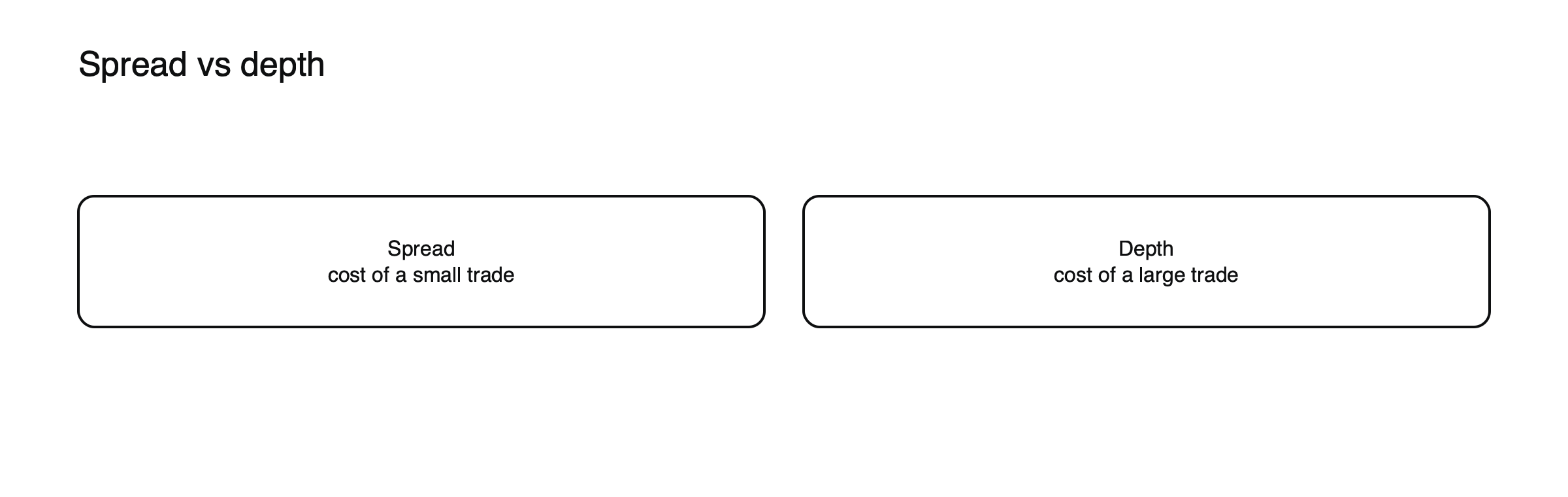
Figure: Spread and depth measure different costs.
Walking the book, illustrated
Suppose the order book for a share shows 2,000 shares offered at $50.00, 3,000 at $50.05, 5,000 at $50.10 and 10,000 at $50.20. (Illustrative order book.) A trader buying 1,000 shares pays $50.00. A fund buying 10,000 shares at once takes the first three levels, paying an average of about $50.07, and moves the best offer to $50.20. On a $500,000 order, that impact costs about $650, far more than any commission. Spreading the order over time, or seeking a block trade, could reduce the cost.
Why size changes everything
- Price impact: each additional share may trade at a worse price.
- Information leakage: visible large orders can move prices before they finish.
- Execution strategy: institutions split orders over time, use algorithms or trade in dark venues to reduce impact. About 45% of US share volume traded away from public exchanges in 2023.
How institutions execute
Large investors rarely send big orders to the market in one go. They use algorithms that slice orders into small pieces and spread them through the day, often aiming to match the day’s average price weighted by volume, or to keep their trading below a set share of market volume. They also use dark pools, which match orders without displaying them, and negotiate block trades directly with other institutions or dealers. The aim in each case is to trade without revealing intentions and pushing the price.
Hidden and iceberg orders
Not all depth is visible. Iceberg orders show only a small portion of their size, refilling as each portion trades, so the displayed book understates real interest. Hidden orders do not display at all. Traders reading an order book should remember that visible depth is only part of the picture.
When depth vanishes
Market makers widen quotes and reduce size when volatility rises. In March 2020, even a major bond ETF traded more than 6% below its asset value, showing how thin markets can get in a panic. Overnight sessions also tend to have thinner depth. See how 24/7 trading is changing market structure.
What retail traders can learn:
- Check the order book, not just the quote, for less liquid assets.
- Use limit orders where depth is thin.
- Expect worse fills around news and at the open and close.
See how market makers make money, why payment for order flow is so controversial and how to read crypto trading volume.
Depth in crypto markets
Crypto order books can look deep on calm days but thin out quickly when prices move. On October 10, 2025, more than $19 billion of leveraged positions were liquidated in a single day as prices fell through thin order books, forcing more selling. Depth is also spread across many exchanges, so a large order on one venue may move its price more than the global market. See what causes liquidation cascades.
Depth and CFDs
CFD traders usually see only a bid and ask quoted by their provider, not the underlying order book. Providers may quote the same price for a range of trade sizes, but very large orders can receive different prices or be filled in stages. Checking a provider’s execution policy for large orders helps avoid surprises. See why best execution matters for traders.
Measuring depth
Common measures include the total volume available within a given distance of the mid price, the cost of executing a standard-size order and how quickly depth refills after trades. Institutions track these measures over time and across venues to decide where and when to trade.
A rule of thumb for impact, illustrated
Traders often estimate market impact with a simple rule: impact grows with the square root of order size relative to daily volume. Suppose a share trades 2 million shares a day with daily volatility of 2%, and a fund wants to buy 200,000 shares, 10% of daily volume. (Illustrative figures.) The rule suggests impact of roughly 2% times the square root of 0.1, about 0.63%. Doubling the order to 20% of daily volume raises the estimate to about 0.89%, not double. The rule is approximate, but it captures why large orders become disproportionately expensive.
Depth through the day
Depth varies through the trading day. It is usually thin in the first minutes after the open, builds through the morning and peaks near the close, when many funds trade to match closing prices. Closing auctions now account for a large share of daily volume in many markets, making them important for institutions seeking size.
Bonds and currencies
In bond and currency markets, there is often no central order book. Institutions request quotes from several dealers, and depth depends on dealers’ willingness to take on risk. In stressed markets, dealers may quote smaller sizes or wider prices.
Common misreadings
- Judging liquidity by spread alone.
- Assuming visible depth will stay when prices move.
Dark pools
Dark pools are trading venues that do not display orders before execution. Institutions use them to buy or sell large blocks without signaling their intentions to the wider market. Trades are reported after execution, so prices still enter the public record. About 45% of US share volume traded away from public exchanges in 2023, including in dark pools and through wholesalers. Critics worry that too much off-exchange trading weakens the public price signal; supporters say it lowers costs for large investors.
Algorithms and depth
Execution algorithms watch depth in real time, slowing down when the book thins and speeding up when liquidity returns. Some seek hidden liquidity across many venues at once. Their goal is to complete large orders at prices close to the market average without leaving a footprint that other traders can exploit.
Depth and volatility
Depth and volatility are closely linked. When volatility rises, liquidity providers reduce the size they are willing to quote, depth shrinks and prices move further for the same order, which in turn raises volatility. This feedback loop explains why markets can move from calm to chaotic quickly, and why institutions often slow their trading when volatility jumps.
Retail orders and depth
Most retail orders are small enough to fill at the best quote in liquid markets, so depth rarely matters for them in normal conditions. It matters more in small-cap shares, exotic currency pairs, smaller crypto tokens and during fast markets, when even modest orders can move prices.
A checklist for larger orders
- How does the order compare with typical daily volume?
- How much depth sits within a few ticks of the price?
- Would splitting the order over time reduce impact?
- Is a limit order more appropriate than a market order?
- Is news due that could drain liquidity?
Depth at the open and close, illustrated
Suppose a share’s order book holds 5,000 shares within five cents of the price at 9:31 a.m. but 40,000 shares within five cents by 3:55 p.m. (Illustrative figures.) A 20,000-share order placed just after the open could move the price far more than the same order near the close. That is why many institutions avoid the first minutes of trading and concentrate large executions in the closing auction, where depth is greatest and a single price is set for all participants. Closing auctions concentrate risk: an imbalance between buy and sell orders at the close can move prices in the final minutes, which is why exchanges publish imbalance information before the auction to attract orders.
Frequently asked questions
Why does depth disappear in a crisis?
Market makers and other liquidity providers reduce risk when volatility jumps, pulling orders until conditions calm.
Does a tight spread mean a market is liquid?
Not necessarily. A tight spread can sit on very little depth, making larger trades expensive.
This article is educational content and does not constitute financial, investment, legal or tax advice. Digital assets are volatile and you may lose the amount you invest.
Sources
- SEC Chair Gensler speaks on modernizing equity markets (about 45% of share volume in dark markets in 2023) — CLS Blue Sky Blog, October 2024
- 14 weeks and 12 numbers (bond ETF 6.2% below NAV on March 12, 2020) — Monevator
- Nasdaq proposes near-24-hour trading (thinner liquidity and wider spreads outside regular hours) — Hogan Lovells
- DeFi TVL drops 39% in 2026 (October 10, 2025 crash erased more than $19 billion of leveraged positions) — Cointelegraph, June 2026