
Why US Stocks Moved to T+1 Settlement
On May 28, 2024, US stock trades began settling one business day after the trade instead of two. Why the change followed the 2021 meme-stock episode.
T+1 settlement means a stock trade is completed, with cash and shares changing hands, one business day after the trade. The US moved from T+2 to T+1 on May 28, 2024. The main driver was the January 2021 meme-stock episode, when two days of settlement risk led to huge margin calls that forced some brokers to restrict trading.
Timeline
- Before 2017: US trades settled in three business days (T+3).
- 2017: the cycle shortens to T+2.
- January 2021: GameStop surges; clearing margin demands jump, and Robinhood restricts buying on January 28.
- February 2023: the SEC adopts the T+1 rule.
- May 28, 2024: T+1 takes effect for stocks, corporate and municipal bonds and related products.
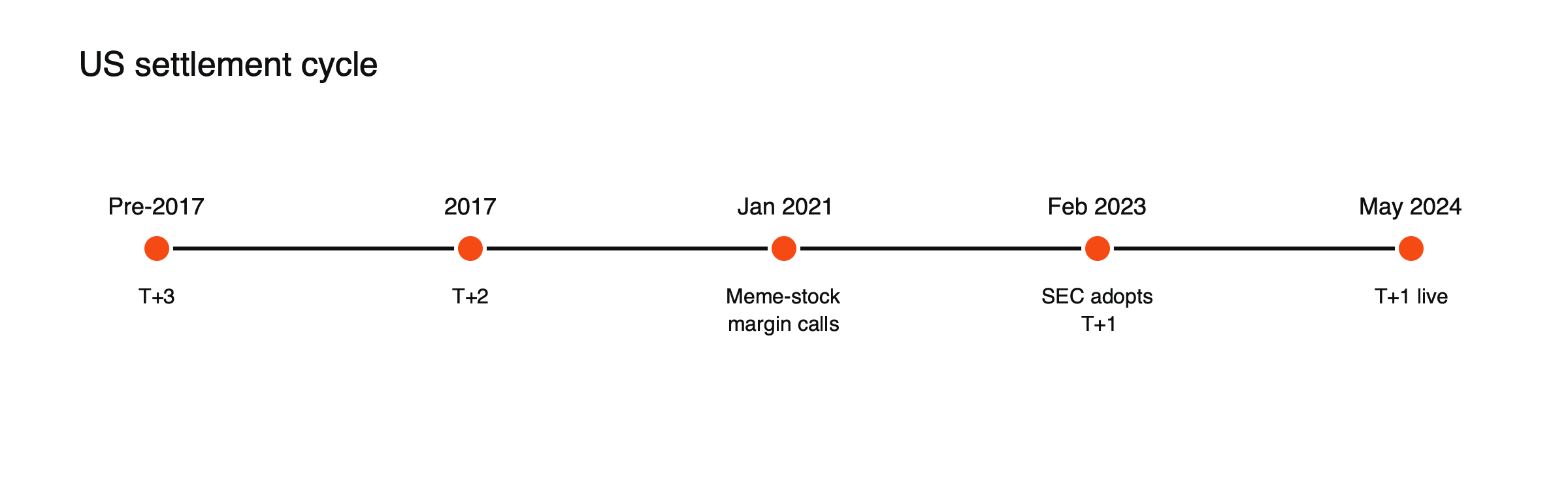
Figure: How US settlement got faster.
Why settlement time matters
Between trade and settlement, the clearinghouse is exposed to the risk that one side fails. It collects margin from brokers to cover that risk. The longer the gap, the more margin is needed, and in volatile markets those demands can spike. In January 2021, one broker faced an extra margin call of about $3 billion on a single day.
Settlement risk, illustrated
Suppose a broker’s customers buy $500 million of a volatile stock on Monday. (Illustrative scenario.) Under T+2, the clearinghouse is exposed until Wednesday; under T+1, only until Tuesday. If the stock swings 20% a day, the potential loss over two days is much larger than over one, so the clearinghouse demands more margin. In January 2021, those demands jumped so sharply that Robinhood needed to raise about $3 billion of additional capital, contributing to its decision to restrict buying. Halving the settlement period reduces the size of such margin calls.
How settlement works
After a trade, the buyer’s and seller’s brokers confirm the details, the clearinghouse becomes the counterparty to both sides and guarantees completion, and on settlement day the central securities depository transfers shares while cash moves through the banking system. Each step must happen within the cycle, which is why shortening it required changes to systems across the industry.
What T+1 changed
- Less risk and margin: halving the settlement cycle reduces the collateral brokers must post.
- Tighter operations: firms must confirm trades the same evening; about 95% were affirmed by the 9 p.m. deadline after the switch.
Other markets
India completed its move to T+1 in 2023, ahead of the US. Canada and Mexico moved alongside the US in May 2024. The European Union, the UK and Switzerland have set October 11, 2027 as their transition date, with the EU’s legal text published in October 2025. Aligning dates reduces mismatches for investors trading across borders.
Global spillovers
Foreign investors must source dollars faster to pay for US stocks, and markets that settle on a longer cycle face mismatches with US trades.
What comes next
Some argue for same-day (T+0) settlement; others note the pressures that would put on funding and operations. See how 24/7 trading is changing market structure , why payment for order flow is so controversial and how client money segregation protects traders.
Effects on investors
For most individual investors, T+1 changed little day to day: shares and cash simply become available a day sooner after a sale. It matters more for investors selling one asset to buy another, who receive funds faster, and for those trading foreign shares, who must arrange currency conversion more quickly. Firms faced the larger adjustment, compressing confirmation and funding processes into a single evening.
Settlement and CFDs
CFDs do not settle in the same way, because no shares change hands; profits and losses are reflected in the account as prices move. However, providers hedging share CFDs in the underlying market must manage their own settlement under T+1, and changes in settlement cycles can affect how corporate actions, such as dividends, are processed. See how CFD pricing works.
From T+3 to T+2
The US moved from three-day to two-day settlement in 2017, following Europe’s move to T+2 in 2014. Each shortening reduced risk and margin needs, but also required firms to speed up processes such as trade confirmation and funding. The 2024 move to T+1 was the largest operational change, because it compressed many steps into the evening after the trade.
Currency pressure, illustrated
Suppose a European fund sells euros to buy $100 million of US shares on a Monday. (Illustrative scenario.) Under T+2, it had until Wednesday to deliver dollars; under T+1, it must deliver on Tuesday, often after arranging currency conversion late on Monday, when European markets are closed. Some funds now pre-fund dollars or trade currency in Asian hours, accepting extra cost or risk. Mismatches like these are one reason Europe is moving to T+1 itself.
Securities lending
Lenders of shares who want them back before a sale settles must recall them faster under T+1. Borrowers, such as short sellers, have less time to return shares, which can raise the risk of failed deliveries if processes lag.
Common misreadings
- Believing T+1 means trades are instant.
- Assuming settlement cycles affect CFD positions directly.
Toward same-day settlement
Some market participants argue for same-day settlement, or even settlement within seconds, using tokenized shares and digital cash. Faster settlement would further reduce counterparty risk and margin needs. But it would require funding trades almost immediately, making it harder to net purchases and sales, borrow shares for short sales or trade across time zones. Most industry groups see T+1 as the practical standard for now, with tokenized markets as a longer-term experiment. See what tokenized stocks are.
Inside firms
To meet T+1, firms automated trade matching, moved confirmation deadlines into the evening of trade date, changed staffing patterns and reviewed securities lending and currency processes. Many invested heavily in systems that had run on overnight batch processing for decades.
Funds and ETFs
Mutual funds and ETFs that hold US shares had to align their own processes with T+1, including how quickly they pay redeeming investors and how authorized participants create and redeem ETF shares. Funds holding assets that settle on longer cycles, such as some foreign shares, face mismatches between when they must pay out and when they receive cash from sales.
Corporate actions
Dividends and other corporate actions depend on who owns shares on a record date. Under T+1, the ex-dividend date and the record date fall on the same day, changing timing that investors had grown used to under T+2. Investors who buy shares on or after the ex-dividend date do not receive the upcoming dividend.
Lessons from the transition
The move to T+1 showed that large market infrastructure changes are possible with long preparation, industry coordination and testing. Firms that automated early found the change easier; those relying on manual processes faced the most pressure. Europe’s preparations for October 2027 draw directly on the North American experience. Regulators also monitored settlement failure rates closely after the switch, which stayed low.
What it means for traders
For active share traders, T+1 means cash from sales becomes available sooner for new purchases in cash accounts, reducing the waiting period that once led to violations of settlement rules. For margin traders, it reduces the amount of collateral brokers must post at clearinghouses, which may make brokers less likely to restrict trading in extreme volatility, as happened in January 2021. For investors in foreign markets, it adds a reminder that settlement rules differ between countries and that timing matters for currency conversion.
A timeline at a glance
| Period | US settlement cycle |
|---|---|
| Before 2017 | T+3 |
| 2017 to May 2024 | T+2 |
| From May 28, 2024 | T+1 |
| EU, UK, Switzerland from October 11, 2027 (planned) | T+1 |
Settlement fails
A settlement fail occurs when shares or cash are not delivered on time. Shorter cycles can raise the risk of fails if processes lag, which is why the industry tracked fail rates closely after the switch. Fail rates are now a standard measure of market health.
Frequently asked questions
Did T+1 cause problems when it launched?
The transition was broadly smooth, with about 95% of trades affirmed by the evening deadline soon after the switch.
Will settlement become instant?
Some advocate same-day or real-time settlement, possibly using tokenized assets, but funding and operational challenges remain significant.
This article is educational content and does not constitute financial, investment, legal or tax advice. Digital assets are volatile and you may lose the amount you invest.
Sources
- Statement on the settlement cycle (meme-stock margin calls; May 28, 2024 compliance date) — SEC Commissioner Lizárraga, February 2023
- T+1 After Action Report (May 28, 2024; equities, corporate and municipal bonds) — SIFMA, ICI and DTCC
- SEC Chair Gensler on modernizing equity markets (about 95% of trades affirmed by 9 p.m.; less margin) — CLS Blue Sky Blog, October 2024
- From meme stocks to market reform (Robinhood’s $3 billion margin increase) — Ideagen, May 2024
- US follows India to T+1 (US moved from T+3 to T+2 in 2017) — Business Standard, February 2023
- T+1 in Europe: what’s next for the EU, the UK and Switzerland? (EU, UK and Switzerland target October 11, 2027; EU text published October 14, 2025; North America moved in May 2024) — BNP Paribas Securities Services