
Soft Landing vs Hard Landing vs No Landing
A soft landing slows inflation without a recession; a hard landing brings one; no landing means growth stays strong. How markets behave in each.
Soft landing vs hard landing describes how an economy cools after rate hikes. In a soft landing, inflation falls without a recession; in a hard landing, tighter policy causes one. “No landing” means growth stays strong and inflation sticky, so rates stay high. About a third of the last 12 US easing cycles came with a soft landing.
Side by side
| Soft landing | Hard landing | No landing | |
|---|---|---|---|
| Growth | Slows, stays positive | Contracts | Stays strong |
| Inflation | Falls toward target | Falls, often sharply | Stays above target |
| Central bank | Cuts gradually | Cuts fast | Holds or hikes |
| Stocks (historical tendency) | Often rise | Often fall | Mixed; rates weigh |
| Bonds | Gain modestly | Rally strongly | Pressured |
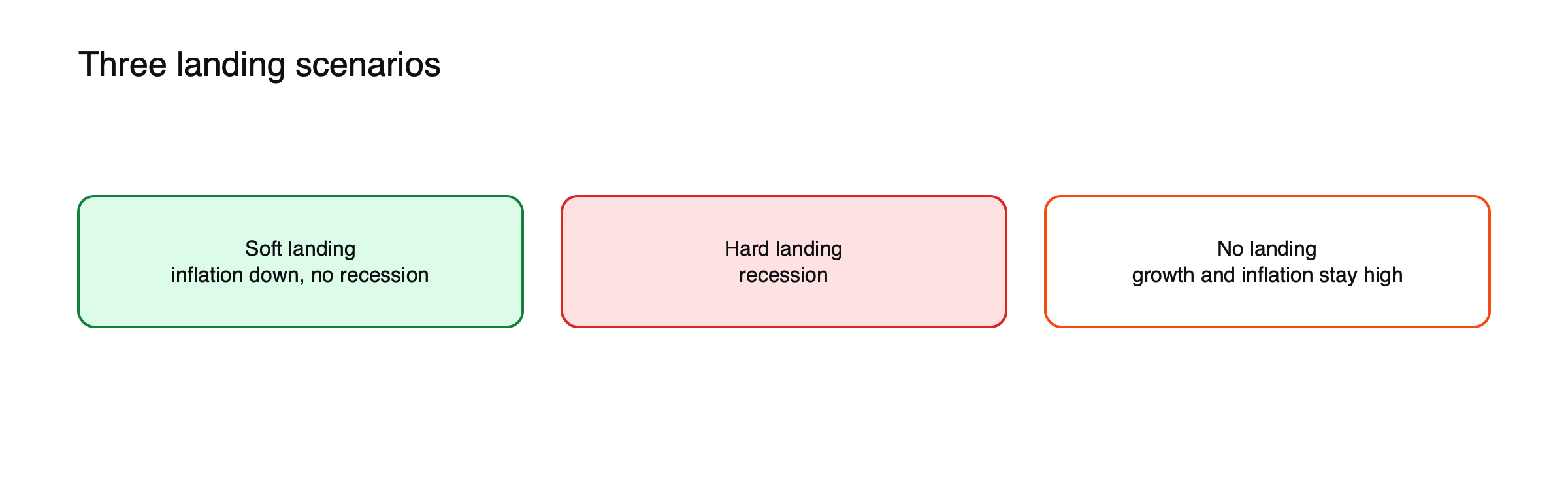
Figure: Three ways an economy can respond to rate hikes.
What history shows
Out of the last 12 US easing episodes, eight came with a recession and four with a soft landing. After the 2022–2023 hiking cycle, the US avoided recession even though the yield curve inverted for a record 26 months, which many saw as a rare soft landing. See how recession signals have performed.
The 1995 soft landing
The best-known US soft landing came in 1994 and 1995. The Fed doubled its policy rate in 1994 to head off inflation, then cut modestly in 1995 as growth slowed without tipping into recession. Shares rallied strongly over the following years, and the episode became the template central banks hope to repeat. It is also one of the few clear examples, which is why soft landings are often described as rare.
2022 to 2026
After the fastest hikes in decades in 2022 and 2023, many forecasters expected a recession. Instead, the US economy kept growing, inflation fell from its peak and the Fed began cutting in September 2024. Strong household finances, government spending and a resilient labor market helped. By 2026, the episode looked like a soft landing, though renewed inflation pressures from energy prices raised the risk that it could still turn into a no landing. See what markets listen for in a central bank meeting.
Why it is hard to call in real time
Recessions are dated after the fact, data are revised, and the same slowdown can look soft or hard depending on the month. Markets swing between scenarios as each data release arrives.
Three scenarios, illustrated
Suppose a portfolio holds US shares and 10-year Treasuries after a hiking cycle. (Illustrative scenarios.) In a soft landing, shares rise perhaps 10% to 15% as earnings hold up and rates fall gradually, while bonds gain modestly. In a hard landing, shares fall 20% or more as earnings drop, but bonds rally strongly as yields fall. In a no landing, shares may be flat as higher rates offset strong earnings, while bonds fall as yields rise. Each outcome rewards a different mix.
Where the usual answer flips
A soft landing is good for the economy but not always for every asset: if growth holds up, central banks may cut less than markets hoped, which can pressure bonds and rate-sensitive stocks. See how stocks have behaved in past rate-cutting cycles and stocks, bonds and commodities across the rate cycle.
Signs of each scenario
| Indicator | Soft landing | Hard landing | No landing |
|---|---|---|---|
| Unemployment | Rises slightly | Rises fast | Stays low |
| Core inflation | Falls steadily | Falls quickly | Stays sticky |
| Credit spreads | Stable | Widen sharply | Tight |
| Yield curve | Re-steepens gradually | Bull steepens fast | Bear steepens or stays flat |
How each scenario affects currencies
In a soft landing, currencies often follow relative rate cuts: the currency of the country cutting faster tends to weaken. In a hard landing, safe havens such as the dollar, yen and Swiss franc tend to strengthen. In a no landing, the currency of the country keeping rates high tends to stay firm. See what happens to currencies when a central bank pivots.
Positioning when the outcome is unclear
Because the outcome is uncertain until late, many investors hold a mix that can cope with more than one scenario: shares for a soft landing, high-quality bonds for a hard landing and short-term bonds or inflation-linked bonds for a no landing. Adjusting gradually as data arrive tends to work better than betting heavily on one outcome.
Earnings in each scenario
Company profits drive much of the difference. In a soft landing, earnings keep growing, though more slowly, supporting shares even as rates fall gradually. In a hard landing, earnings often fall 15% to 30% or more, overwhelming the support from lower rates. In a no landing, earnings stay strong, but high rates limit how much investors will pay for them. Watching earnings forecasts is one of the best ways to judge which scenario markets expect.
The role of fiscal policy
Government spending can tilt the outcome. Large deficits supported US growth after 2022, helping the economy absorb higher rates and making a soft or no landing more likely. But heavy borrowing can also keep inflation and long-term yields higher, limiting how far central banks can cut. See how fiscal deficits affect rates, currencies and stocks.
Landings outside the US
Other economies face their own landings. The euro area came close to stagnation in 2023 and 2024 as energy shocks and higher rates hit, while China struggled with a property slump and weak prices. Different landings across countries create differences in rate paths, which drive currencies and relative market performance.
Common misreadings
- Assuming the first rate cut confirms a soft landing.
- Treating one weak data release as the start of a hard landing.
A scenario checklist
- Is unemployment rising, and how fast?
- Is core inflation falling steadily?
- Are credit spreads widening?
- Are earnings forecasts being cut?
Bonds in each scenario
High-quality government bonds tend to perform best in a hard landing, as central banks cut aggressively and investors seek safety. In a soft landing, they usually gain modestly as rates drift lower. In a no landing, with rates staying high or rising, longer-dated bonds can lose value. Corporate bonds behave differently: they do well in soft landings, when defaults stay low, but suffer in hard landings as credit spreads widen. See what credit spreads tell equity traders.
Gold and commodities
Gold has tended to gain in hard landings, as real yields fall and safe-haven demand rises, and to hold up in soft landings when rates fall gently. Industrial commodities such as copper and oil usually do best in soft or no landings, when demand stays firm, and worst in hard landings. Energy can also trigger a no landing on its own, if a supply shock keeps inflation high.
Why markets keep changing their minds
Because each data release nudges the odds, markets often swing between scenarios within weeks. A weak jobs report can revive hard-landing fears, while a hot inflation reading the next week can shift attention to a no landing. These swings drive volatility in bonds, currencies and shares, even when the underlying economy changes slowly.
Trading the landing debate
Traders often express views on the landing through the yield curve, the dollar and the balance between cyclical and defensive sectors. A trader expecting a hard landing might favor long-dated bonds, gold and defensive shares; one expecting a no landing might favor short-dated bonds, energy and the dollar. Because the debate can flip quickly, sizing positions modestly and setting clear exit points matters more than conviction. Leveraged CFD positions are especially exposed to sudden shifts in sentiment around major data releases.
A note on timing
Even when the destination is clear, timing is not. Recessions have often begun a year or more after the last rate hike, and soft landings can look fragile for many months before they are confirmed. Investors who act too early on a hard-landing call can miss strong gains, while those who ignore warning signs can be caught by a sudden turn. Treating scenarios as probabilities that shift with the data, rather than as fixed forecasts, helps investors avoid both costly mistakes.
Frequently asked questions
How common are soft landings?
Relatively rare: four of the last 12 US easing episodes came with a soft landing, according to one study.
Who decides when a recession started?
In the US, a committee of economists dates recessions, often many months after they begin.
This article is educational content and does not constitute financial, investment, legal or tax advice. Digital assets are volatile and you may lose the amount you invest.
Sources
- Fed rate cuts: market implications (of the last 12 easing episodes, eight accompanied by recession, four by a soft landing) — LGT
- 2s10s Yield Curve Inversion History (26-month inversion, July 2022–August 2024, not followed by recession as of 2026) — Eco3min
- Three investments that thrive after the Fed’s first rate cut (S&P 500 returns with and without recession) — Interactive Investor