
What Past Tariff Rounds Did to Currencies and Stocks
Tariff shocks have hit stocks fast, then often reversed when policies softened. What happened in April 2025, how currencies and bonds reacted and the lessons.
Tariffs and markets follow a familiar pattern: a surprise escalation hits stocks hard and fast, and a pause can reverse much of it just as quickly. After the US announced sweeping tariffs on April 2, 2025, the S&P 500 fell about 12% in four days, then jumped 9.5% in a day when most were paused on April 9.
Timeline of April–May 2025
- April 2: steeper-than-expected tariffs on nearly all US trading partners; China later faces duties up to 145%.
- April 2–8: the S&P 500 falls about 12%; the Dow loses nearly 4,600 points.
- April 9: a 90-day pause on most tariffs except China; the S&P 500 rises 9.5%, one of its best days ever.
- Early May: stocks regain their April 2 level; Treasuries and the dollar lag behind.
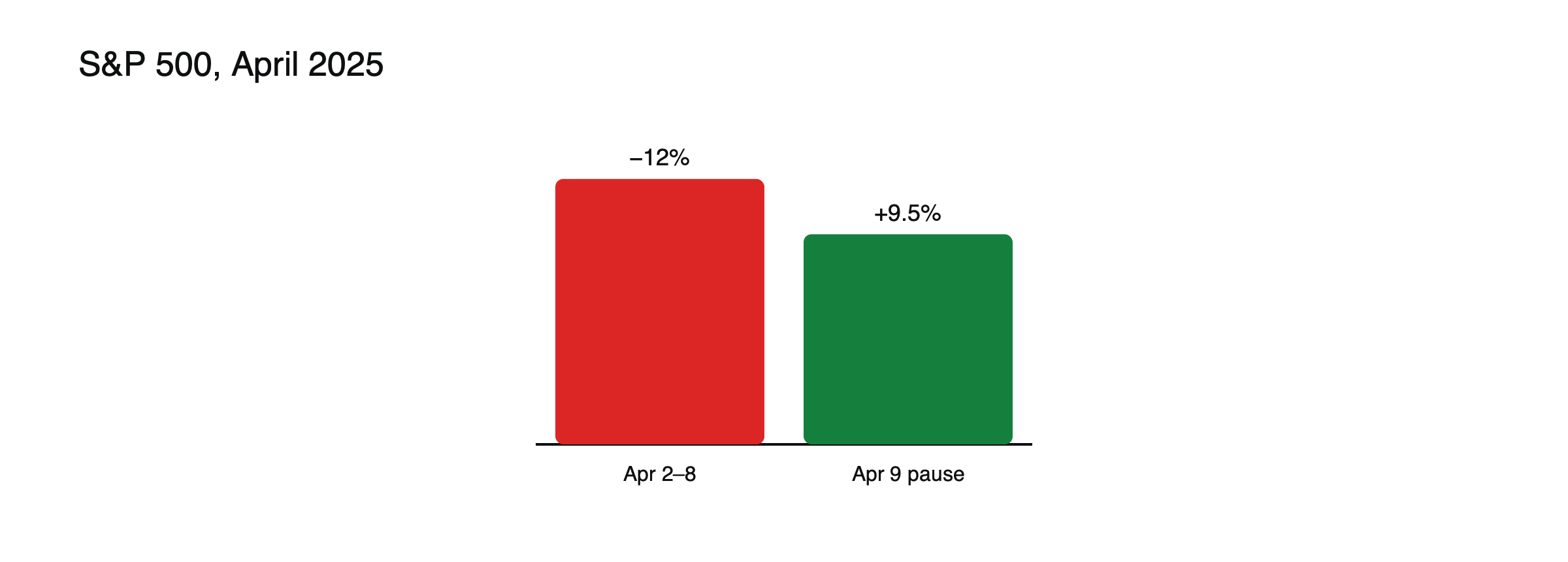
Figure: The tariff shock and the pause. Source: AP.
Earlier tariff rounds
Tariffs have shaken markets before. In 1930, the Smoot-Hawley tariffs raised US duties on thousands of imports, prompting retaliation and contributing to the collapse in global trade during the Great Depression, a history often cited when tariffs rise sharply. In 2018 and 2019, the US and China imposed escalating tariffs on each other’s goods. Share markets fell on several escalations, especially in late 2018 and May 2019, and recovered when talks progressed, with headlines driving short, sharp swings in shares, the yuan and soybeans.
What happened to currencies and bonds
Unusually, the dollar fell during the sell-off, and Treasuries did not fully rally, which some read as fading faith in US assets as a safe haven. Trading partners’ currencies moved with the perceived risk to their exports.
Why tariffs move markets:
- Costs: tariffs raise input prices and squeeze profit margins.
- Growth: retaliation and uncertainty can slow trade and investment.
- Inflation: higher import prices complicate central bank decisions.
A tariff shock, illustrated
Suppose a country imposes a 25% tariff on imports from a major trading partner. (Illustrative scenario.) Importers face higher costs and either raise prices or accept lower margins. Shares of companies relying on those imports fall, while domestic competitors may rise. The trading partner’s currency often weakens, partly offsetting the tariff by making its exports cheaper. If the partner retaliates, exporters on both sides suffer, and broad share indices fall on fears of slower growth. Bond yields can move either way: up on inflation fears, down on growth fears.
Sectors most exposed
Companies with global supply chains, such as electronics, autos, retailers and machinery makers, tend to be hit hardest by tariff escalation. Agricultural exporters often face retaliation. Domestic-focused sectors, such as utilities and some services, tend to be less affected. Small companies, more domestic on average, have sometimes held up better than multinationals during tariff fights, though they are more sensitive to any slowdown.
Lessons
- The first reaction prices the worst case; policy changes can reverse it quickly.
- Headline risk makes positions vulnerable to single announcements.
- Safe havens may not behave as expected when the shock comes from the US itself. See Bitcoin, gold and the dollar under market stress , why volatility in one market spills into others and how recession signals have performed.
Inflation and central banks
Tariffs raise import prices, adding to inflation at least temporarily, while weighing on growth. That creates a dilemma for central banks similar to an energy shock: tightening fights the price rise but deepens the slowdown. Most central banks try to look through one-off price increases from tariffs, but they watch closely for signs that higher prices are feeding into inflation expectations. See inflation surprise vs inflation trend.
Trading headline risk
Tariff news can arrive at any hour, often through social media posts or unscheduled announcements, and markets can gap sharply. Traders holding positions in affected currencies, index CFDs or commodities face the risk of sudden moves against them. Smaller positions, wider stops and guaranteed stops where offered can reduce the damage from an unexpected headline. See why volatility in one market spills into others.
After the April 2025 pause
The April 9 pause did not end the story. Tariffs on China remained very high until the two countries agreed in May 2025 to cut them for an initial period, a step that lifted shares again. Tariff announcements, deadlines and negotiations continued to move markets through the following months, with sectors and currencies reacting to each development. The pattern showed that trade policy had become a recurring source of volatility rather than a single event.
Tariffs and the dollar
Standard economic theory suggests that tariffs should strengthen the currency of the country imposing them, because they reduce imports. In April 2025, the opposite happened: the dollar fell as investors worried about US growth, policy uncertainty and the reliability of US assets as safe havens. Currency reactions to tariffs depend on how they affect confidence, not just trade balances. See how a strong dollar hits commodities, emerging markets and crypto.
Tariffs and company earnings
Companies facing tariffs on their inputs can raise prices, absorb the cost or shift suppliers. Each choice affects earnings differently: price rises risk lost sales, absorbing costs cuts margins and moving supply chains takes time and money. Earnings guidance often reflects tariff uncertainty, and analysts cut forecasts for exposed companies quickly. See what company guidance tells investors.
Tariffs and commodities
Agricultural exports are frequent targets for retaliation, so soybean, corn and pork prices can swing on trade news. Metals face tariffs too, and duties on steel and aluminum can widen the gap between domestic and international prices.
Common misreadings
- Assuming the first market reaction reflects the final policy.
- Expecting the imposing country’s currency to rise.
Supply chains shift
Persistent tariffs encourage companies to move production to other countries, a process that takes years. After the 2018 and 2019 tariffs, some manufacturing shifted from China to countries such as Vietnam and Mexico. Those shifts created winners among countries and companies able to attract investment, and they changed trade flows in ways that outlasted the original headlines.
Retaliation patterns
Trading partners usually respond to tariffs with their own duties, often aimed at politically sensitive exports such as farm goods, motorcycles or spirits. Retaliation widens the economic damage and extends market uncertainty. Markets watch not only the first tariff but also whether partners respond in kind or negotiate, because escalation and de-escalation drive the biggest moves. See how China’s policy moves ripple into commodities.
Tariffs and inflation expectations
Large tariff increases can raise inflation expectations, especially if businesses pass costs on quickly. Breakeven inflation rates in bond markets show whether investors expect the price effect to persist.
Tariffs and bonds
Bond markets face competing forces when tariffs rise: higher import prices push inflation expectations up, while slower growth pushes yields down. In April 2025, US Treasuries did not rally as strongly as in typical sell-offs, which some investors read as concern about US policy. The balance between inflation and growth fears decides which way yields move.
Legal and political uncertainty
Tariff policy can change through new announcements, negotiations, court rulings and legislative action. Each creates a new source of uncertainty for markets, and the timing is often unpredictable.
Lessons from 2018 and 2019
The earlier trade war showed that markets eventually adjust to tariffs that stay in place, but that each escalation still triggers sharp moves. Traders learned to expect volatility around deadlines and negotiating rounds.
How investors protected themselves
During tariff escalations, some investors shifted toward domestic-focused companies, defensive sectors and gold, while reducing exposure to exporters and import-dependent retailers. Others used options to limit downside or simply reduced position sizes ahead of announced deadlines. The most effective protection in April 2025 was avoiding forced selling during the worst days, because the rebound after the pause came within a week. Investors who sold at the lows missed one of the largest single-day gains on record.
Watching negotiations
Markets react to signals from negotiations, such as scheduled talks, statements from officials and extensions of deadlines. Extensions of deadlines have often lifted markets, while breakdowns in talks have triggered sharp falls, so the calendar of negotiations has become a key input for traders holding exposed positions overnight.
Frequently asked questions
Do tariffs strengthen the currency of the country imposing them?
Sometimes, in theory, but in April 2025 the dollar fell as investors questioned US policy and growth.
How long do tariff sell-offs last?
Often days or weeks when policy reverses quickly, as in April 2025, but longer if tariffs stay in place and slow growth.
This article is educational content and does not constitute financial, investment, legal or tax advice. Digital assets are volatile and you may lose the amount you invest.
Sources
- How the stock market made back all its losses after Trump escalated the trade war (S&P 500 −12% in four days; Dow −4,600 points; April 9 pause, +9.5%) — AP via Fortune, May 2025
- How the S&P 500 recovered all of its losses for the year (China duties up to 145%; dollar sank; Treasuries and the dollar had not fully recovered) — AP via Yahoo Finance, 2025