
Why Markets Sometimes Rally on Bad News
Stocks can rally on weak data when lower rate expectations help valuations more than growth fears hurt earnings. The market regime decides which effect wins.
Markets rally on bad news, such as weak economic data, because prices respond to changes in expectations, not to whether a headline sounds good or bad. If softer jobs or inflation data make investors expect lower rates, the valuation benefit can outweigh the earnings damage. Once weakness starts to threaten profits, the same “bad news” can push stocks down instead.
The first contest is rates versus earnings
A stock price reflects expected future cash flows discounted back to today.
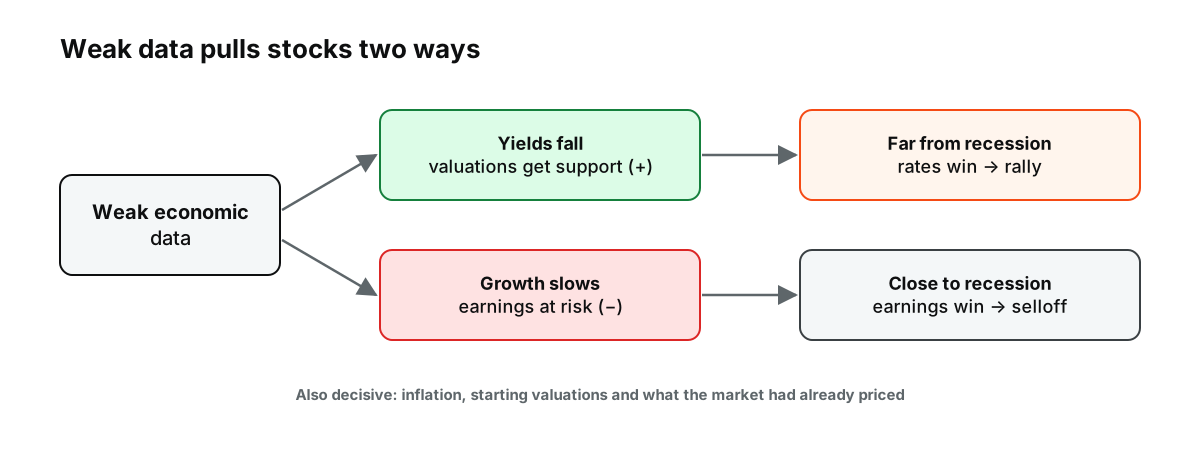
Figure: The rates-versus-earnings contest. Example: a soft US jobs report on September 5, 2025 lifted equity futures as yields fell (Reuters).
Weak economic data can affect both sides of that equation:
- expected earnings may fall because demand looks weaker;
- discount rates may fall because the Federal Reserve is expected to ease policy.
If the rate effect dominates, stocks can rise on bad macro news. If the earnings effect dominates, they fall.
This is why the same employment number can produce opposite market reactions at different points in the cycle.
Research found the regime matters
An NBER study by John Boyd, Ravi Jagannathan and Jian Hu examined how stocks reacted to unemployment news. The authors found that rising unemployment was often treated as good news for stocks during expansions because the interest-rate channel dominated. During contractions, rising unemployment was more likely to be bad news because the signal about future earnings became more important.
That finding is a useful framework for almost any “bad news is good news” session.
The market is asking: is this slowdown enough to improve policy expectations without being bad enough to damage cash flows?
A soft slowdown creates the cleanest “bad news rally”
Suppose payroll growth comes in below expectations while unemployment rises slightly.
If investors still believe the economy is expanding, they may interpret the report as evidence that wage pressure and inflation will cool. Bond yields can fall. Expectations for rate hikes can be reduced, or rate-cut expectations can move forward.
Growth stocks and other rate-sensitive assets may then rally because their discount rate has fallen.
The data are weak. The change in the expected policy path is favorable.
The same data can become bearish in a recession scare
Now change one assumption. Payrolls are weak, unemployment is rising rapidly, credit spreads are widening and companies are cutting guidance.
Lower rates are no longer enough to offset the earnings risk. Investors begin asking how far profits could fall, whether defaults will rise and how much balance-sheet stress is building.
At that point, bad news becomes bad news again.
The transition can happen quickly. Markets do not wait for an official recession declaration.
A recent example: weak US jobs data in September 2025
On September 5, 2025, a softer-than-expected US jobs report increased expectations for Federal Reserve rate cuts. Reuters reported that equity futures rose while Treasury yields fell as investors interpreted the weaker labor data as support for easier policy.
The reaction was not simply “investors like job losses.” The report was being processed through the policy function. At the time, the market judged that softer labor demand increased the chance of rate relief without yet proving that the economy had entered a severe contraction.
That is the narrow zone where this market logic works.
Ranked: what decides whether weak data help or hurt stocks
1. Distance from recession
Weak data during a healthy expansion can reduce overheating risk. Weak data during an already fragile economy can confirm a downturn.
2. Inflation
If inflation is still too high, weak growth may not produce easier policy. That removes much of the valuation benefit.
3. Earnings expectations
Watch analyst revisions, company guidance and credit spreads. They show whether the slowdown is reaching corporate cash flows.
4. Starting yields and valuations
A drop in yields has a larger valuation effect when rates were previously restrictive and rate-sensitive sectors were under pressure.
5. What the market had priced before the release
A “bad” number can still disappoint markets if investors had expected something even weaker. The surprise matters more than the level.
What to watch after a bad-news rally
A one-day reaction does not tell you whether the market’s interpretation will hold.
Check whether:
- two-year Treasury yields keep falling;
- rate-cut expectations remain priced after the next inflation report;
- credit spreads stay contained;
- earnings revisions stabilize;
- cyclical sectors participate in the rally;
- volatility falls rather than simply rotating between sectors.
If rates fall but credit stress rises and earnings expectations collapse, the market may be moving from “good slowdown” to “bad slowdown.”
The phrase is shorthand for a changing discount rate
“Bad news is good news” sounds irrational because it removes the mechanism from the sentence.
The mechanism is usually straightforward: weaker data can lower expected interest rates, and lower rates can raise the present value of future cash flows. That relationship lasts only while investors believe the damage to earnings will remain manageable.
A bad-news rally, illustrated
Suppose a monthly jobs report shows far weaker hiring than expected, while inflation has already been easing. (Illustrative scenario.) Two-year Treasury yields fall 0.15 percentage points as investors bring forward expected rate cuts. The Nasdaq 100 rises 1.5%, the S&P 500 1%, while bank shares slip because lower rates squeeze lending margins. A trader who expected the weak report to hit shares finds the opposite. A month later, if further data suggest the slowdown is deepening, the same kind of report might push shares down instead.
Which shares gain most
Shares whose value depends most on distant earnings, such as technology and other growth companies, tend to benefit most when weak data pull yields down. Small companies with floating-rate debt can benefit from the prospect of lower borrowing costs. Banks and companies tied closely to near-term demand may lag. See why tech stocks are so sensitive to bond yields.
The bond and currency reaction
Bad-news rallies usually start in the bond market: yields fall first, and the dollar often weakens as rate expectations shift. Watching two-year yields and the dollar in the minutes after a release shows whether the market is reading the data through the policy channel. If yields fall but shares also fall, investors are worrying more about growth than welcoming lower rates.
When good news is bad news
The same logic works in reverse. Strong data can push shares down when investors fear the central bank will keep rates high for longer or raise them further. In 2022, when inflation was the main concern, strong jobs reports often hit shares for exactly that reason.
Trading data days
For index CFD traders, major data releases can produce sharp moves within seconds, often in a direction that seems counterintuitive. Many traders reduce size before releases, avoid placing stops close to the price and wait for the first reaction to settle. See how to read an economic calendar and what moves stock market indices.
Regimes that changed the reaction
In 2019, when the Federal Reserve cut rates as insurance against a slowdown, weaker data were often welcomed because they supported further easing while the economy kept growing. In 2001 and 2008, rate cuts came as the economy slid into recession, and weak data pushed shares lower despite easier policy, because earnings were collapsing. The same type of news produced opposite reactions because the regime was different.
The market’s reaction function
Traders sometimes speak of the market’s reaction function, the way it typically responds to data given its current main concern. When inflation is the worry, strong data hurt and weak data help; when growth is the worry, the reverse applies. Watching how shares react to a few consecutive releases reveals the current reaction function, which helps interpret the next one. When that function shifts, as it can in a few weeks, old patterns stop working.
A data-day checklist
- What is the market’s main concern: inflation or growth?
- What had economists forecast?
- How did two-year yields and the dollar react?
- Are credit spreads and earnings forecasts stable?
- Is the reaction holding after the first hour?
A reaction that reverses within the hour often signals that investors are unsure which concern matters more, which is a reason to wait before acting.
Frequently asked questions
Why would weak data push stocks up?
Because weaker data can lower expected interest rates, which raises the value investors place on future earnings, as long as the slowdown does not threaten those earnings seriously.
When does bad news become bad news again?
When the slowdown looks severe enough to cut profits sharply, usually as unemployment rises quickly and credit conditions tighten.
This article is educational content and does not constitute financial, investment, legal or tax advice. Digital assets are volatile and you may lose the amount you invest.