
Why Recessions and Falling Stocks Don’t Always Line Up
Stocks are forward-looking while recessions are dated after the fact. That is why markets can fall before a recession and rally while one is still underway.
Recessions and falling stocks do not line up neatly because they measure different things on different clocks. A recession describes a broad decline in current economic activity. Stock prices discount expected future profits and interest rates. Equities can fall before a recession begins, bottom during it, or rise while economic data are still deteriorating.
The stock market is trying to price the next few years
A share price reflects the present value of expected future cash flows.
That makes the market forward-looking by construction. Investors constantly revise assumptions about revenue, margins, financing costs and the return they demand for taking risk.
Economic data are different. Employment, production and income mostly describe what has already happened.
When investors become convinced that a recession is coming, stock prices can fall months before the broad economy contracts. Once the recession is obvious, the market may already be asking a new question: how deep will it be, and what comes after it?
This mismatch creates the strange sight of stocks rallying while current economic headlines are still ugly.
Recession dates are deliberately set with hindsight
In the United States, the National Bureau of Economic Research maintains the widely used chronology of business-cycle peaks and troughs.
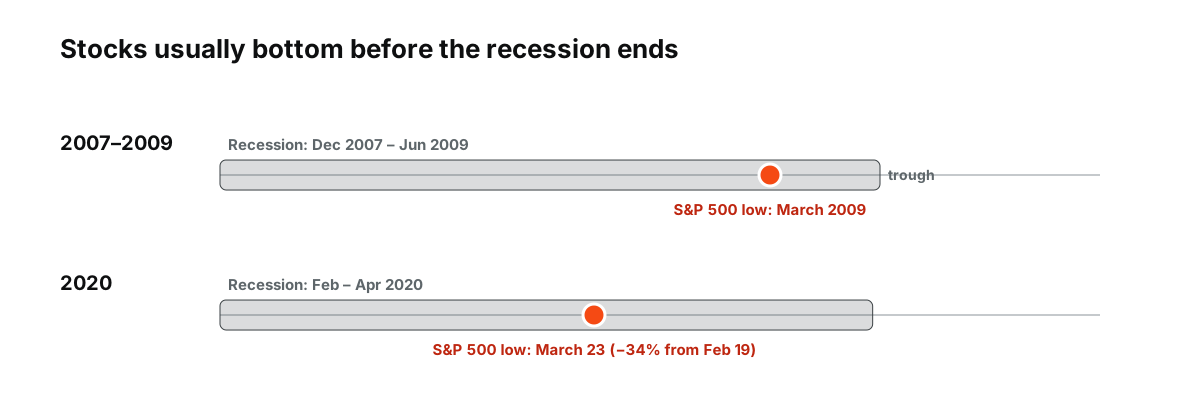
Figure: Stocks bottomed before the recession ended in both cases. Recession dates: NBER; index lows: S&P Dow Jones Indices.
The NBER does not declare a recession the moment a weak data point appears. It waits until there is enough evidence to identify a significant decline spread across the economy.
That makes the chronology reliable for history and awkward for real-time market timing.
For example, the NBER later determined that the 2007–2009 recession began in December 2007 and ended in June 2009. The S&P 500 reached its financial-crisis low in March 2009, several months before the economic trough.
The market turned first because it was pricing a future stabilization, not because the recession was already over.
2020 compressed the timing mismatch into a few weeks
The pandemic provides an unusually clean example.
The S&P 500 fell about 34% from February 19 to March 23, 2020, according to S&P Dow Jones Indices. The NBER dates the US recession from February through April.
Stocks therefore bottomed while the economy was still contracting sharply.
By June 2020, the Federal Reserve noted that broad equity prices had rebounded materially even though earnings forecasts remained bleak. Massive monetary and fiscal support had changed the expected distribution of outcomes.
A later Federal Reserve analysis described the apparent “disconnect” between stocks and the real economy. Its explanation was not that markets had stopped caring about the economy. It was that much of the market’s value reflected dividends expected more than five years into the future.
Current GDP was only one part of the valuation.
A recession can be bad for the economy and already priced for stocks
Imagine analysts expect a 20% decline in company earnings.
If the eventual decline is 10%, earnings are still bad. They are simply less bad than the price had assumed.
Markets move on the gap between expectations and outcomes.
This is why a weak payroll report can occasionally lift stocks. If the report makes investors expect lower interest rates and the economic damage is not severe enough to overwhelm that benefit, the discount-rate effect can dominate.
The same data point can be bad for the economy and good for the market’s expectations.
Not every bear market needs a recession
The relationship breaks in the other direction too.
Stocks can suffer a major decline without the NBER declaring a recession.
The 1987 crash is the classic example. Equity prices fell sharply, but the US economy did not enter an NBER recession immediately afterward.
The 2022 bear market also centered heavily on inflation, monetary tightening and valuation compression rather than a formal recession. Higher bond yields reduced the present value of long-duration earnings, especially in growth stocks.
A market drawdown can therefore be driven by the price of money, even if current economic activity remains positive.
Earnings and discount rates can pull in opposite directions
A simplified equity valuation has two big moving parts:
- expected future cash flows; and
- the rate used to discount those cash flows back to today.
Recessions usually hurt the first variable. Policy easing can help the second.
If a recession causes investors to expect rapid rate cuts, valuations can receive support even while earnings forecasts decline. If inflation remains high and prevents easing, both variables can work against stocks at the same time.
That is why the inflationary 1970s felt different from the disinflationary recessions that followed.
The label “recession” leaves out the policy regime.
Different sectors experience the same recession differently
A broad economic contraction does not produce identical earnings damage across the index.
Banks care about credit losses, funding and the yield curve. Consumer-discretionary firms care about employment and household spending. Energy companies can be dominated by commodity prices. Defensive sectors may hold demand better but still be affected by valuation changes.
The index is a portfolio of businesses, not a single proxy for GDP.
Market concentration also matters. If a handful of large companies have strong balance sheets and global earnings, the index can behave better than the typical domestic company.
That can make the stock market look disconnected from the lived economy even when the underlying company-level logic is consistent.
The market often bottoms when the recession story stops worsening
Historical market bottoms tend to occur before investors receive confirmation that the economy has recovered.
The turning point can come when:
- credit spreads stop widening;
- earnings revisions become less negative;
- policy stops tightening;
- liquidity returns;
- leading economic indicators stabilize;
- the feared scenario becomes less severe.
None of these guarantees a bottom. They explain why the market can turn while coincident data remain poor.
The recession is still happening. The change in expectations about the recession is what the market trades.
The useful comparison is expectations versus reality
Instead of asking whether stocks “should” rise during a recession, separate the clocks.
Ask:
- What economic decline is already embedded in earnings estimates?
- What policy response is priced into bond yields?
- Are credit conditions still deteriorating?
- Are analysts cutting forecasts faster or slower than before?
- Is the market pricing the present recession, or the recovery after it?
That framework explains more than the recession label alone.
Stocks and recessions are related. They are simply not synchronized, because one series is trying to see the future while the other is recording the present.
Sources
- Business Cycle Dating — NBER
- US Business Cycle Expansions and Contractions — NBER
- The Stock Market–Real Economy “Disconnect”: A Closer Look — Federal Reserve, October 2020
- Monetary Policy Report — Federal Reserve, June 2020
- Natural Selection: Tactics and Strategy with Equity Sectors — S&P Dow Jones Indices, July 2024