
Market, Limit and Stop Orders in CFD Trading
A market order fills now at the best price; a limit fills only at your price or better; a stop triggers at a set level. How each CFD order type works.
The main CFD order types are market, limit and stop orders. A market order fills now at the best available price. A limit order fills only at your price or better, so it may not fill. A stop order becomes a market order at a trigger level and fills, possibly at a worse price.
The four pending orders at a glance
Suppose EUR/USD trades at 1.1000. (Example prices.)
| Order | Placed at | What it does |
|---|---|---|
| Buy limit | 1.0950 | Buys if the price dips to 1.0950 or lower |
| Sell limit | 1.1100 | Sells if the price rises to 1.1100 or higher |
| Buy stop | 1.1050 | Buys if the price rises through 1.1050 |
| Sell stop | 1.0950 | Sells if the price falls through 1.0950 |
Limits wait for a better price than now; stops wait for the market to move through a level, usually to join a move or to cut a loss.
Market orders
Use when getting in or out matters more than the exact price. In thin or fast markets, the fill can differ from the price you saw, called slippage.
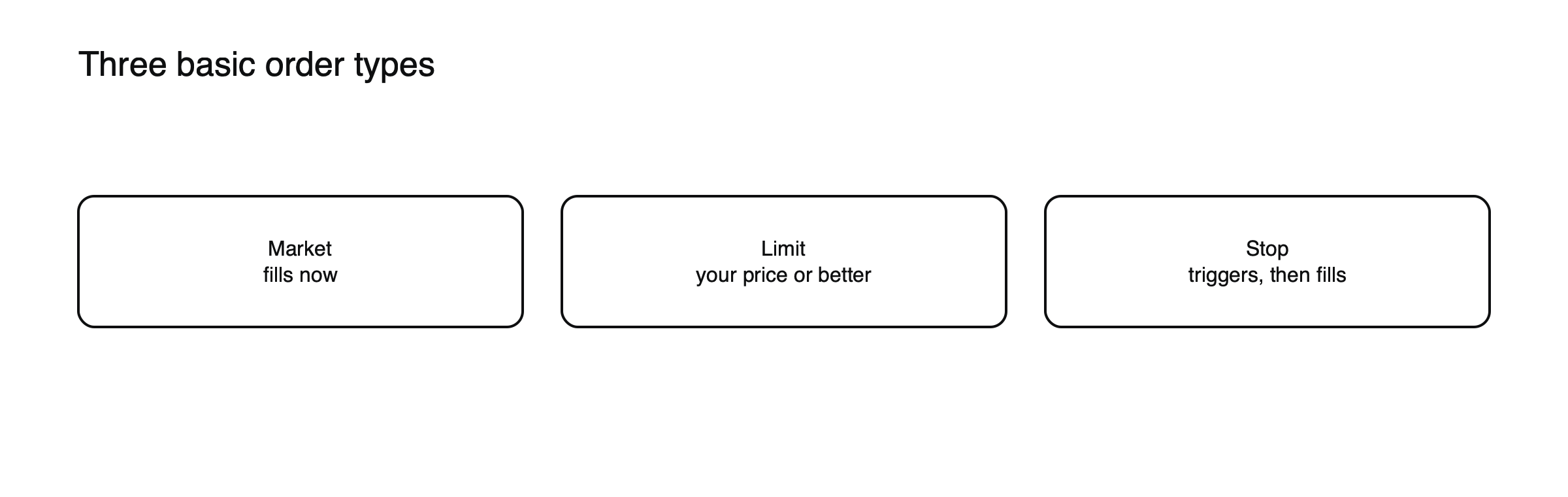
Figure: Price certainty vs execution certainty.
Limit orders
- Buy limit: below the current price, to buy on a dip.
- Sell limit: above the current price, to sell into a rise; often used as a take-profit. See how to set a take-profit level.
The price is protected, but the order may never fill.
Stop orders
- Buy stop: above the current price, to enter on a breakout.
- Sell stop: below the current price, to enter short or to exit a long position as a stop-loss. See how stop-loss orders work.
Execution is likely, but the price is not guaranteed: in a gap, the order fills at the next available price.
Variations
- Trailing stop: a stop that moves with the price in your favor. See what a trailing stop is.
- Guaranteed stop: some providers offer a stop that fills at your exact level for a premium.
- Good till cancelled vs day orders: how long a pending order stays active.
Stop-limit orders
A stop-limit order combines the two ideas: when the stop price is reached, a limit order is placed instead of a market order. It protects you from filling at a far worse price in a gap, but it may not fill at all if the market moves straight past your limit. As an exit for a losing position, that risk usually outweighs the benefit, because a stop that does not fill offers no protection.
Bracket orders and one-cancels-the-other
Many platforms let you attach a stop-loss and a take-profit to an entry order at the same time, often called a bracket. Once the entry fills, both exit orders become active, and when one of them fills, the other is cancelled automatically. This one-cancels-the-other link means a trade can be fully planned in advance, with no need to watch it, and no risk of leaving a stray order behind after the position has closed.
How orders are executed
Providers fill orders in different ways. Some act as the counterparty to client trades and may occasionally offer a new price, a requote, when the market moves quickly. Others pass orders to liquidity providers and fill them at the best available market price, which can include slippage in either direction. The provider’s order execution policy explains which applies and how it handles fast markets, and it is worth reading before relying on any order type in volatile conditions.
Pending orders over weekends and gaps
Pending orders stay active when the market is closed, unless you set them to expire. If the market reopens at a very different price, stops and limits can be triggered at the opening price rather than at their levels: a buy limit may fill better than its level, but a stop may fill much worse. Reviewing pending orders before weekends and major announcements avoids surprises. See why prices gap over the weekend.
Choosing the right order
Ask what matters more: price or execution. For exits in a crisis, execution usually matters more. For entries, a limit often avoids chasing price. For the crypto version, see market order vs limit order. For the basics, read what a CFD is.
One trade, from entry to exit
Suppose you expect EUR/USD to rise if it breaks above 1.1050. (Example prices.) You place a buy stop at 1.1050 with an attached stop-loss at 1.0990 and a take-profit at 1.1170. Nothing happens until the price reaches 1.1050; then the buy stop triggers and fills, perhaps at 1.1051 in a fast move. From that moment, the stop-loss and take-profit are live. If the price rises to 1.1170, the take-profit fills and the stop-loss is cancelled; if it falls to 1.0990, the stop-loss fills and the take-profit is cancelled. The whole plan, entry, risk and target, was decided before the trade existed, and no further action was needed.
Order size and partial fills
Large orders in less liquid markets can fill in pieces at different prices, or partly fill and leave the rest pending. Most retail CFD orders fill in one piece, but for bigger positions it is worth checking how the provider handles size and whether limit orders can fill partially.
Common order mistakes
- Placing a buy stop when a buy limit was intended, or the reverse, so the order triggers in the wrong situation.
- Forgetting pending orders that are no longer wanted, which can open unexpected positions.
- Using market orders in thin markets or around news, where slippage is largest.
- Leaving no stop attached to a new position because the plan was to add it later.
Every trading platform keeps a record of orders placed, changed, filled and cancelled. Checking that log carefully after a surprising fill shows exactly what happened and when, which is the first step in raising a question with the provider or adjusting your own process for next time.
Frequently asked questions
Can I change or cancel a pending order?
Yes, until it is triggered. Most platforms let you move the price level, change the size or cancel the order at any time before it fills.
Why did my limit order not fill when the chart touched my price?
Charts often show mid or bid prices, while a buy order needs the ask price to reach your level. The spread can keep an order unfilled even when the chart line appears to touch it.
This article is educational content and does not constitute financial, investment, legal or tax advice. Digital assets are volatile and you may lose the amount you invest.