
Why Best Execution Matters for Traders
Best execution requires brokers to get the most favorable terms for client orders, not just the quoted price. What it covers, how it is checked, why it matters.

Best execution is a broker’s duty to get the most favorable terms reasonably available for a client’s order, weighing price, costs, speed, likelihood of execution and size. It matters because the price shown is not always the price you get, and small differences add up. The US, UK and EU all require it, with different enforcement.
What it covers
- Price: including any improvement over the quoted price.
- Costs: commissions, spreads and fees.
- Speed and likelihood: whether the order fills, and how fast.
- Size and nature of the order: a large or unusual order may need different handling.
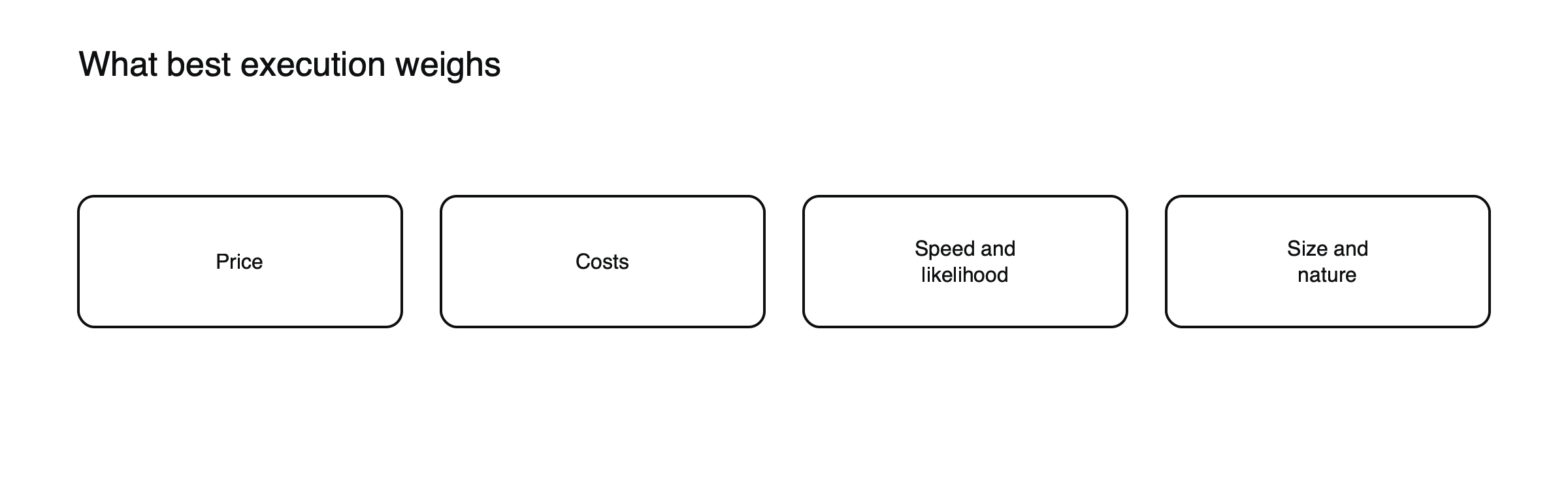
Figure: Best execution weighs more than price alone.
Execution quality, illustrated
Suppose a trader places a market order to buy 1 lot of EUR/USD when the quoted ask is 1.0850. (Illustrative scenario.) If the order fills at 1.0850, there is no slippage. If it fills at 1.0852, the trader pays 2 pips more than the quote, worth about $20 on a standard lot. If it fills at 1.0849, the trader receives 1 pip of price improvement, worth about $10. Over hundreds of trades, consistent slippage in one direction can cost far more than visible commissions. Best execution rules aim to keep fills fair, and symmetrical slippage, passing on improvements as well as worse fills, is one sign of a fair process.
Why conflicts make it important
When brokers are paid to route orders to particular market makers, best execution is the safeguard meant to ensure customers are not short-changed. See why payment for order flow is so controversial.
Best execution in CFDs
When trading CFDs, the client usually trades with the provider rather than on an exchange, and the provider sets prices based on underlying markets. Best execution then focuses on whether those prices fairly reflect the underlying market, how quickly orders are filled, how slippage is handled in fast markets and whether costs such as spreads and financing are clearly disclosed. Providers acting as the client’s counterparty face an obvious conflict of interest, which regulators expect them to manage through clear policies and monitoring. See how CFD pricing works.
How it is checked
United States: brokers with more than 100,000 customers must publicly disclose execution quality under updated rules adopted in 2024.
UK and EU: firms must have execution policies and monitor results; the UK and EU treat payment for order flow as incompatible with best execution and have banned it.
What traders can do
- Compare fills with the quote at the time of the order.
- Read a broker’s order execution policy and quality reports.
- Use limit orders where prices move quickly.
- Watch for hidden costs in spreads and currency conversion.
Order types and execution
The order type affects execution. Market orders fill quickly at the best available price, which can differ from the last quote in fast markets. Limit orders control the price but may not fill. Stop orders become market orders when triggered, so they can fill well past the stop level in a gap. Understanding these mechanics helps traders judge whether a fill was fair. See CFD order types.
Limits
Best execution is a process standard, not a guarantee of the best possible price on every trade. See why institutional traders care about market depth and what zero-commission trading really changed.
Slippage and requotes
Slippage, the difference between the expected and actual fill price, is normal in fast markets, around news releases and when markets open after weekends. Requotes, when a provider rejects an order and offers a new price, can also occur. Persistent one-sided slippage, or frequent requotes only when prices move in the client’s favor, are warning signs worth raising with the provider or its regulator.
Execution around news
Liquidity often thins in the seconds around major releases, such as US inflation or jobs data, and spreads widen. Orders placed then are more likely to slip, which is why many traders avoid market orders at those moments. See why payroll data can move bonds before stocks.
Execution reports
Firms subject to best execution rules typically publish an order execution policy explaining the factors they consider, the venues or liquidity providers they use and how they monitor quality. Reading it gives traders a clearer picture of how their orders are handled.
How the rules developed
Best execution duties have deep roots. In the United States, broker-dealers’ duty of best execution developed through industry rules and court cases, and market structure reforms in the 2000s sought to ensure orders were routed to the best prices across exchanges. In Europe, the Markets in Financial Instruments Directive introduced formal best execution requirements in 2007, strengthened in 2018 to require firms to take all sufficient steps to obtain the best possible result. Disclosure rules have been updated repeatedly as markets have changed.
Price improvement
Price improvement occurs when an order fills at a better price than the quote at the time it was placed. Some market makers advertise average price improvement statistics. For retail traders, price improvement can offset part of the spread, but it should be judged alongside overall costs rather than in isolation.
Liquidity providers and venues
Providers may execute client orders against their own inventory or route them to banks, market makers or exchanges. Their execution policy should explain which venues or liquidity providers they use and how they choose among them.
Common misreadings
- Believing zero commission means best execution.
- Treating slippage in a fast market as proof of bad practice.
Monitoring your own execution, illustrated
Suppose a trader records the quoted price and fill price for 50 market orders over a month. (Illustrative method.) If 20 filled at the quote, 15 slightly better and 15 slightly worse, slippage looks symmetrical and broadly fair. If 40 filled worse and none better, especially in calm markets, it is worth asking the provider how orders are handled. Simple records like these turn a vague feeling about fills into evidence.
Best execution in crypto
Crypto markets are fragmented across many exchanges, with prices for the same coin sometimes differing noticeably between venues. Not all crypto platforms are subject to formal best execution rules. Traders using crypto CFDs or exchanges can compare prices across venues and check whether their provider publishes an execution policy. See what a crypto exchange is.
Execution and spreads
For CFDs and currencies, the spread is often the main cost of a trade, and its width varies with liquidity, volatility and the time of day. Best execution includes whether spreads are consistent with underlying market conditions. A provider whose spreads widen far more than the underlying market during volatile periods deserves scrutiny.
Thin markets
In less liquid instruments, such as smaller shares or exotic currency pairs, prices can move sharply on modest orders. Large orders in thin markets may need to be split or placed as limit orders to avoid excessive slippage.
A checklist
- Read the order execution policy.
- Compare fills with quotes over time.
- Use limit orders in fast or thin markets.
- Check spreads around major news releases.
Execution and leverage
Leverage magnifies the impact of execution quality. A 2-pip difference on a leveraged currency position may represent a meaningful share of a trader’s expected profit or acceptable loss. Traders using high leverage are therefore more sensitive to slippage and spread widening than those trading small, unleveraged positions.
When to raise concerns
If fills consistently differ from quotes in ways that favor the provider, or if orders are rejected only when prices move in the client’s favor, traders can ask for an explanation, request execution records and, if needed, complain to the regulator. Keeping screenshots and trade logs makes complaints easier to assess. Regulators take patterns more seriously than single trades, so a log covering several weeks is more useful than one fill.
Frequently asked questions
Does best execution mean I always get the quoted price?
No. It means the firm must take sufficient steps to get the best result reasonably available, which can differ from the quote in fast markets.
What should I do if I think my orders are badly executed?
Keep records of quotes and fills, raise the issue with the provider and, if unresolved, contact its regulator or ombudsman.
This article is educational content and does not constitute financial, investment, legal or tax advice. Digital assets are volatile and you may lose the amount you invest.
Sources
- SEC Chair Gensler on modernizing equity markets (Rule 605 updates: brokers with over 100,000 customers disclose execution quality) — CLS Blue Sky Blog, October 2024
- Payment for Order Flow Explained (UK inducement and best-execution rules; EU ban) — LearnSignal
- Regulators are missing the mark on PFOF (SEC: PFOF cannot interfere with best execution) — IFLR