
Why the UK Banned Crypto Derivatives for Retail Investors
Since January 6, 2021, UK firms cannot sell crypto CFDs, futures, options or ETNs to retail clients. Why the FCA acted, what the ban covers and the criticism.

The UK crypto derivatives ban took effect on January 6, 2021, when the FCA barred firms in or from the UK from selling crypto CFDs, futures, options and exchange-traded notes to retail clients. It said volatility and the difficulty of valuing crypto made them ill-suited for retail investors and estimated savings of about £53 million a year.
Timeline
- 2018: the UK, following ESMA, caps retail crypto CFD leverage at 2:1.
- July 2019: the FCA proposes a ban.
- October 6, 2020: final rules published; 97% of consultation respondents opposed the ban.
- January 6, 2021: the ban takes effect; existing positions can be held until closed.
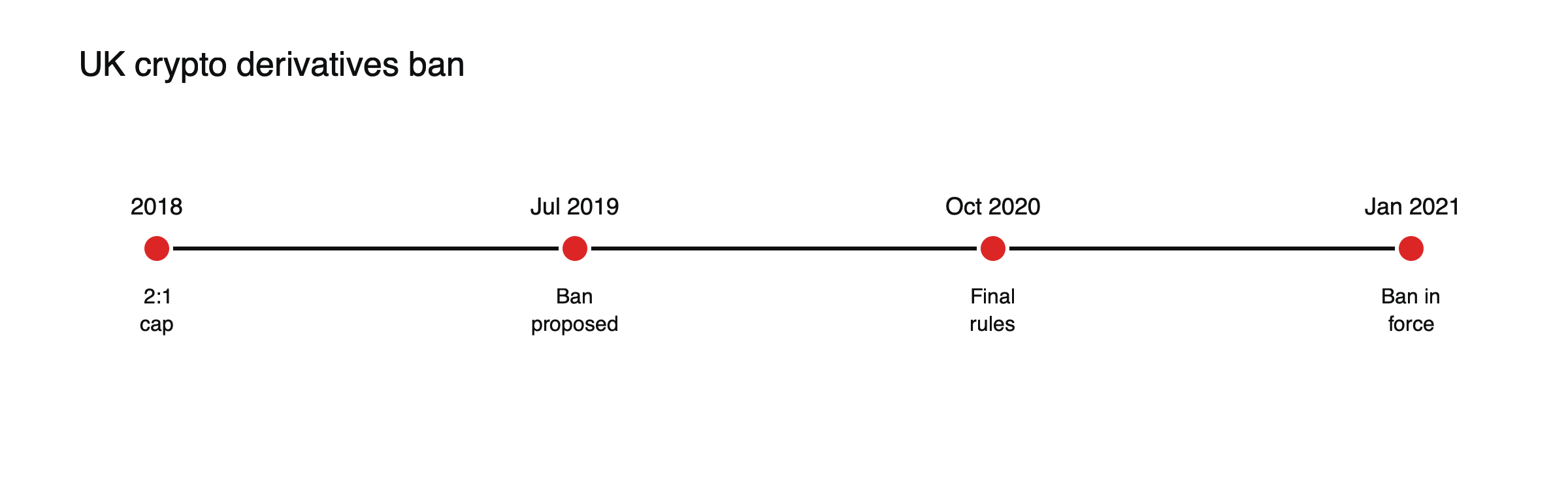
Figure: From leverage cap to outright ban.
How large the harm was estimated to be
The FCA estimated that the ban could save retail consumers about £53 million a year in losses from crypto derivatives. It pointed to evidence that retail clients often traded these products with leverage, at high cost, during periods of extreme volatility, and that many did not understand the risks. Firms argued that the estimate overstated the harm and ignored consumers who used the products responsibly.
What happened to existing positions
Retail clients holding positions before the ban could keep them until they chose to close them; firms could not open new ones.
What it covers
Derivatives (CFDs, futures, options) and exchange-traded notes referencing unregulated, transferable cryptoassets such as bitcoin and ether, when sold to retail clients. Buying crypto itself was not banned.
Why the FCA acted
- Volatility: large, fast price swings combined with leverage.
- Valuation: no reliable way to value the underlying assets.
- Market abuse and financial crime in the underlying markets.
- Poor understanding: many retail investors lacked a legitimate need for the products.
Volatility and leverage, illustrated
Suppose a retail trader opens a crypto CFD worth £2,000 with £1,000 of margin, the maximum allowed at 2:1 before the ban. (Illustrative scenario.) A 25% fall in bitcoin, not unusual in a few days, would cut the position’s value by £500, half the trader’s margin. A 50% fall, as seen in March 2020, would wipe it out entirely. At higher leverage offered offshore, far smaller moves would be enough. The FCA judged that these risks were too great for retail clients, especially given the difficulty of valuing crypto. See what crypto CFDs are.
The criticism
Opponents argued the ban would push UK investors toward unregulated offshore platforms with weaker protections. The FCA also estimated firms would lose about £75 million a year in fees.
What it means
Any firm offering crypto derivatives to UK retail clients is likely operating outside the rules; the FCA warned such offers may be scams. See leverage limits in the EU, UK and Australia compared , what ESMA’s 2018 CFD rules changed and what perpetual futures are.
The 2025 change for crypto ETNs
In August 2025, the FCA announced that retail investors would be able to buy crypto exchange-traded notes again from October 8, 2025, provided they are traded on an FCA-recognised UK investment exchange. Professional investors had been allowed to access such notes since 2024. The FCA said that its ban on retail access to crypto derivatives, including CFDs, futures and options, would remain in place. The change reflected a gradual shift toward regulating crypto rather than excluding it, while keeping leveraged products off-limits for retail clients. See who owns bitcoin ETFs.
How the UK compares
The EU allows crypto CFDs for retail clients under ESMA’s rules, with leverage capped at 2:1, while the UK bans them for retail clients. Some other jurisdictions apply similar caps, and many offshore platforms offer much higher leverage with fewer protections. These differences mean that the same product can be legal, restricted or banned depending on where a client lives. See what ESMA’s 2018 CFD rules changed.
Signs of an unregulated offer
- A firm offers crypto CFDs or futures to UK retail clients.
- Leverage far above international norms is advertised.
- The firm is not authorized by the FCA or another recognized regulator.
- Bonuses or pressure tactics encourage larger deposits.
The consultation
When the FCA consulted on the ban, 97% of the 527 respondents opposed it, mostly firms and crypto users who argued that retail clients could make informed decisions and that leverage limits were enough. The FCA went ahead, concluding that the potential harm outweighed those arguments. The episode illustrated the gap between industry views and the regulator’s assessment of retail risk.
The offshore problem
The main criticism of the ban was that it would push UK investors toward unregulated offshore platforms offering crypto derivatives with high leverage and few protections. Such platforms may not segregate client money, offer negative balance protection or provide recourse through UK complaint and compensation schemes. The FCA warned consumers that firms offering crypto derivatives to UK retail clients were likely acting illegally.
How firms responded
UK-authorized providers stopped offering crypto derivatives to retail clients, while continuing to serve professional clients where they qualified. Some focused on other products, such as share and currency CFDs, or on offering crypto exposure through regulated channels as they became available.
The wider UK framework
The ban was one part of the UK’s approach to crypto. Since 2020, crypto firms have had to register with the FCA for anti-money-laundering purposes, and rules on crypto promotions took effect in 2023. A broader regime for crypto trading and custody was expected to take effect in 2026.
Common misreadings
- Believing the UK banned owning crypto.
- Assuming the 2025 ETN change also allowed crypto CFDs.
Professional client status
Clients who meet criteria on trading experience, portfolio size and professional knowledge can be classified as professional, removing retail protections such as the crypto derivatives ban, leverage caps and negative balance protection. The FCA has warned firms against encouraging retail clients to opt up just to access riskier products, and it expects firms to check that clients genuinely qualify.
The ETN change in detail
From October 8, 2025, retail investors could access crypto ETNs listed on FCA-recognised UK investment exchanges, with firms required to follow consumer protection and promotion rules. The notes track the price of crypto assets but do not use leverage, which helped the FCA distinguish them from derivatives. Retail access to crypto funds investing directly in crypto still required changes to fund rules.
Lessons beyond the UK
The UK’s approach shows how regulators weigh access against protection. Other jurisdictions have chosen leverage caps rather than bans, while some have moved toward broader crypto regulation that may eventually reshape access to derivatives too.
Protections compared, illustrated
Suppose two retail traders want leveraged exposure to bitcoin, one through an EU-regulated provider and one through an offshore platform. (Illustrative comparison.) The EU client is limited to 2:1 leverage, has negative balance protection and segregated client money. The offshore client might use 50:1 or more, with no guarantee of segregation or protection from negative balances. A 10% fall would cost the EU client 20% of margin, while wiping out the offshore client several times over, with recovery uncertain if the platform failed.
What UK traders should check
UK retail traders considering crypto exposure can check whether a firm is FCA-authorized, whether the product is a derivative and therefore banned for retail clients, and whether any compensation or complaint scheme applies.
The cost of the ban to firms
The FCA estimated that firms would lose about £75 million a year in revenue from crypto derivatives sold to retail clients. Some providers shifted marketing toward professional clients or toward other products, while others argued that the rules put UK firms at a disadvantage against overseas competitors not bound by the ban. Supporters countered that protecting retail clients from heavy losses mattered more than firms’ revenue, and that offshore platforms were already outside UK rules.
Frequently asked questions
Can UK retail investors buy bitcoin?
Yes. The ban applies to derivatives and, until October 2025, ETNs, not to buying crypto itself.
Can professional clients trade crypto derivatives in the UK?
Yes, the ban applies only to retail clients; professional clients can access these products under the relevant rules.
This article is educational content and does not constitute financial, investment, legal or tax advice. Digital assets are volatile and you may lose the amount you invest.
Sources
- FCA bans the sale of crypto-derivatives to retail consumers (scope; £53 million; January 6, 2021; scam warning) — FCA
- City watchdog bans crypto-derivatives (£75 million a year in lost fees for firms) — LBC, October 2020
- UK regulator bans sale of crypto derivatives (97% of 527 respondents opposed; criticism about offshore platforms) — Silicon Canals
- FCA bans cryptocurrency CFDs for retail traders (2:1 cap from 2018) — FX News Group
- UK Financial Conduct Authority opens retail access to crypto ETNs (retail access from October 8, 2025 on recognised investment exchanges; ban on retail cryptoasset derivatives remains; professional-only cETN segment from March 2024) — Mondo Visione, August 2025
- UK to lift crypto ETN ban for retail traders on October 8 (broader UK crypto regime expected to go live in 2026) — AMBCrypto, 2025