
What Is Negative Balance Protection?
Negative balance protection limits a retail trader's losses to the money in the account. Where it applies, how it works and what the 2015 franc shock showed.
Negative balance protection means a retail trader cannot lose more than the money in their account: if a sudden move pushes the balance below zero, the provider absorbs the shortfall. EU rules have required it for retail CFD clients since August 2018, with similar rules elsewhere. Without it, a trader can owe money after a gap.
How it works
If your positions are closed at prices that leave your account at, say, −$2,000, the provider resets the balance to zero instead of asking you to pay. The protection applies to the account as a whole, not to each trade.
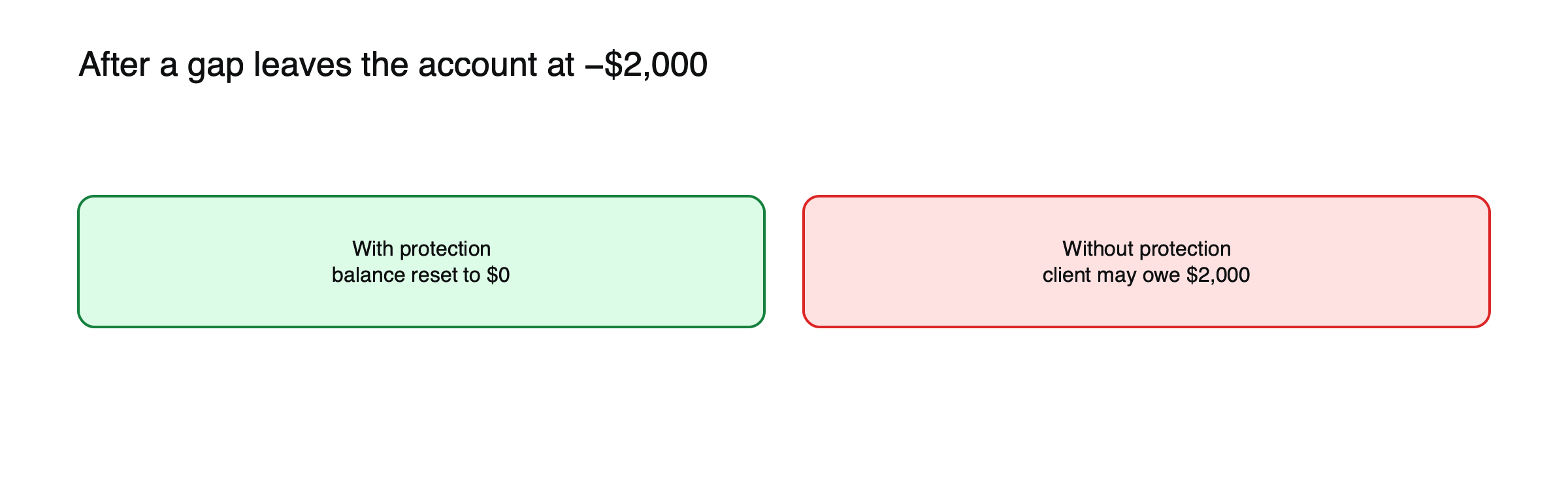
Figure: What negative balance protection changes after a gap.
An example of a gap past the stop-out
Suppose an account holds $5,000 and a single currency position worth $100,000, using about $3,333 of margin at 30:1. (Example values.) Overnight, a central bank surprise moves the currency 20% against the position before any orders can be filled. The loss is about $20,000, leaving the account at about −$15,000. With negative balance protection, the provider closes the position and resets the account to zero: the client loses the $5,000 deposit but owes nothing more. Without it, the client could be asked to pay the $15,000.
Who pays the shortfall
When an account goes negative under protection, the provider absorbs the loss. Providers manage this risk through their own hedging, margin rules and capital, which regulators require them to hold. Large, sudden market moves can still threaten weaker providers, as some discovered in 2015.
Why it was introduced
On January 15, 2015, the Swiss National Bank removed its floor on the euro-franc rate. The franc jumped almost 30% within minutes and liquidity disappeared. Stop orders were filled far from their levels, many traders ended with negative balances, and at least two brokers became insolvent. Some providers forgave negative balances; others pursued clients for them. ESMA later made negative balance protection mandatory for retail CFD clients in the EU.
What happened to traders and brokers in 2015
When the franc surged, some brokers forgave their clients’ negative balances, while others pursued them. Two firms, Alpari’s UK business and Global Brokers in New Zealand, became insolvent, and administrators later sought to recover negative balances from clients. The episode showed retail traders that a single overnight move could cost far more than their deposits, and that recovery depended on the broker’s choice and solvency rather than on any rule. European regulators later made negative balance protection mandatory for retail CFD accounts.
Per account, not per trade
The protection applies to the account as a whole. A large loss on one position is first set against your other positions and cash in that account; only if the total falls below zero does the protection reset the balance. It does not refund losses on individual trades while the account remains positive.
What it does not cover
- Losses up to zero: you can still lose your entire balance.
- Professional clients: those who opt out of retail status usually lose this protection.
- Every jurisdiction: rules vary; check whether the protection applies where your account is held.
Why it matters. Gaps happen around central bank decisions, weekends and major news. Negative balance protection limits the worst outcome, but not the likely one: most retail CFD accounts lose money. See what happens in a margin call and a stop-out and what ESMA’s 2018 CFD rules changed. For the basics, read what leverage is in CFD trading.
The professional client trade-off
Traders who qualify and choose to be treated as professional clients can access higher leverage, but they usually give up negative balance protection and other retail safeguards. For most individuals, the extra leverage is a poor exchange for the risk of owing money after a gap.
Outside the EU, UK and Australia
Providers regulated elsewhere may or may not offer negative balance protection, and where they do, it may be a company policy rather than a legal requirement that can be withdrawn. Checking the client agreement for an explicit commitment, and who regulates the provider, matters before trading with leverage.
Not the same as investor compensation
Negative balance protection limits what you can owe from trading losses. It does not protect your deposit if the provider itself fails; that is the role of client money rules and investor compensation schemes, which vary by country and have their own limits.
How providers limit the risk
Providers use several tools to keep accounts from going negative in the first place. Margin close-out rules shut positions before losses exceed the account in normal markets. Many raise margin requirements ahead of weekends, elections and central bank meetings, when gaps are more likely. Some cap position sizes in thinly traded instruments, and many offer guaranteed stops for a fee. Negative balance protection is the last line, needed only when all of these are overrun.
Checking whether you are protected
Look for an explicit statement in the client agreement or the provider’s key information that retail clients cannot lose more than the funds in their account. Check which regulator authorizes the provider and which entity your account is held with, since one brand can operate several entities under different rules. Confirm whether opting into professional status would remove the protection.
Weekend gaps and crypto CFDs
Gaps are most likely when markets reopen after being closed. Crypto markets never close, but CFD providers may price them differently at weekends or have reduced liquidity, and sharp moves can occur at any hour. Positions in volatile instruments held over weekends are where negative balance protection is most likely to matter.
What protection does not replace
Even with protection, losing the whole account is a serious outcome. Moderate leverage, stops placed well inside the stop-out level and position sizes based on risk are what keep accounts away from that edge. The protection is a floor, not a plan.
How the rules developed
Before 2015, negative balance protection was rare, and clients of many providers could be asked to cover losses beyond their deposits. The Swiss franc shock that January showed how quickly that could happen to ordinary traders. European regulators introduced negative balance protection for retail CFD clients as part of their product intervention measures, applying per account from August 1, 2018, alongside leverage caps and margin close-out rules. National regulators later made the measures permanent, and the UK and Australia adopted similar protections for retail clients. Providers outside these regimes set their own policies, which is why the same trade can carry different worst-case outcomes depending on where the account is held. When comparing providers, the existence and scope of this protection deserves as much attention as spreads and leverage, because it decides the real worst case.
Frequently asked questions
Does negative balance protection mean I cannot lose money?
No. You can lose everything in the account. The protection only stops losses from going beyond that.
Is it applied automatically?
For retail clients of providers covered by EU, UK or Australian rules, it should apply automatically. Elsewhere, check the client agreement.
This article is educational content and does not constitute financial, investment, legal or tax advice. Digital assets are volatile and you may lose the amount you invest.
Sources
- ESMA publishes decisions about CFDs (negative balance protection limits liability to funds in the account) — WealthBriefing
- ESMA adopts CFD measures (negative balance protection per account from August 1, 2018) — Finadium
- Swiss franc’s surge causes two brokerage firms to become insolvent (about 30% move; Alpari, Global Brokers NZ) — Fox News / AP, January 2015
- Brokers forgiving negative balances and those not (Alpari administrators to chase balances) — ForexLive via Benzinga