
How to Read a Commodity Contract Specification
Check the underlying, contract size, tick value, trading hours, margin, expiry and roll dates and costs: a step-by-step guide to commodity contract specs.
To read a commodity contract specification, identify the underlying and benchmark, contract size and quote, tick size and value, trading hours, margin, expiry and roll dates, and all costs. The specification turns a chart into concrete money: what a move is worth, when you can trade and what it costs to hold.
Before you start
Open your provider’s specification page for the instrument, such as an oil, gold or natural gas CFD.
Reading it, field by field
Underlying and benchmark
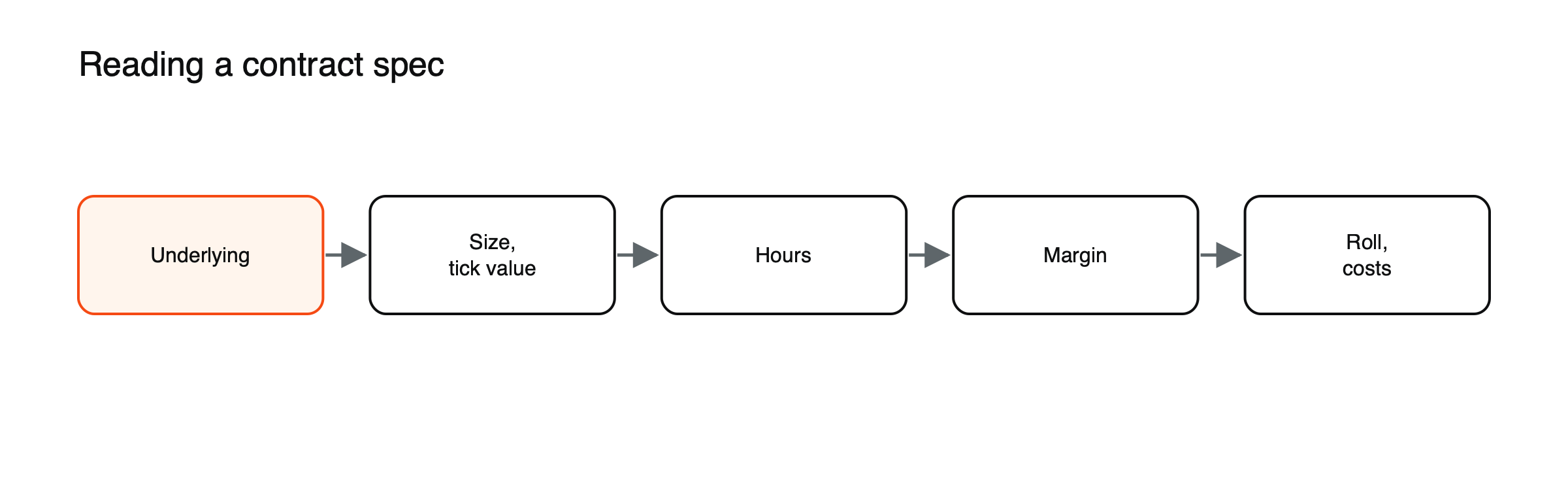
Figure: What to read in a spec.
WTI or Brent? Spot or a specific futures month? See WTI vs Brent.
Contract size and quote
For example, 100 ounces per lot for gold, or a set number of barrels for oil. On exchanges, crude contracts are 1,000 barrels and products 42,000 gallons.
Tick size and value
The smallest price move and what it is worth per lot.
Trading hours
Including daily breaks and holiday schedules.
Margin
The margin rate and any increase for large positions or volatile periods. See how much margin you need for one lot of gold.
Expiry and roll
Roll dates and how open orders are treated. See how a futures roll adjusts a commodity CFD price.
Costs
Spread, financing, commissions and roll charges.
A sample specification
| Field | Example entry |
|---|---|
| Underlying | WTI crude oil, front-month futures |
| Contract size | 100 barrels per lot |
| Quote | US dollars per barrel |
| Minimum price move | $0.01, worth $1 per lot |
| Trading hours | Nearly 24 hours on weekdays, with a daily break |
| Margin | 10% for retail clients |
| Roll | Monthly, a few days before futures expiry |
| Costs | Spread; roll adjustment; possible roll charge |
(Illustrative entries; real specifications differ by provider.)
Turning the specification into risk
From the sample: one lot is 100 barrels, and each $0.01 move is worth $1, so a $1 move in oil is worth $100 per lot. A stop $1.50 away risks about $150 per lot. At $80 a barrel, one lot is worth $8,000 and needs about $800 of margin at 10%. Working through these numbers before trading converts the specification from a list of facts into a clear picture of what a position will do to the account. See how to size a CFD position using risk per trade.
A gold example
For a gold CFD, a specification might define one lot as 100 ounces, quoted in dollars per ounce, with a minimum move of $0.01 worth $1 per lot. A $10 move then changes the value of one lot by $1,000. Another provider might define a lot as 1 ounce or 10 ounces, so the same order size can mean very different exposure. See how much margin you need for one lot of gold.
Fields that are easy to miss
- Minimum and maximum order size, which affect how precisely you can size positions.
- Minimum stop distance, which may stop you placing a stop too close to the price.
- Guaranteed stop availability and cost.
- Margin tiers, where larger positions need a higher margin rate.
- Holiday trading hours, which can differ from normal sessions.
Common mistakes
Assuming one lot means the same everywhere, and missing trading breaks that can gap prices. See how commodity CFDs work.
Exchange contracts and CFDs
Exchange-traded futures have standardized sizes, such as 1,000 barrels for the main crude contracts and 42,000 gallons for refined products. CFD providers often use much smaller lots so that retail traders can take modest positions, which is why a CFD specification is the one to read for your trades rather than the exchange’s. The exchange specification still matters for understanding expiry dates and price limits that affect the underlying market.
Specifications change
Providers can change margin rates, trading hours or other terms, often with notice, and sometimes quickly in volatile markets, such as ahead of major events. Checking the specification page from time to time, especially before holding positions over weekends or through big announcements, avoids surprises such as a sudden increase in required margin.
Reading the cost fields
The cost section of a specification is where most surprises hide. A spread quoted in points needs converting into money per lot. Financing for cash CFDs is usually given as an annual rate added to or subtracted from a benchmark, which on an $8,000 oil position at an illustrative 6% a year is about $1.32 a night. Futures-based CFDs may list a roll charge instead. Commissions, if any, may be charged per lot or as a percentage. Adding them up for your planned holding period gives the true cost of a trade before you place it.
Margin and leverage fields
Specifications show the margin rate, which for retail clients in the EU cannot be lower than 5% for gold or 10% for other commodities. Some providers set higher rates for particular instruments, raise them before weekends or major events, or apply tiered rates that rise with position size. Knowing these in advance prevents a position from suddenly needing more margin than expected.
Order rules
Specifications often include rules about orders: the minimum distance between the current price and a stop or limit, whether guaranteed stops are available and at what premium, and how orders are handled at rolls and during trading breaks. A stop that seems sensible on the chart may be rejected if it is closer than the minimum distance.
Comparing two providers
| Field | Provider A | Provider B |
|---|---|---|
| Gold lot size | 100 ounces | 1 ounce |
| Typical spread | $0.30 | $0.45 |
| Financing | Benchmark plus 2.5% | Benchmark plus 3% |
| Guaranteed stops | Available for a fee | Not offered |
(Illustrative terms.) The same view on gold can cost different amounts and carry different risks depending on these details, which is why comparing specifications is worth a few minutes before choosing where to trade.
A pre-trade specification check
- What exactly does the CFD track, and when does it roll?
- How much is one minimum price move worth per lot?
- What margin rate applies today, and could it rise?
- When are the daily breaks and holiday closures?
- What is the spread, financing or roll charge for my holding period?
- Are there minimum stop distances or order size limits?
Answering these six questions once for each instrument, and saving the answers, takes a few minutes and avoids most specification surprises. Keep the saved answers next to the trading plan for quick reference each time.
Frequently asked questions
Why is one lot of oil different between providers?
Because providers set their own CFD contract sizes. Always check the specification rather than assuming a lot means the same amount everywhere.
Where do I find the specification?
Usually on the provider’s website under instrument or contract details, and in the trading platform’s information panel for each instrument.
This article is educational content and does not constitute financial, investment, legal or tax advice. Digital assets are volatile and you may lose the amount you invest.