
What Is a Commodity Supercycle?
A commodity supercycle is a decade-plus rise in prices driven by structural demand that supply takes years to meet. Past examples and the 2020s debate.
A commodity supercycle is a long period, often a decade or more, when broad commodity prices rise well above trend because structural demand outpaces supply that takes years to expand. The best-known modern case was China’s 2000s boom. Some analysts argue electrification and data centers are driving a new one.
How a supercycle works
- A large, lasting source of demand appears, such as industrialization or a new technology.
- Supply cannot respond quickly: new mines and fields take many years.
- Prices rise and stay high, encouraging investment.
- New supply eventually arrives, and prices fall for years.
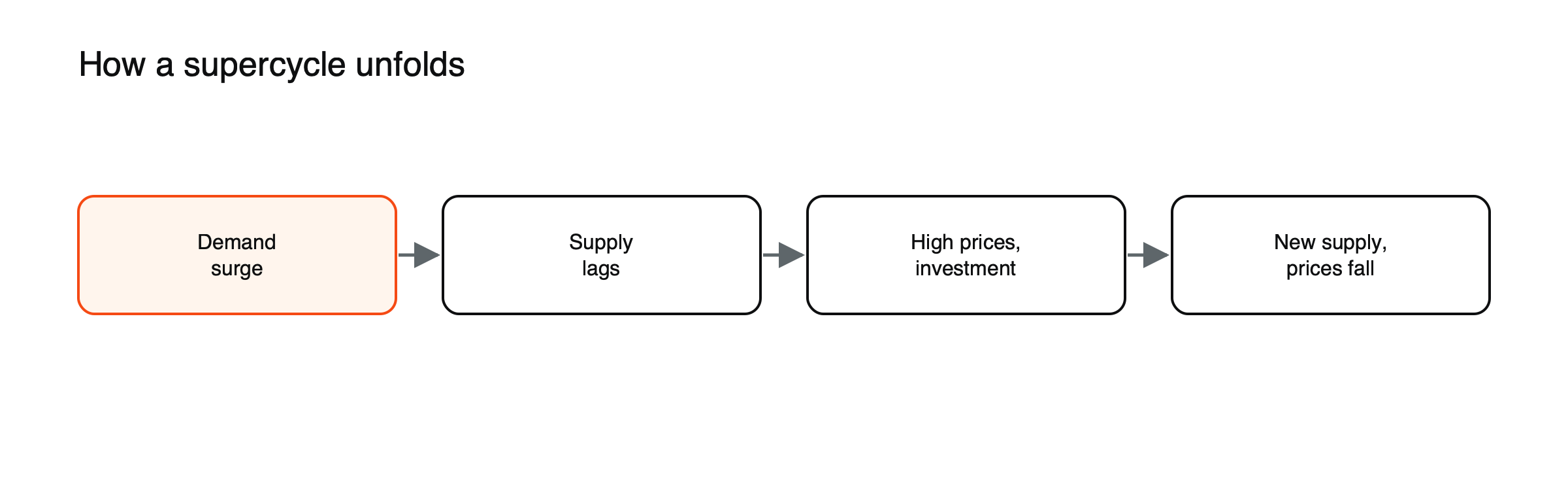
Figure: The supercycle pattern.
Cycles versus supercycles
Ordinary commodity cycles last a few years: prices rise in an economic upswing, producers expand, and prices fall back as supply catches up and growth slows. A supercycle is longer and broader, lasting a decade or more and lifting many commodities at once, because the underlying demand shift is large enough to outrun supply across whole sectors. Within a supercycle, ordinary cycles still happen, so prices can fall sharply for a year or two without ending the longer trend.
Past examples
- Post-war rebuilding in the 1950s and 1960s.
- The 1970s, with oil shocks and inflation.
- The 2000s China boom, as urbanization drove demand for metals and energy.
The 2000s, in more detail
As China urbanized and industrialized in the 2000s, it built cities, railways, power plants and factories at a pace the world had rarely seen, consuming vast amounts of steel, copper, coal and oil. Mining companies had underinvested during the weak prices of the 1990s, so supply could not keep up. Copper reached records in 2006 and again in 2011, and oil and iron ore surged. Miners then spent heavily on new capacity, which arrived just as Chinese growth slowed, and prices fell steeply in the mid-2010s, culminating in the oil collapse of 2014–2016. The full cycle, from shortage to investment boom to glut, took well over a decade. See what caused the 2014 oil price crash.
What ends a supercycle
Supercycles usually end in one of three ways: the source of demand fades, as Chinese construction did; new supply arrives in large volumes after years of investment; or high prices push users toward substitutes and efficiency. Often all three combine. The end is typically recognized only in hindsight, after several years of falling prices that do not recover.
The 2020s debate
Supporters point to grids, renewables, electric vehicles and data centers, which need large amounts of copper, alongside years of low mining investment. Copper hit records in 2026. Skeptics note slowing Chinese construction, recycling and substitution, and that high prices eventually bring new supply.
Why it matters for traders. Supercycles describe long trends, not short-term moves; prices can swing sharply within them. See what moves copper prices, are commodities a good inflation hedge? and how commodity CFDs work.
Signs analysts watch
| Signal | What it suggests |
|---|---|
| Sustained deficits and falling inventories | Demand outpacing supply |
| Rising investment in new mines and fields | Supply response beginning |
| Long project lead times and permitting delays | Supply slow to respond |
| Substitution and efficiency gains | Demand response to high prices |
| Broad gains across many commodities | A wider cycle rather than one market |
No single signal confirms a supercycle; analysts look for several pointing the same way over years.
Supercycles and inflation
Because commodities feed into the cost of energy, food and manufactured goods, a long period of rising commodity prices tends to add to inflation, as in the 1970s and, to a lesser degree, the 2000s. Central banks respond, and higher interest rates can in turn slow demand for commodities. That feedback is one reason supercycles often end in, or overlap with, economic slowdowns. See are commodities a good inflation hedge?.
The energy transition question
The case for a new supercycle rests largely on the energy transition. Building power grids, wind and solar farms, batteries and electric vehicles requires large amounts of copper, aluminum, lithium, nickel and other metals. If that demand grows as quickly as many forecasts suggest while mining investment lags, shortages could last years. The counterarguments are that technology may reduce the metal needed per unit, that recycling will grow and that higher prices will bring new mines faster than expected. The outcome will likely differ by metal rather than apply to commodities as a whole.
Using the idea as a trader
A supercycle view can shape which markets a trader focuses on and whether pullbacks are treated as buying opportunities or warnings, but it says little about timing. Even in the strongest supercycles, prices have fallen 20% or more within a year, enough to wipe out leveraged positions. Short-term trades still need stops, sizing and attention to the drivers of the moment, whatever the long-term story.
Why supply takes so long
Large new mines and oil fields can take many years from discovery to first production, after exploration, financing, permits and construction. Even expanding existing operations takes years. During that time, high prices persist, which is the essence of a supercycle. When the new capacity finally arrives, it often comes all at once, because many companies responded to the same high prices at the same time.
Stages of a supercycle
| Stage | What happens |
|---|---|
| Early | New demand emerges; inventories fall; prices begin to rise |
| Middle | Prices rise broadly; producers report record profits; investment starts |
| Late | Investment peaks; costs rise; new supply begins to arrive |
| Decline | Supply exceeds demand; prices fall for years; investment is cut |
The decline stage sets up the next cycle, because underinvestment during years of low prices leaves supply short when demand eventually returns.
Producer countries
Supercycles reshape the economies of commodity exporters. Rising prices lift their currencies, government revenues and investment, as in Australia, Brazil, Chile and many oil producers during the 2000s. When the cycle turns, the same economies face falling currencies, budget pressures and slower growth. Their currencies are often watched as indicators of where a cycle stands. See what moves AUD/USD.
Prices adjusted for inflation
Supercycles are best judged in real terms, after adjusting for inflation. A record price in dollars may be well below earlier peaks once decades of inflation are taken into account. Real prices show whether a commodity is truly scarce relative to the past or simply rising with the general price level.
Common misreadings
- Treating a strong year as proof of a supercycle.
- Assuming supercycles rule out deep corrections.
Metals at the center of the current debate
| Metal | Main energy-transition use |
|---|---|
| Copper | Grids, motors, wiring, charging |
| Aluminum | Lightweight vehicles, power lines, solar frames |
| Lithium | Batteries |
| Nickel | Battery cathodes |
| Silver | Solar cells |
How long cycles last
Studies of long price histories suggest that supercycles have often lasted two to three decades from trough to trough, with rising phases of roughly ten to fifteen years. The timing varies widely, and estimates depend on how cycles are measured, so these figures are guides rather than rules.
What would confirm a new supercycle
Analysts looking for confirmation would want to see several years of supply deficits across a range of metals, inventories falling to low levels, prices staying high in real terms through economic slowdowns and new mining investment lagging despite high prices. A rise in a single metal, or a strong year or two, would not be enough. Until then, the idea remains a hypothesis that traders can watch rather than a trend they can assume. Watching these signals year by year, rather than reacting to headlines about a new supercycle, keeps expectations grounded in measurable evidence from the actual markets.
Frequently asked questions
Are we in a commodity supercycle now?
Analysts disagree. Some see one building around electrification and data centers, especially for copper; others think slowing Chinese construction and new supply will limit it. Supercycles are usually confirmed only in hindsight.
Do all commodities rise together in a supercycle?
Broadly, but not equally. Metals tied to the main source of demand usually rise most, while others may lag or follow their own cycles.
This article is educational content and does not constitute financial, investment, legal or tax advice. Digital assets are volatile and you may lose the amount you invest.
Sources
- Copper all-time high (May 2006 China-led boom; February 2011 record; 2026 record) — MetalCharts
- Copper hits record amid weak output (structural demand from grids, electrification and data centers; long lead times for new mines) — Saxo, September 2026
- Copper: the perfect squeeze? (Chinese construction demand fading; scrap surge) — Hellenic Shipping News, 2026