
Why the US Dollar Matters for Commodity Prices
Most commodities are priced in dollars, so a stronger dollar often weighs on prices and a weaker one helps. How the link works and when supply shocks win.
The dollar matters for commodity prices because oil, metals and most farm goods are priced in dollars. A stronger dollar makes them dearer for other buyers, which can weigh on prices; a weaker one tends to help. Supply shocks often override this: in 2022, commodities rose about 18% as the dollar hit a 20-year high.
How the link works
- Purchasing power: a stronger dollar raises local-currency costs for importers.
- Producer costs: many producers’ costs are in local currencies, so a stronger dollar lets them sell for fewer dollars.
- Financial flows: a stronger dollar often reflects higher US rates, which also raise the cost of holding commodities.
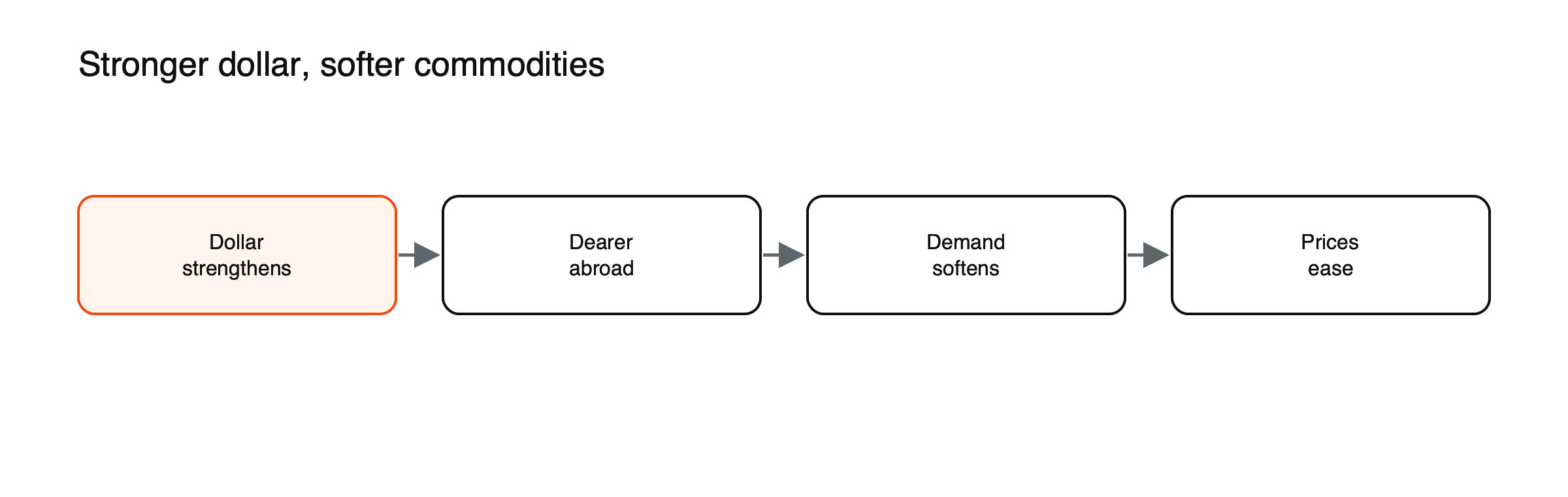
Figure: The usual dollar link; supply shocks can override it.
The effect in numbers
Suppose oil trades at $80 a barrel while USD/JPY is 150, so a Japanese buyer pays ¥12,000. If the dollar strengthens to 160 yen and oil stays at $80, the same barrel costs ¥12,800, about 6.7% more. (Illustrative prices.) Japanese demand may soften, and producers selling in dollars receive more in their own currencies, which can encourage them to sell more. Both effects tend to push the dollar price down over time.
Producer currencies
Many commodity exporters have currencies that move with their main exports: the Australian dollar with iron ore and metals, the Canadian dollar and Norwegian krone with oil, the Chilean peso with copper. When the dollar strengthens, these currencies often weaken, lowering local production costs in dollar terms and allowing producers to accept lower dollar prices. That link helps explain why a strong dollar can weigh on commodities through supply as well as demand.
Which commodities react most
Gold has one of the most consistent inverse links to the dollar. See why gold and the US dollar usually move in opposite directions. Industrial metals and oil react too, but their own supply and demand often dominate.
The interest rate channel
A stronger dollar often reflects higher US interest rates, which raise the cost of financing inventories and the return on holding cash instead of commodities. Investors who hold commodities through futures also see changes in the returns on their collateral. These financial effects mean that a dollar rally driven by rising US rates tends to weigh on commodities more than one driven by trouble elsewhere in the world.
When the link breaks
- Supply shocks: in 2022, energy and food prices surged with the dollar after Russia’s invasion of Ukraine.
- Geopolitics: oil spiked in early 2026 regardless of currency moves. See how geopolitical events move oil and gold.
2022 in more detail
In 2022 the dollar index reached a 20-year high in September, yet commodities as a group rose about 18% over the year, while US stocks fell about 18% and bonds about 16%. Russia’s invasion of Ukraine disrupted energy and grain supplies so severely that the dollar’s usual drag was overwhelmed. Gold, more sensitive to the dollar and real rates, ended the year roughly flat. The year showed that supply shocks can override currency effects for a long time.
Measuring the link
Traders look at correlations between the dollar index and commodity indices or individual commodities over rolling periods. The relationship is usually negative but varies widely, so a recent measure is more useful than a long-term average. Comparing commodity prices in dollars and in other currencies also helps separate currency effects from real changes in supply and demand.
Dollar cycles and commodity cycles
Long periods of dollar weakness have often coincided with strong commodity markets, as in much of the 2000s, while extended dollar strength has often accompanied weaker prices. These cycles reflect interest rates, capital flows and global growth together, so the dollar is best seen as one part of a wider financial backdrop rather than a single cause.
What it means for traders
Watch the dollar index alongside commodity fundamentals, and remember that for non-dollar accounts, currency moves change returns too. See what the US Dollar Index is and how commodity CFDs work.
Prices outside the dollar
Not every commodity benchmark is in dollars. European gas at the TTF hub is priced in euros, and Shanghai futures for copper and other metals are priced in yuan. Differences between these local prices and dollar benchmarks reflect both currency moves and local supply and demand, and traders sometimes compare them to spot regional shortages or surpluses.
Managing currency exposure
For traders with accounts in euros, pounds or other currencies, a dollar-priced commodity position carries two exposures: the commodity and the dollar. A rise in oil can be partly offset by a weaker dollar when profits are converted back. Some traders accept this; others hedge the currency separately with a position in the relevant currency pair. Knowing which exposures you hold avoids being surprised by results that differ from the commodity’s move.
A dollar move across commodities, illustrated
Suppose the dollar index rises 3% in a month as US interest rate expectations climb. (Illustrative scenario.) Gold falls 4%, reacting to both the stronger dollar and higher real yields. Copper drops 2%, weighed down by the dollar and concerns about growth. Oil, meanwhile, rises 1% because of a production cut announced in the same month. The same currency move had different effects depending on what else was driving each market, which is typical.
Emerging market demand
Many large buyers of commodities are emerging economies whose currencies tend to weaken when the dollar strengthens. For them, a strong dollar raises the local cost of fuel, metals and food, which can reduce demand or strain budgets where governments subsidize energy. This channel makes a strong dollar a headwind for commodity demand in the fastest-growing parts of the world economy.
A dollar checklist for commodity traders
- Is the dollar moving on US rates or on global fear?
- Are commodity-producer currencies moving with it?
- Is a supply shock overriding the currency effect?
- What is your account currency, and is the position exposed to it?
Common misreadings
- Assuming the dollar link is fixed and strong for every commodity.
- Ignoring why the dollar is moving.
- Forgetting currency effects on non-dollar accounts.
Why the euro matters
Because the euro carries the largest weight in the dollar index, much of what is called dollar strength is really euro weakness, and vice versa. Moves in EUR/USD are therefore often the quickest way to see the currency side of commodity moves. European buyers, who pay for dollar-priced commodities in euros, feel those changes directly in their costs. See what the US Dollar Index is.
Commodity currencies as signals
Currencies of commodity exporters sometimes move ahead of, or alongside, the commodities themselves. A firm Australian dollar can reflect strong Chinese demand for metals; a weak Canadian dollar can accompany falling oil. Watching these currencies together with the dollar index helps separate broad dollar moves from changes in commodity demand. When the Australian dollar falls against a weaker US dollar, for example, the problem is likely specific to metals or China rather than the dollar itself. See what moves AUD/USD.
Long-run perspective
Over many years, the dollar’s effect on commodities tends to be smaller than the effects of supply, demand and investment cycles. It matters most in the short term, around shifts in US interest rate expectations, and for commodities held mainly as financial assets, such as gold. Treating it as one input among several keeps the analysis balanced.
Frequently asked questions
Does a weak dollar always lift commodities?
Not always. It usually helps, but supply, demand and geopolitics can dominate, as in 2022, when commodities rose despite a very strong dollar.
Which commodity is most sensitive to the dollar?
Gold usually shows the most consistent inverse link, because it is held largely as a financial asset rather than consumed.
This article is educational content and does not constitute financial, investment, legal or tax advice. Digital assets are volatile and you may lose the amount you invest.
Sources
- Commodities are more than just an inflation hedge (2022: commodities +18%, gold about flat, US equities −18%, bonds −16%) — WisdomTree
- Why the strong dollar could be a source of concern (dollar-priced commodities dearer abroad) — AJ Bell, September 2022
- The Dollar Index (20-year high in September 2022) — BIT Knowledge Hub