
How Much Margin Do You Need for One Lot of Gold?
With one lot often 100 troy ounces, gold at $4,000 is a $400,000 position; at 20:1, margin is $20,000 and a $10 move is $1,000. Worked examples by size.
The margin for one lot of gold is position value times the margin rate. Many platforms define one lot as 100 troy ounces, so at $4,000 one lot is worth $400,000. EU retail rules allow 20:1 on gold, a 5% margin, so one lot needs $20,000 of margin, and each $10 move changes its value by $1,000.
The formula
- Position value = lots × ounces per lot × gold price
- Margin = position value × margin rate (5% at 20:1)
- P&L = price change × ounces
Check your provider’s contract size; it can differ.
Worked example: one lot
- 1 lot = 100 oz (typical; check your provider)
- Gold at $4,000 (example price)
- Position: $400,000; margin at 20:1: $20,000
- A $10 move: $1,000; a $100 move: $10,000
At the June 2026 price
With gold at $4,063.17 on June 26, 2026, one 100-ounce lot was worth about $406,317, needing about $20,316 of margin at 20:1. A $10 move still meant $1,000 per lot. As the price rises, the margin for the same number of ounces rises with it, so a position that fitted comfortably in an account at $2,000 an ounce needs twice the margin at $4,000.
Smaller sizes
| Size | Ounces | Position at $4,000 | Margin at 20:1 | Per $10 move |
|---|---|---|---|---|
| 1 lot | 100 | $400,000 | $20,000 | $1,000 |
| 0.1 lot | 10 | $40,000 | $2,000 | $100 |
| 0.01 lot | 1 | $4,000 | $200 | $10 |
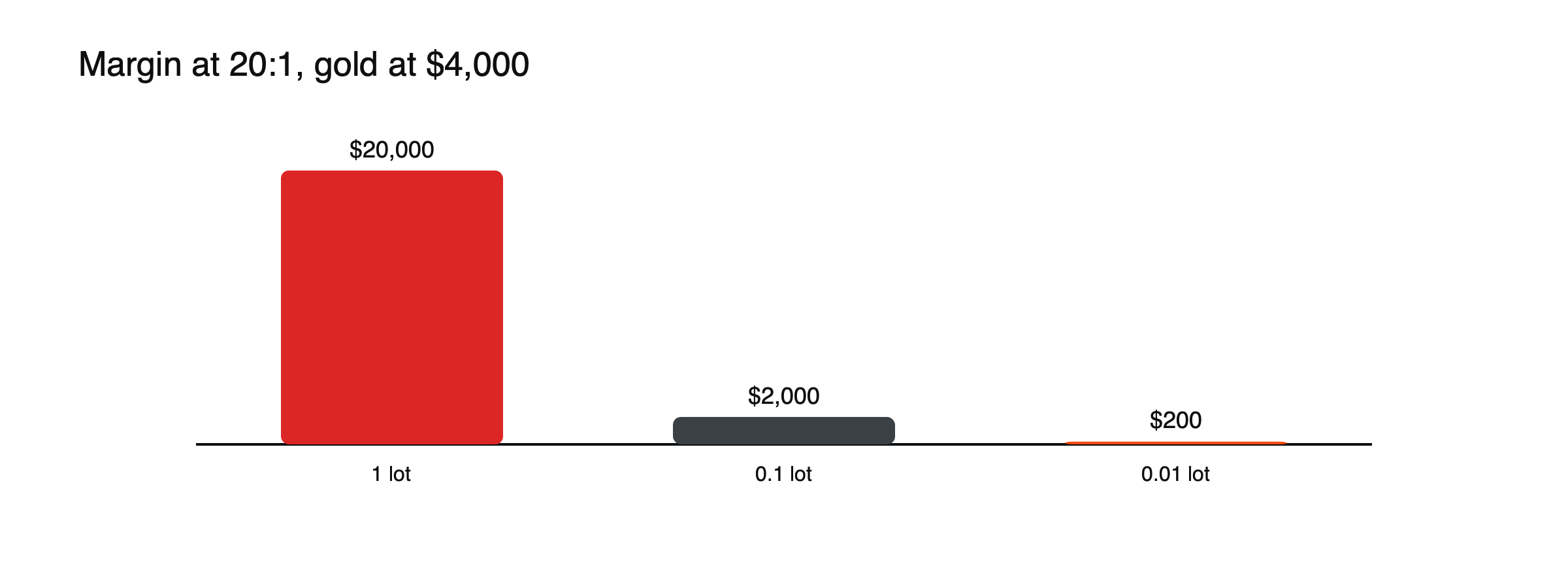
Figure: Margin by size (example price; 100 oz per lot assumed).
Why it matters. Gold can move $100 or more in a day in volatile periods. A $100 move on one lot is $10,000, half of the 20:1 margin. Size by risk, not by available margin. See how to size a CFD position using risk per trade and how to calculate the margin for a CFD trade.
Margin level and the stop-out, worked through
Suppose an account holds $25,000 and opens one lot of gold at $4,000, using $20,000 of margin. (Illustrative figures.) The margin level, equity divided by used margin, is 125%. A $50 fall in gold costs $5,000, bringing equity to $20,000 and the margin level to 100%, when many providers issue a margin call. Under EU retail rules, positions are closed when the margin level reaches 50%, here when equity falls to $10,000, after a fall of about $150. Gold has moved that much in a single day in volatile periods, so this account could be stopped out in one session. See what margin calls and stop-outs are.
Sizing from risk instead
A trader willing to risk $500 with a stop $20 away from entry should hold $500 ÷ $20 = 25 ounces, or 0.25 lots on a 100-ounce contract. The margin needed at $4,000 is about $5,000, but the margin is not what limits the risk; the stop and the size do. Starting from the loss you accept and working back to the position size keeps margin well below the account’s equity and leaves room for normal swings.
When margin requirements change
Providers can raise margin rates above the regulatory minimum during volatile periods, ahead of major events or for large positions. A position opened at 5% margin may suddenly need more, reducing free margin and bringing the account closer to a margin call even if the price has not moved. Checking the provider’s notices, especially before weekends and big announcements, avoids that surprise.
Professional clients
Clients classified as professional can access higher leverage than the 20:1 retail limit, which reduces the margin needed but increases the speed at which losses consume it. They also give up some retail protections. Lower margin makes positions cheaper to open, not safer to hold. See leverage in CFD trading.
Silver margin, for comparison
Silver carries a lower leverage cap of 10:1 under EU retail rules, so it needs a 10% margin. If a provider defines one silver lot as 1,000 ounces, a lot at $59.04 is worth about $59,040 and needs about $5,904 of margin, with each $1 move worth $1,000. (Illustrative contract size.) Silver’s percentage moves are usually larger than gold’s, so even though its margin per lot is lower, its risk per lot can be comparable or higher.
Overnight financing on gold
Holding a gold CFD overnight usually incurs a financing charge on the full position value, not on the margin. On a one-lot position worth about $406,317, an illustrative 6% annual rate costs roughly $67 a night, or about $2,000 over a month. Financing rates differ for long and short positions and between providers, so checking them matters for anyone holding gold for weeks. See how CFD overnight financing works.
Accounts in other currencies
Gold margin is calculated in dollars and converted into the account currency. For a euro account, the $20,316 margin on one lot at June 2026 prices is about €18,469 at EUR/USD 1.10. If the dollar strengthens while the position is open, the margin in euros rises, and so does the value of each dollar of profit or loss.
A margin checklist
- How many ounces is one lot with this provider?
- What margin rate applies today, and could it rise?
- How far can gold move before a margin call or stop-out?
- What will financing cost for the planned holding period?
- Is the position sized from risk, with margin well below equity?
Margin at different gold prices
| Gold price | Value of 1 lot (100 oz) | Margin at 20:1 |
|---|---|---|
| $2,000 | $200,000 | $10,000 |
| $3,000 | $300,000 | $15,000 |
| $4,000 | $400,000 | $20,000 |
| $5,000 | $500,000 | $25,000 |
As gold has risen, the margin for the same number of ounces has risen with it, which is one reason many retail traders now trade fractions of a lot.
Why margin is not the risk
Margin tells you how much money the provider holds while a position is open. It does not tell you how much you can lose. The loss depends on the size of the position and how far gold moves, and a fast move can cost more than the margin itself. Thinking of margin as the cost of a trade, rather than as a deposit against possible losses, is one of the most common reasons traders take positions far larger than they intended.
Fractional lots
Most platforms allow sizes as small as 0.01 lots, or 1 ounce, so even small accounts can trade gold with sensible risk. Small sizes are also useful for testing a strategy or building a position gradually, rather than committing a large amount all at once, which reduces risk while learning.
Frequently asked questions
Why does my provider show a different margin for one lot?
Because contract sizes and margin rates differ. Some providers define a lot as 1 or 10 ounces, and some set rates above the regulatory minimum.
Does the margin include the spread?
No. Margin is the deposit held while the position is open; the spread is a cost paid when trading. Both affect how much room the account has.
Leverage, margin and cost figures in this article are example values for illustration. Actual terms depend on the provider, the instrument and the rules in your country.
This article is educational content and does not constitute financial, investment, legal or tax advice. Digital assets are volatile and you may lose the amount you invest.