
What Is OPEC+ and How Do Its Decisions Affect Oil?
OPEC+ joins OPEC and producers led by Saudi Arabia and Russia, formed in 2016 to manage output. How its decisions move oil and why cuts do not always bite.
OPEC+ is an alliance of OPEC members and other major producers, most importantly Russia, formed in 2016 to coordinate oil output. Led by Saudi Arabia and Russia, it sets production targets, and its decisions can move prices sharply: in October 2022 it cut targets by 2 million barrels a day and Brent rose above $93.
How it came about
- 1960: OPEC founded by Iran, Iraq, Kuwait, Saudi Arabia and Venezuela.
- 2016: Saudi Arabia and Russia agree to cooperate, creating OPEC+ under the “Declaration of Cooperation,” in response to falling prices during the US shale boom.
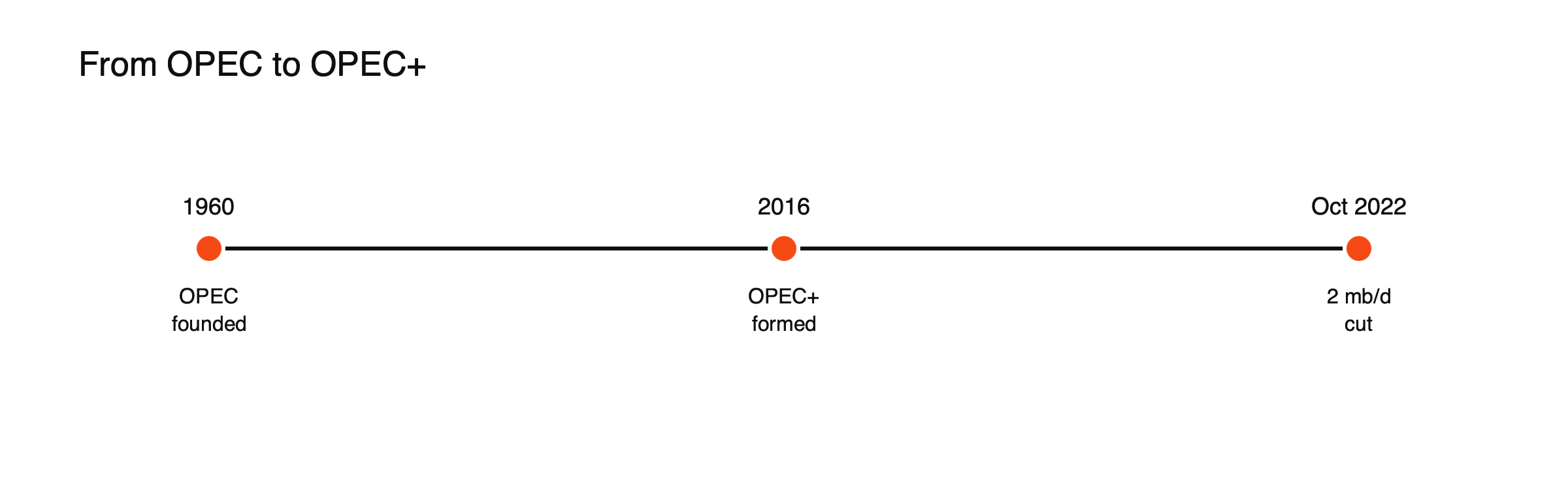
Figure: From OPEC to OPEC+.
Who is in it
OPEC+ brings together the members of OPEC and a group of other producers, most importantly Russia. In 2026 the wider alliance had 21 member countries. Within it, a smaller core group of seven or eight producers, led by Saudi Arabia and Russia, has taken many of the key decisions on voluntary output changes, meeting monthly to adjust targets.
How decisions are made
The group holds regular meetings, often online, to review market conditions and set production targets for each member. Decisions are usually announced in a statement after the meeting, sometimes on a weekend. Officials often signal their intentions in the days before, so the outcome is frequently expected; what moves markets is a decision that differs from those signals, or a change in the guidance about future months.
How its decisions move prices
- Production cuts reduce expected supply and tend to lift prices.
- Increases do the reverse.
- Surprises matter most: markets price expected decisions in advance.
Why cuts don’t always bite
Headline cuts can be smaller in practice. In 2022, many members were already producing below their quotas, so the effective cut was estimated at around 1.2 million barrels a day.
Other limits on its power
US shale and other non-members can raise output when prices rise; demand shocks can overwhelm supply policy; and members sometimes produce above targets.
Quotas, compliance and compensation
Each member has a target, but actual output can differ. Some members produce above their targets and are asked to make up for it later with deeper cuts, known as compensation. Others cannot reach their targets because of underinvestment or disruptions. Analysts therefore compare official targets with estimates of actual production, and the gap between the two often matters more than the headline decision.
2026: targets versus reality
In 2026 the gap between targets and reality became extreme. From March onward, the core group kept raising its targets, by 206,000 barrels a day for April and then by 188,000 barrels a day in several following months, as part of a plan to reverse a 1.65 million barrel-a-day cut agreed in 2023. But with shipping through the Strait of Hormuz effectively blocked, Gulf producers could not deliver: the group’s actual output fell from about 42.8 million barrels a day in February to roughly 33.2 million in April. As tanker traffic gradually resumed in the summer, the targets began to translate into real barrels again, and prices, which had climbed toward $120, fell back to around $72 for Brent by early July. See what moves crude oil prices.
Spare capacity: the real lever
The group’s influence depends on spare capacity, oil that can be added quickly. Before the 2026 conflict, the International Energy Agency estimated that Saudi Arabia and the United Arab Emirates held most of it, around 2.5 million barrels a day combined. Because that capacity sits in the Gulf, a disruption to Gulf shipping removes both current supply and the cushion meant to replace it, which is why such disruptions move prices so sharply.
OPEC+ and shale
US shale producers are not part of OPEC+, and they respond to prices rather than quotas. When prices are high, they tend to drill more, adding supply within months; when prices fall, they cut back. This limits how far OPEC+ can push prices up for long, and it was one of the main reasons the alliance was formed in 2016, when rising shale output had pushed prices down.
What traders watch
Meeting dates, comments from Saudi and Russian officials beforehand, compliance with quotas and spare capacity.
See what moves crude oil prices, WTI vs Brent and how commodity CFDs work.
A meeting-day plan
- Note the expected decision from official comments and press reports in the preceding days.
- Check where Brent and WTI trade relative to recent ranges, and how much positioning has built up.
- Be ready for weekend announcements and Monday gaps.
- After the statement, compare the new targets with estimates of what members can actually produce.
Key decisions at a glance
| Year | Decision or event | Context |
|---|---|---|
| 2016 | Saudi Arabia and Russia agree to cooperate, forming OPEC+ | Prices depressed by the US shale boom |
| 2020 | Record output cuts | Demand collapse during the pandemic |
| 2022 | Targets cut by 2 million barrels a day | Concerns about slowing demand |
| 2023 | Voluntary cut of 1.65 million barrels a day by a core group | Supporting prices amid weak demand |
| 2026 | Gradual reversal of the 2023 cut, while Gulf exports are disrupted | Strait of Hormuz closure, then reopening |
Reading an OPEC+ statement
Statements are short, so details matter. Look for the size and timing of any change in targets, whether it applies to all members or a core group, how much of a previous cut is being reversed, and any language about pausing or reversing changes “subject to market conditions.” Comments on compensation by members that overproduced indicate whether the effective change will be larger or smaller than the headline. Finally, compare the new targets with estimates of what members can actually produce.
Signals before a meeting
OPEC+ outcomes are rarely a complete surprise. In the days before a meeting, delegates often speak anonymously to news agencies about the options under discussion, and senior officials sometimes hint at their preferences in public. Reports from the International Energy Agency and OPEC’s own monthly report also shape expectations about the market’s balance. When these signals point one way and the decision goes another, the market’s reaction is usually largest, so tracking the pre-meeting reporting is as important as reading the final statement. Reading those reports alongside the statement helps judge how much of a decision was already fully priced in.
Frequently asked questions
Does OPEC+ control oil prices?
It has a large influence on supply, but not control. Demand, non-member supply, inventories and geopolitics can all outweigh its decisions, as 2026 showed when shipping disruptions mattered far more than quotas.
Why do OPEC+ meetings often happen on weekends?
Meetings are scheduled to suit members and are sometimes held on weekends, which means decisions can lead to price gaps when markets reopen.
This article is educational content and does not constitute financial, investment, legal or tax advice. Digital assets are volatile and you may lose the amount you invest.
Sources
- OPEC decides to cut oil supply by 2 million barrels per day (largest since May 2020; alliance forged in 2016 to address the shale-driven price fall) — Atalayar / EFE, October 2022
- OPEC+ (founded 1960 by Iran, Iraq, Kuwait, Saudi Arabia and Venezuela; Saudi–Russia cooperation from September 2016) — Journals of India
- Brent to reach $100 by Christmas? (effective cut estimated at about 1.2 million bpd as many members underproduce) — WorkBoat / ING, October 2022
- OPEC+ lifts quotas for fourth month running despite Gulf production collapse (output 42.77 million b/d in February vs 33.19 million in April 2026; Brent $96.63 on June 8; reversal of 2023 cut of 1.65 million b/d; 21 members) — Kotak Neo, June 2026
- OPEC+ decides on additional output increase as transit through the Strait of Hormuz resumes (Brent about $72 on July 3, down from about $120 after the conflict began; +188,000 b/d from August) — FN News, July 2026
- OPEC+ to boost oil production 206,000 b/d as Iran conflict threatens supply (Hormuz carries about 20% of global crude and product flows; Saudi and UAE spare capacity about 2.5 million b/d per the IEA) — World Oil / Bloomberg, March 2026