
Common Mistakes With Crypto CFDs
A symptom checker for crypto CFD mistakes: what you notice in your account, the mistake usually behind it, the numbers and the fix, from sizing to gaps.
Common crypto CFD mistakes: sizing by margin, ignoring financing and weekend costs, trusting stops in gaps, trading thin altcoins like bitcoin, stacking coins that move together, holding full size through events and not checking whether retail crypto CFDs are permitted. Each one leaves a recognizable symptom in an account.
How to use this symptom checker
Mistakes are easier to spot from their effects than from their causes. Each section below starts with something a trader might notice in their own account, names the mistake usually behind it, shows the numbers and gives the fix. If a symptom sounds familiar, the matching mistake is worth checking first. (All figures are illustrative.)
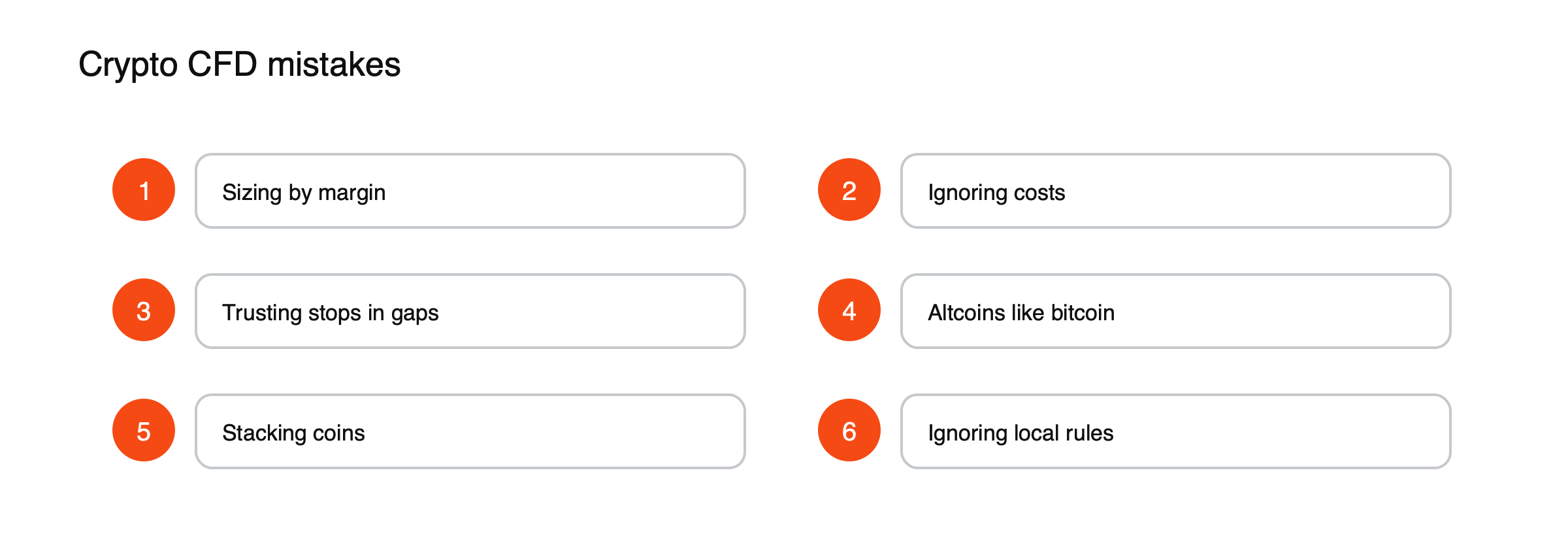
Figure: Mistakes behind common symptoms.
Symptom: “An ordinary dip puts my account near close-out”
Likely mistake: sizing by margin. A trader with $3,000 uses all of it as margin for a $6,000 bitcoin position at 2:1. A 10% fall, common in crypto, cuts equity to $2,400 against $2,700 of used margin, leaving no free margin, and a 33% fall reaches the close-out level. The position was sized by what the account could open, not by what it could afford to lose.
Fix: size from the loss you accept. Risking 1% of $3,000, $30, with an 8% stop gives a position of about $375, not $6,000. See how to size a crypto CFD position for high volatility.
Symptom: “My trade was right, but I made far less than the move”
Likely mistake: ignoring holding costs. A $6,000 bitcoin long held for 90 days while bitcoin rose 10% gains $600 gross, but financing at 18% a year costs about $266, nearly half the gain, because it is charged on the full position every night, weekends included.
Fix: estimate financing for the planned holding period before entering, and compare it with the expected move. See how much it costs to hold a bitcoin CFD for a month.
Symptom: “My stop filled far below where I set it”
Likely mistake: trusting stops in gaps. A long at $60,000 with a stop at $57,000 is exposed when bitcoin drops 7% within an hour on a Sunday: the stop becomes a market order and fills near $55,800. On 0.1 BTC, the planned $300 loss becomes $420.
Fix: size as if the stop could fill at twice its distance, or use a guaranteed stop where offered. See how to set stop-losses on crypto CFDs when prices gap.
Symptom: “My altcoin trades lose much more than my bitcoin trades”
Likely mistake: treating altcoins like bitcoin. The same $2,000 position and 8% stop on bitcoin and on a small altcoin carry very different risks: the altcoin’s normal swings can be two or three times larger, so its stop is hit more often, and when it is, slippage is worse.
Fix: use wider stops and smaller sizes on altcoins. With $100 of risk, a bitcoin position with an 8% stop can be about $1,250; an altcoin needing a 20% stop should be about $500. See why altcoin CFDs move more than bitcoin CFDs.
Symptom: “All my positions lose on the same day”
Likely mistake: stacking correlated coins. Positions of $2,000 each in bitcoin, ether and two altcoins look like four ideas. In a crypto-wide sell-off where bitcoin falls 10%, they might lose about $200, $280, $400 and $500, about $1,380 in total, far more than any single position suggested.
Fix: treat all crypto positions as one risk bucket with a combined limit, such as 2% to 3% of the account across all of them.
Symptom: “My biggest losses come around big announcements”
Likely mistake: holding full size through events. US inflation data, central bank decisions and regulatory announcements can move crypto sharply and widen spreads. A full-size position held through such an event can lose several days’ worth of expected gains in minutes, often through a gap.
Fix: keep a calendar of major events and reduce size or close before them unless the trade is specifically about the event.
Symptom: “My provider closed my position or refused to open one”
Likely mistake: ignoring local rules. Crypto CFDs are banned for retail clients in the UK since January 6, 2021, and limited to 2:1 leverage in the EU and Australia. Providers may also withdraw smaller coins or restrict trading for some client categories.
Fix: check what is permitted for your country and client status, and what leverage applies, before planning trades. See how leverage limits work for crypto CFDs.
The checker at a glance
| Symptom | Usual mistake | First fix |
|---|---|---|
| Ordinary dips threaten close-out | Sizing by margin | Size from risk |
| Small gains on correct calls | Ignoring holding costs | Estimate financing first |
| Stops fill far away | Trusting stops in gaps | Size for slippage |
| Altcoins lose more | Treating altcoins like bitcoin | Wider stops, smaller sizes |
| Everything falls together | Stacking correlated coins | One risk bucket |
| Losses around news | Holding through events | Cut size before events |
| Positions closed or refused | Ignoring local rules | Check permissions |
Most of these symptoms trace back to size and costs rather than to picking the wrong direction. See what a crypto CFD is.
When a symptom has several causes
Some symptoms point to more than one mistake at once. Losses clustering around announcements can come from holding full size through events, from stops being skipped in the resulting gaps and from correlated positions all reacting together. When a symptom appears, checking each possible cause, rather than fixing only the first one found, avoids repeating the problem in a slightly different form.
Why these mistakes are so common
Crypto’s round-the-clock trading, sharp moves and the ease of opening positions from a phone make it tempting to act quickly. Margin requirements make large positions look affordable, and long calm stretches make gaps feel unlikely. Most of the mistakes above come from treating crypto CFDs like calmer markets, when their volatility, weekend trading and costs call for more caution, not less.
Running the checker regularly
Reviewing an account once a month against these symptoms takes a few minutes. Looking at the largest losses, the gap between expected and actual stop fills, the financing paid and the days when every position lost shows which symptoms are present and which mistakes deserve attention first.
A monthly review, illustrated
A trader’s month shows three things: the two largest losses both came on Sunday nights, stops filled an average of 40% beyond their levels on those days, and financing took about a third of gross profits. (Illustrative review.) The symptoms point to trusting stops in gaps, holding through thin weekend hours and ignoring holding costs. The fixes for next month follow directly: smaller size before weekends, sizing for slippage and shorter holding periods.
From symptom to rule
Each symptom found in a review can become a written rule, such as “halve size before weekends” or “estimate financing before any trade held more than three days”. Over time, the rulebook grows from the account’s own history rather than from general advice.
Symptoms that are not mistakes
Some losses have no mistake behind them: a well-sized trade with a sensible stop can simply be wrong. If a review finds no symptom pointing to a mistake, the right response is usually to keep following the plan rather than to change it after one bad result.
Frequently asked questions
Which mistake is the most damaging?
Sizing by margin, because it magnifies every other mistake. A trader who sizes from a small risk per trade can survive most of the others.
Can these mistakes be avoided entirely?
Not entirely, but a written rulebook, sized positions and a regular review catch most of them before they become expensive. See risk management rules for crypto CFD trading.
This article is educational content and does not constitute financial, investment, legal or tax advice. Digital assets are volatile and you may lose the amount you invest.