
How to Hedge Crypto Holdings With CFDs
Open a short CFD sized to the coins you want to protect, keep margin, track financing and close when the risk passes. Hedging crypto, with a 0.5 BTC example.
To hedge crypto holdings with CFDs, open a short CFD on the same coin sized to what you want to protect, keep enough margin, track daily financing and close the hedge when the risk passes. Holding 0.5 BTC and shorting 0.5 BTC at $60,000, a fall to $50,000 costs your coins $5,000 while the short gains about $5,000.
Before you start
Decide what you are protecting against, a specific event or a period, and how much of your holding to cover. A hedge reduces losses but also gives up gains.
Hedging, step by step
Size the hedge
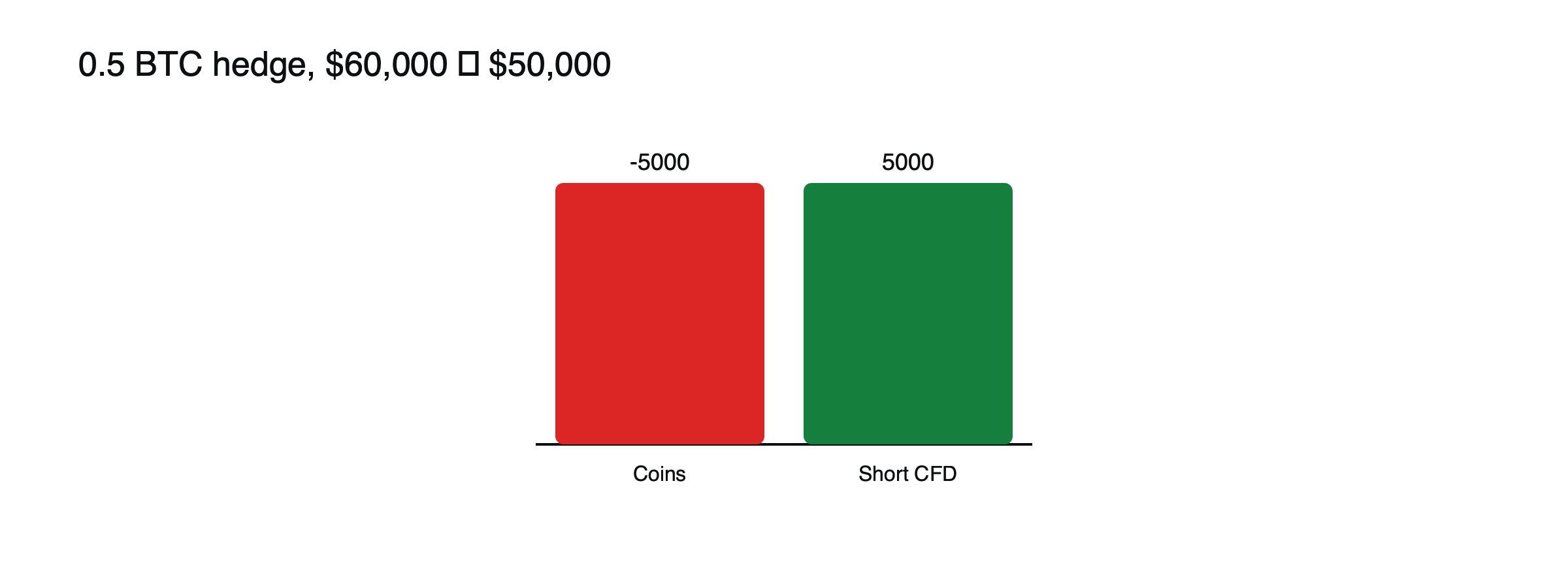
Figure: A full hedge offsets the fall (before costs).
Full hedge: short the same number of coins. Partial hedge: short a fraction, such as half.
Post margin
0.5 BTC at $60,000 is a $30,000 short; at 2:1, margin is $15,000. Keep extra free margin: if bitcoin rises, the short loses while your coins gain, and margin calls can still happen.
Track costs
Financing on the short accrues daily. See how much it costs to hold a bitcoin CFD for a month.
Monitor the match
Price differences between your exchange and the CFD can leave small gaps in the hedge.
Close the hedge
Close when the event passes or your view changes.
The hedge in numbers
| Bitcoin price | Coins (0.5 BTC) | Short CFD (0.5 BTC) | Net |
|---|---|---|---|
| $60,000 → $50,000 | −$5,000 | +$5,000 | ≈ $0 before costs |
| $60,000 → $70,000 | +$5,000 | −$5,000 | ≈ $0 before costs |
A partial hedge, illustrated
An investor holding 0.5 BTC shorts only 0.25 BTC, hedging half the holding. (Example values.) If bitcoin falls from $60,000 to $50,000, the coins lose $5,000 and the short gains $2,500, a net loss of $2,500 instead of $5,000. If bitcoin rises to $70,000, the coins gain $5,000 and the short loses $2,500, a net gain of $2,500. A partial hedge halves both the downside and the upside, which suits investors who want to reduce risk without abandoning their view.
Margin in a rally, worked through
A full 0.5 BTC short at $60,000 needs $15,000 of margin. Suppose the investor deposits $20,000 in the CFD account. If bitcoin rises, the short loses money and its margin requirement grows with the position’s value, even though the coins held elsewhere gain the same amount. The CFD account reaches the 50% close-out level at about $80,000, a rise of a third. The coins’ gains sit in a different account and do not help the CFD margin, so a strong rally can close the hedge just when the investor is doing well overall. (Example values.)
Common mistakes
Over-hedging, running out of margin on a rally and forgetting tax or accounting treatment differs between coins and CFDs. See how shorting bitcoin with a CFD works and what a crypto CFD is.
The cost of hedging
Hedging is insurance, and it has a price. On a $30,000 short at an illustrative 18% a year, a month of financing costs about $444, plus the spread to open and close. For a hedge around a specific event lasting a few days, the cost is modest; for a hedge kept for months, it can exceed the losses it protects against.
Hedging a mixed portfolio
An investor holding several coins can hedge each one separately or use a crypto index CFD as a broad hedge. An index hedge is simpler and cheaper but matches the portfolio only approximately. See what a crypto index CFD is.
When hedging makes sense
Hedging suits investors who want to keep their coins, for example for long-term reasons or to avoid selling, but expect a short period of risk, such as a major regulatory decision or market-wide uncertainty. It makes less sense as a permanent arrangement, because costs build up and the hedge cancels the gains the investor holds the coins for.
Records and tax
Coins and CFDs may be treated differently for tax and accounting purposes, so a hedge that is neutral in price terms may not be neutral after tax. Keeping full records and checking local rules avoids surprises.
Hedging before a known event, illustrated
An investor holding 0.5 BTC expects a major regulatory decision on Thursday and fears a sharp fall. On Tuesday, with bitcoin at $60,000, they short 0.5 BTC through a CFD. The decision disappoints and bitcoin falls to $54,000 on Thursday: the coins lose $3,000 and the short gains $3,000. On Friday, with the uncertainty gone, the investor closes the short. Three days of financing at 18% on $30,000 cost about $44, plus spreads. (Example values.) Used this way, a hedge works like short-term insurance around a specific risk.
Adjusting the hedge
The holding or the outlook may change while a hedge is open. If the investor sells some coins, the hedge should be reduced to match; if they buy more, it may need increasing. Some investors also scale a hedge up as risk grows and down as it fades, rather than switching it fully on and off.
Differences between venues
Coins held on an exchange or in a wallet are valued at exchange prices, while the CFD follows the provider’s reference price. In calm markets, the difference is negligible; in fast markets, it can leave a temporary gap, so the hedge may not offset losses exactly at every moment.
Hedging an altcoin with bitcoin, worked through
An investor holds $2,000 of an altcoin that tends to move about 1.5 times as much as bitcoin. Shorting about $3,000 of bitcoin, 1.5 times the holding, offsets the altcoin’s typical market-driven moves: if bitcoin falls 5%, the altcoin might fall 7.5%, losing about $150, while the bitcoin short gains about $150. (Example values.) Project-specific news is not hedged at all.
Common misreadings
- Expecting a hedge to protect against all risks.
- Forgetting that hedges cancel gains as well as losses.
Signs a hedge has done its job
A hedge opened for a specific risk should usually be closed when that risk passes: after the announcement, after the volatile period or when the investor’s view changes. Leaving it open out of habit turns insurance into a cost with no purpose. Setting a review date when opening the hedge helps avoid that drift.
Options as an alternative
Some investors hedge with put options on bitcoin, available on certain exchanges and on some regulated markets, which limit losses below a chosen price while keeping the upside, in exchange for an upfront premium. Options are more complex but avoid the margin calls a short CFD can bring in a rally.
A hedge checklist
- What exactly is being protected, and for how long?
- Is the hedge full, partial or ratio-based?
- Is there enough margin for a strong rally?
- What will financing cost over the expected period?
- When will the hedge be reviewed or closed?
Hedging in stages, illustrated
An investor holding 1 BTC grows worried as bitcoin rallies to $70,000 on what looks like excessive leverage in the market. (Illustrative scenario.) They short 0.25 BTC at $70,000, add another 0.25 BTC if funding rates spike or a key level breaks and plan to remove both once a correction of 15% or more has occurred or the warning signs fade. Building the hedge gradually spreads the timing risk and avoids paying for full insurance before the risk is clear, though it also means the first part of any fall is only partly hedged. Whichever approach is used, recording each step and its reason helps judge later whether the hedging decisions added value or simply added cost. It also makes the next hedge much easier to plan.
Frequently asked questions
Does a perfect hedge exist?
Rarely. Price differences between venues, costs and timing mean a hedge usually leaves a small gap.
Can I hedge an altcoin with a bitcoin CFD?
Partly. Altcoins usually move with bitcoin but by more, so a bitcoin hedge offsets only part of an altcoin’s moves.
Leverage, margin and cost figures in this article are example values for illustration. Actual terms depend on the provider, the instrument and the rules in your country.
This article is educational content and does not constitute financial, investment, legal or tax advice. Digital assets are volatile and you may lose the amount you invest.