
Stop-Out vs Liquidation on Crypto CFDs and Crypto Exchanges
A CFD stop-out closes positions at a margin level such as 50%; an exchange liquidation closes a futures position at a liquidation price. How the two differ.
Stop-out vs liquidation is how leveraged positions close when losses mount. On regulated CFDs, a stop-out closes positions when equity falls to a set share of margin, 50% under EU and Australian retail rules, with losses capped at the deposit. Exchanges liquidate futures at a liquidation price, often at far higher leverage.
Side by side
| CFD stop-out | Exchange liquidation | |
|---|---|---|
| Trigger | Margin level, such as 50% | Liquidation price per position |
| Typical leverage | 2:1 for retail crypto CFDs | Often 10x to 100x |
| Loss cap | Negative balance protection for retail | Margin posted; insurance funds |
| Scope | Account-wide | Per position or cross margin |
| In a crash | Gaps can skip the level | Cascading liquidations |
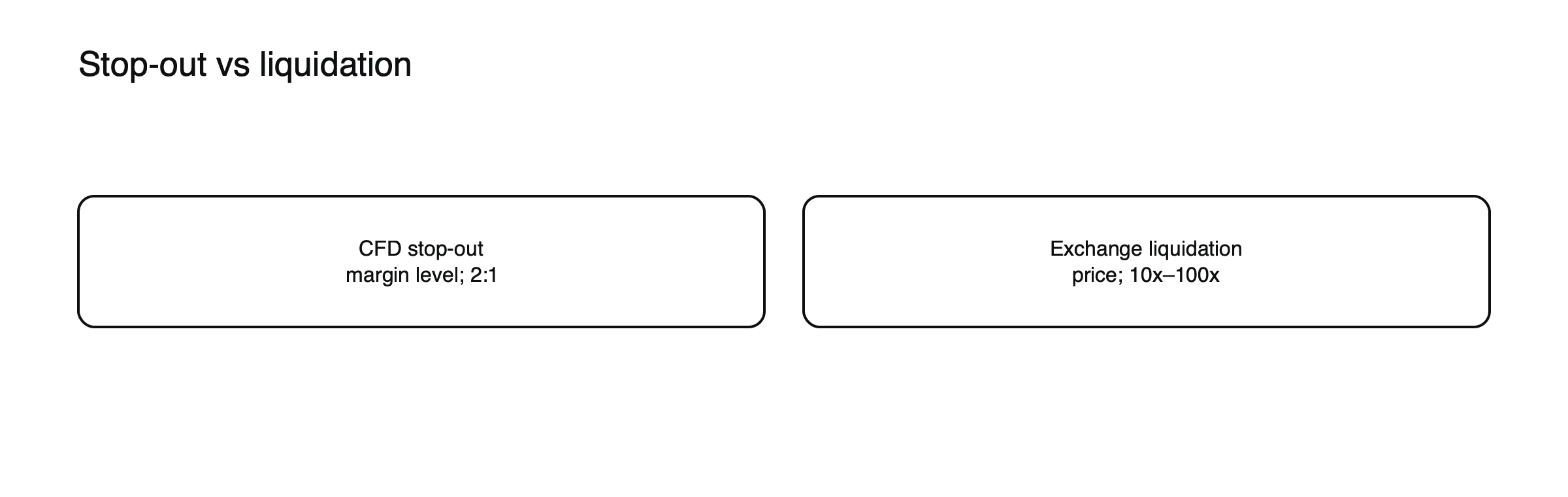
Figure: Two ways leveraged positions close.
A CFD stop-out, worked through
A retail client deposits $3,000 and buys 0.1 BTC at $60,000 through a CFD, using all $3,000 as margin at 2:1. The margin level is equity divided by used margin. If bitcoin falls to $40,000, equity is $1,000 and used margin $2,000, so the margin level reaches 50% and the provider closes the position. The client loses $2,000 of the $3,000 deposited; with negative balance protection, losses could never exceed $3,000 even in a gap. (Example values.)
An exchange liquidation, worked through
On a crypto exchange, a trader opens a long at 10x at $60,000. The liquidation price is set close to where the margin would be exhausted, at about $54,300, roughly a 9.5% fall. If bitcoin touches that level, the exchange closes the position and the margin is lost. A 9.5% fall in bitcoin can happen within a single day, so positions at this leverage are often liquidated by ordinary volatility.
Why leverage changes everything
At 10x on an exchange, a move of about 9.5% can liquidate a position. At 2:1 on a CFD, a much larger move is needed before close-out. See how volatility changes the margin on a crypto CFD.
Isolated and cross margin
Exchanges often offer isolated margin, where each position has its own collateral and only that collateral can be lost, and cross margin, where all positions share the account’s collateral, like a CFD account. Cross margin delays liquidation by using spare funds, but one bad position can drain the whole account. CFD stop-outs work on an account-wide basis similar to cross margin.
Mark price and last price
Exchanges usually trigger liquidations on a mark price, an average of prices across venues, rather than on the last trade on their own market, to avoid liquidations caused by brief spikes. CFD providers trigger stop-outs on their own quoted prices, which are also usually built from several venues. In both cases, the reference price, not just the chart, decides when positions close.
Cascades
When many leveraged positions are liquidated at once, forced selling pushes prices further. In the October 10, 2025 crash, more than $19 billion of leveraged positions were wiped out. See what a liquidation cascade is.
When the trigger level is not the exit price
A stop-out is not a guaranteed price: in gaps, positions close at the next available price.
See what happens in a margin call and a stop-out and what a crypto CFD is.
Insurance funds and deleveraging
When an exchange liquidation closes at a worse price than the position’s collateral covers, the exchange’s insurance fund usually absorbs the shortfall. If the fund is insufficient in extreme markets, some exchanges reduce profitable traders’ positions automatically to cover losses, a process known as auto-deleveraging. CFD clients do not face this mechanism, but they depend on the provider’s financial strength instead.
Protection compared
Retail CFD clients in the EU and Australia have negative balance protection, so they cannot owe money beyond their account balance. On exchanges, losses are normally limited to the margin committed, but protections vary by venue and jurisdiction, and the high leverage available makes losing that margin far more likely.
How to avoid both
Using low effective leverage, keeping spare cash in the account, setting stops well before any close-out or liquidation level and reducing size before weekends and major events make it much less likely that either mechanism decides when a trade ends.
The same move, two outcomes, illustrated
Two traders each put $3,000 behind a bitcoin long at $60,000. One uses a CFD at 2:1, a $6,000 position; the other uses a perpetual at 10x, a $30,000 position. (Example values.) Bitcoin falls 12% to $52,800, then recovers to $60,000 within two days. The CFD trader loses $720 at the low, leaving equity of $2,280 against used margin of $2,640, a margin level of about 86%, and the position survives to recover. The exchange trader is liquidated near $54,300 and loses the $3,000, missing the recovery.
Partial liquidation
Some exchanges liquidate positions in stages, closing part of a position to bring margin back above requirements rather than closing it all at once. That can leave a smaller position open, but each partial liquidation locks in losses. CFD providers may also close positions one by one when an account has several, often starting with the largest loss, until the margin level recovers.
Funding moves the liquidation price
On perpetuals, funding payments are taken from or added to a position’s margin. A long paying high funding for days loses margin steadily, moving its liquidation price closer to the market even if the price does not change. CFD financing similarly reduces account equity each night, gradually raising the price at which a stop-out would occur.
Common misreadings
- Assuming an exchange’s liquidation price is fixed.
- Thinking retail CFD stop-outs and exchange liquidations offer the same protections.
The real decision is leverage
Stop-outs and liquidations are consequences; the decision that determines how likely they are is the leverage chosen at the start. At low effective leverage, ordinary crypto volatility rarely reaches either threshold. At high leverage, a typical bad day can end the position. Comparing products by their close-out mechanics matters less than choosing a position size the account can carry through normal swings.
Warnings and timing
Many CFD providers send margin call warnings as the margin level falls, giving some time to add funds or reduce positions before the close-out level. Exchanges may also warn, but at high leverage the move from warning to liquidation can take minutes. Neither warning helps if the market gaps.
After a close-out
After a stop-out or liquidation, the temptation is to re-enter quickly to win back the loss. Pausing to review what happened, whether the size was too large, the stop too close to the close-out level or the timing poor, usually prevents a second loss of the same kind.
Liquidation fees
Many exchanges charge a fee when they liquidate a position, sometimes taking part of any remaining margin into their insurance fund. That makes being liquidated more expensive than closing a position voluntarily at the same price. CFD providers close positions at their quoted prices, with the usual spread, but do not normally add a separate liquidation fee.
A close-out checklist
- At what price would my position be stopped out or liquidated?
- How many normal daily moves away is that price?
- How much spare margin do I hold?
- Would a weekend gap reach the level?
- What warnings will I receive, and how will I respond?
Working through these questions before opening a position, and again whenever volatility rises, keeps the close-out level a distant backstop rather than the likely end of the trade. If the answers are uncomfortable, the position is too large. Reducing it before opening costs nothing, while discovering the problem during a crash can cost the whole margin. A few minutes of checking can prevent most forced exits.
Frequently asked questions
Which happens sooner, a stop-out or a liquidation?
It depends on leverage. At 2:1, a CFD position needs a large move to reach stop-out; at 10x or more on an exchange, liquidation can follow a move of less than 10%.
Can a stop-out happen below 50%?
Yes. The 50% level is when the provider must act, but in a gap, positions close at the next available price, which may be well below it.
This article is educational content and does not constitute financial, investment, legal or tax advice. Digital assets are volatile and you may lose the amount you invest.
Sources
- Liquidation price (mark price; isolated vs cross margin; at 10x about a 9.5% move liquidates) — Spark
- ESMA adopts CFD measures (2:1 for cryptocurrencies; 50% margin close-out; negative balance protection) — Finadium
- DeFi TVL drops 39% in 2026 (October 10, 2025 crash erased more than $19 billion of leveraged positions) — Cointelegraph