
Fixed vs Floating Exchange Rates
Floating currencies are priced by markets; pegged ones are held near a target by a central bank. How each works, with the Swiss franc floor and Hong Kong peg.
The difference between fixed vs floating exchange rates is who sets the price. A floating currency, such as the euro or yen, moves with supply and demand. A fixed or pegged currency is held near a target by its central bank, which trades to defend the level. Pegs bring stability until they break, and breaks can be violent.
Side by side
| Floating | Fixed or pegged | |
|---|---|---|
| Who sets the rate | The market | The central bank, around a target |
| Day-to-day moves | Continuous | Small, near the peg |
| Shock absorber | The exchange rate adjusts | Reserves and interest rates adjust |
| Main risk | Volatility | Sudden de-pegging |
| Examples | USD, EUR, JPY, GBP | Hong Kong dollar (pegged to USD) |
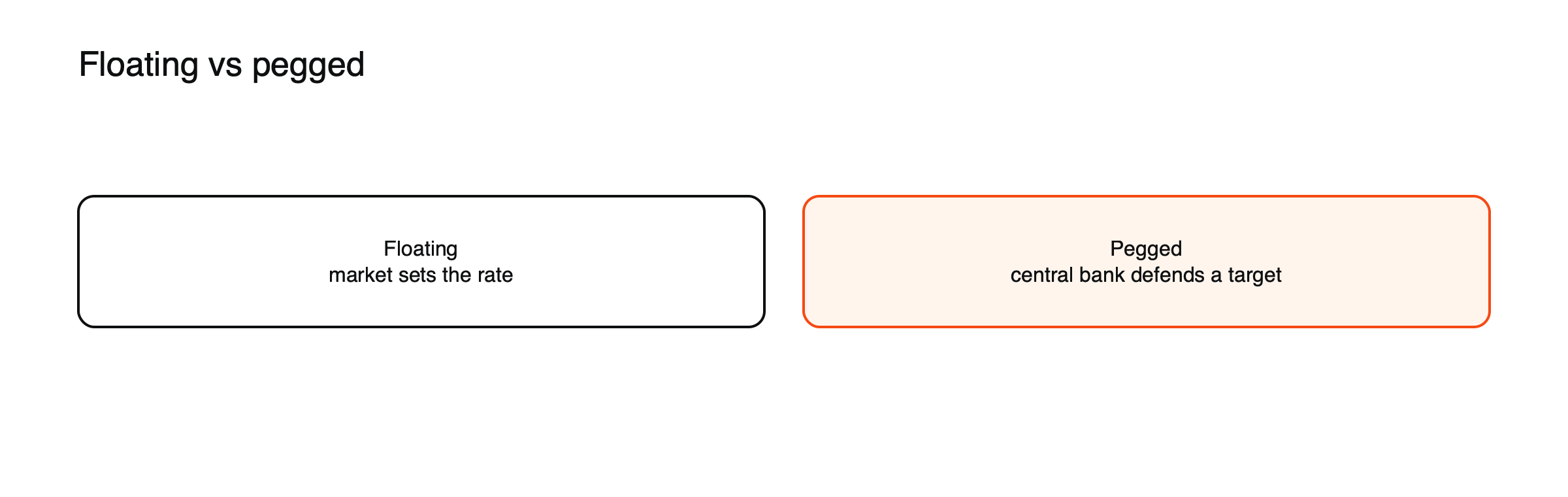
Figure: Who sets the price in each system.
Many countries sit in between, with a managed float where the central bank smooths moves.
A spectrum, not two boxes
| Regime | How it works | Examples |
|---|---|---|
| Free float | Market sets the rate; central bank rarely acts | US dollar, euro, yen |
| Managed float | Market sets the rate, but the central bank smooths sharp moves | Many emerging market currencies |
| Band or crawling peg | Rate allowed to move within a range, or a target adjusted gradually | Various emerging economies |
| Hard peg or currency board | Rate fixed to another currency, backed by reserves | Hong Kong dollar |
| Using another country’s currency | No national currency to adjust | Some countries use the US dollar |
The further down the table, the less the exchange rate can absorb shocks, and the more the economy itself, through wages, prices and interest rates, has to adjust instead.
Why countries choose pegs
Pegs can import credibility: a country with a history of high inflation can tie its currency to a stable one and borrow that stability. They make trade and investment planning easier for companies dealing with the anchor country, and they remove day-to-day currency risk. The price is losing independent monetary policy: interest rates must broadly follow the anchor country’s, whatever is happening at home.
How a peg is defended
The central bank sells its currency when it is too strong and buys it when it is too weak, using foreign reserves. Hong Kong’s monetary authority repeatedly sold Hong Kong dollars in 2025 to stop the currency strengthening past its peg.
Hong Kong’s currency board
Hong Kong has linked its dollar to the US dollar since 1983 and keeps it within a narrow band around 7.8 per US dollar. When the currency reaches the strong end of the band, near 7.75, the monetary authority sells Hong Kong dollars; at the weak end, near 7.85, it buys them. Because the arrangement is backed by large reserves and the territory’s interest rates follow US rates, the peg has survived several crises, including 1997, when other Asian pegs collapsed.
When pegs break
From 2011 the Swiss National Bank held the franc at or weaker than 1.20 per euro. On January 15, 2015, it abandoned the floor without warning; the franc jumped about 30% within minutes, and several brokers failed. See what negative balance protection is.
Stability is not the same as low risk
Pegs look low-risk because prices barely move, but the risk is concentrated in rare, large jumps. Floating currencies look riskier day to day but spread risk more evenly.
Why pegs break
Pegs usually fail for one of two reasons. Either the domestic economy needs different interest rates from the anchor country, and the pain of following the anchor becomes politically unbearable, or reserves run low as investors bet against the peg. The UK left the European Exchange Rate Mechanism in 1992 for the first reason; Thailand floated the baht in 1997 largely for the second. In Switzerland’s case in 2015, the opposite pressure applied: holding the franc down required creating ever more francs, and the central bank decided the cost was too high. See Black Wednesday and the 1997 Asian financial crisis.
Managed floats
Many currencies fall between the extremes. China, for example, sets a daily reference rate for the yuan and allows trading within a limited band around it, adjusting the reference over time. Other central banks let the market set the rate most of the time but step in during sharp moves. For traders, managed currencies can trend smoothly for long periods, then jump when the authorities change their approach, so official statements matter as much as economic data.
What it means for traders
Check whether a currency is pegged or managed before trading it; low volatility may hide gap risk. See why prices gap over weekends and how the forex market works.
Signs a peg is under pressure
- Foreign reserves falling month after month.
- Interest rates raised sharply to defend the currency.
- Forward exchange rates pricing in a much weaker currency than the peg.
- Officials repeatedly insisting the peg will hold.
- A widening gap between official and unofficial exchange rates where controls exist.
None of these guarantees a break, but together they suggest the market is testing the commitment.
Trading pegged and managed currencies
Pegged currencies often offer steady interest income and very small daily moves, which can make positions look safe. The risk sits in the tail: a devaluation or float can move the rate by 10% to 30% in a day, far beyond any stop. Some brokers widen spreads or restrict trading around expected changes. Small positions and a clear view of what would trigger a break are essential. See why prices gap over weekends.
Pegs and interest rates
A country with a firm peg must keep its interest rates close to those of the anchor country, or money will flow in or out until the peg is tested. Hong Kong’s rates broadly follow US rates for this reason. When the anchor raises rates while the pegging economy is weak, the pain builds; when the anchor cuts while the pegging economy is booming, bubbles can form. This loss of control over interest rates is the main trade-off behind every peg.
Using another country’s currency
The most extreme form of fixing is to abandon a national currency altogether and use another, usually the US dollar. It removes exchange-rate risk with the anchor completely, but also removes any ability to adjust through the currency or set interest rates. Countries that take this route usually do so after long periods of high inflation.
Pegs and other assets
A peg affects more than the currency itself. Shares, bonds and property in a pegged economy carry hidden exposure to a break, because a sudden devaluation cuts their value for foreign investors overnight. Investors holding such assets sometimes hedge the currency separately, accepting the cost as insurance. Others reduce exposure when the signs of pressure listed above start to appear. Checking whether any part of a portfolio quietly depends on a peg is a worthwhile habit.
Common misreadings
- Assuming a currency is safe because its chart has been flat for years.
- Treating official promises to defend a peg as guarantees.
- Forgetting that managed currencies can be repriced by policy decisions rather than by market moves.
Frequently asked questions
Is a floating currency riskier than a pegged one?
Day to day, yes, because it moves more. But a pegged currency concentrates risk into rare, sudden breaks, which can be far larger than a floating currency’s normal moves.
Can a country switch from a peg to a float?
Yes, and many have, sometimes by choice and gradually, sometimes forced and overnight. Forced exits usually bring the largest and most disruptive moves.
This article is educational content and does not constitute financial, investment, legal or tax advice. Digital assets are volatile and you may lose the amount you invest.
Sources
- Can you make money from the Big Mac index? (Hong Kong defending its dollar peg by selling HK dollars; actual rate HK$7.75) — The Economist via Breezy, 2025
- FXCM publishes data on the SNB event (removal of the 1.2000 EUR/CHF floor on January 15, 2015) — Finance Magnates
- Swiss franc’s surge causes two brokerage firms to become insolvent (about 30%) — Fox News / AP