
How to Calculate Position Size in Forex
Position size in lots = risk amount ÷ (stop in pips × pip value per lot). Worked examples for EUR/USD and USD/JPY on a $5,000 account risking 1%.
Forex position size is how many lots to trade so that a stopped-out trade loses only what you planned. Lots = risk amount ÷ (stop distance in pips × pip value per lot). On a $5,000 account risking 1%, or $50, with a 25-pip EUR/USD stop at $10 per pip per lot, that is 0.2 lots.
The formula
- Risk amount = account balance × risk per trade (%)
- Stop distance in pips = distance from entry to stop-loss
- Pip value per lot in your account currency
- Lots = risk amount ÷ (stop distance × pip value per lot)
A standard lot is 100,000 units of the base currency, a mini lot 10,000 and a micro lot 1,000. On EUR/USD and other pairs quoted in US dollars, one pip is worth $10 per standard lot, $1 per mini lot and $0.10 per micro lot. See how to calculate pip value.
Worked example 1: EUR/USD
- Account: $5,000; risk per trade: 1% = $50
- Entry 1.0850, stop-loss 1.0825: 25 pips
- Pip value: $10 per standard lot
- Lots = 50 ÷ (25 × 10) = 0.2 lots (20,000 euros)
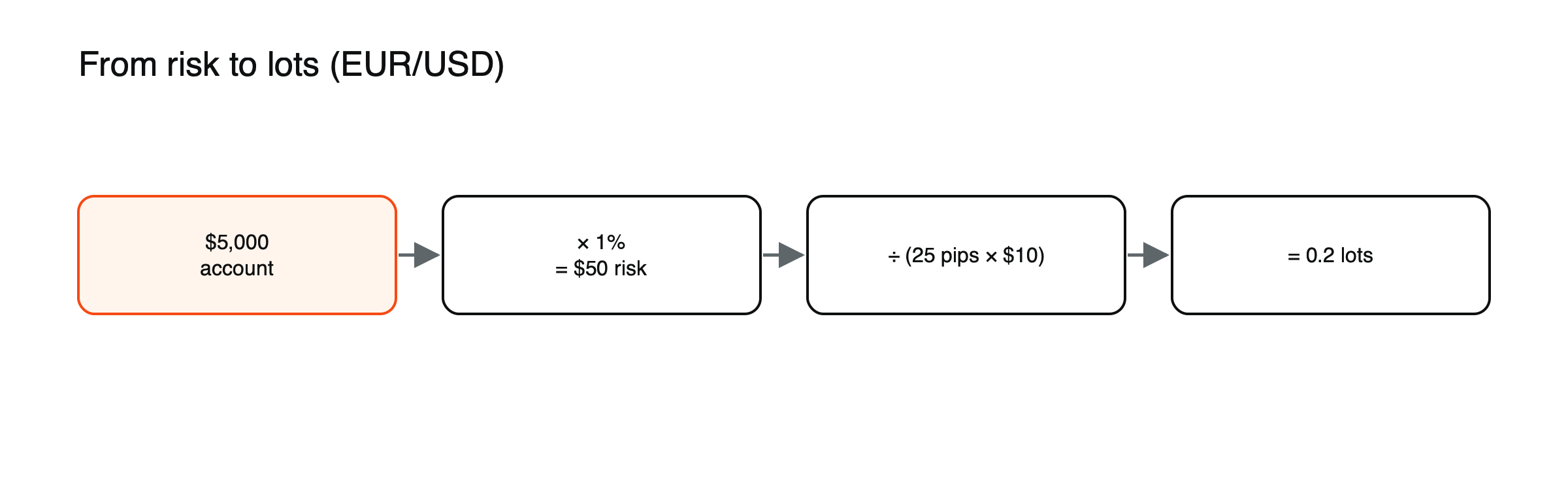
Figure: Sizing from risk (example values).
If the stop is hit, the loss is 0.2 × 25 × $10 = $50, exactly the planned risk, before spread and slippage.
Worked example 2: USD/JPY
On pairs quoted in yen, one pip is 0.01 yen, so a standard lot moves 1,000 yen per pip. At USD/JPY 150, that is about $6.67 per pip.
- Same $50 risk; stop 40 pips
- Lots = 50 ÷ (40 × 6.67) ≈ 0.1875, rounded down to 0.18 lots
- Loss if stopped: 0.18 × 40 × 6.67 ≈ $48
Always round down, never up, so the actual risk stays at or below your limit. (Example values.)
Worked example 3: an account in euros
If your account is in euros, convert the pip value. At EUR/USD 1.0850, $10 is about €9.22.
- Risk €50; EUR/USD stop 25 pips
- Lots = 50 ÷ (25 × 9.22) ≈ 0.217, rounded down to 0.21 lots
The position is slightly larger than in the dollar example because each pip is worth less in euros.
Worked example 4: a cross pair
On a pair where neither currency is your account currency, convert the pip value through the quote currency. On EUR/GBP, a pip is worth £10 per standard lot; at GBP/USD 1.2700, that is $12.70.
- Risk $50; stop 30 pips
- Lots = 50 ÷ (30 × 12.70) ≈ 0.131, rounded down to 0.13 lots
- Loss if stopped: 0.13 × 30 × 12.70 ≈ $49.53
Choosing your risk percentage
Many traders risk between 0.5% and 2% of the account per trade. The reason is how losing streaks compound:
| Risk per trade | Drawdown after 10 losses in a row |
|---|---|
| 1% | 9.6% |
| 2% | 18.3% |
| 5% | 40.1% |
A 40% drawdown needs a 67% gain just to get back to the starting balance. Small, fixed risk keeps a normal losing streak survivable.
Why the stop decides the size
The stop belongs where your trade idea is proven wrong, not at a distance that happens to fit a convenient size. Size then adjusts to the stop:
| Stop distance (EUR/USD) | Lots for $50 risk |
|---|---|
| 12.5 pips | 0.4 |
| 25 pips | 0.2 |
| 50 pips | 0.1 |
| 100 pips | 0.05 |
A wider stop, often needed in volatile markets, means a smaller position for the same risk. Many traders base stop distances on a measure of recent volatility, such as the average daily range, so that normal fluctuations do not trigger them.
Check the margin as well
Position size from risk and margin are separate checks. At 30:1 leverage, 0.2 lots of EUR/USD at 1.0850 needs about $723 of margin, about 14% of a $5,000 account. That leaves plenty of free margin. If the calculation ever produces a position whose margin would use most of your account, the stop is too tight or the risk percentage too high. See how to calculate the margin for a CFD trade.
Sizing several trades at once
When more than one trade is open, risk adds up. Two positions each risking 1% on pairs that tend to move together, such as EUR/USD and GBP/USD, behave much like one position risking 2%. Many traders set a cap on total open risk, such as 3% to 5% of the account, and size new trades to fit within whatever room remains. See currency correlation.
A short routine before each trade
Write the entry and the stop, measure the stop in pips, look up the pip value in your account currency, calculate the size from your risk amount and round down to the broker’s step. Then check the margin and the total risk across open trades. Done in that order, the routine takes a minute and prevents most sizing mistakes.
When the calculated size feels too small
Sizing by risk often produces positions that feel disappointingly small, especially on small accounts or with wide stops. That feeling is the calculation doing its job. Increasing the size to make a trade feel worthwhile raises the loss if the stop is hit, which is exactly the risk the calculation was meant to control. A better answer is a setup with a tighter, still sensible stop, or patience while the account grows.
Recording the calculation
Writing the account balance, risk amount, stop distance, pip value and resulting size in a trading journal for each trade makes it easy to check later whether sizing rules were followed. Over time, the record shows whether actual losses matched planned ones, and where gaps or slippage made them larger. See how to keep a trading journal. Consistent sizing across many trades matters far more than getting the size of any single trade exactly right.
Limits of the calculation
- Slippage and gaps: in fast markets a stop can fill beyond its level, so the real loss can exceed the planned risk. In January 2015, stops on EUR/CHF filled hundreds of pips away. See what happened when the Swiss franc floor was removed.
- Spread: the spread is paid on entry, so the loss at the stop is slightly larger than the calculation.
- Correlated trades: two positions on pairs that move together, such as EUR/USD and GBP/USD, act like one larger position. Size them as a combined risk. See currency correlation.
- Changing pip values: for pairs not quoted in your account currency, pip value moves with exchange rates, so recalculate before each trade.
See how the forex market works, how leverage changes the math on a forex trade and how to size a CFD position using risk per trade.
Leverage, margin and cost figures in this article are example values for illustration. Actual terms depend on the provider, the instrument and the rules in your country.
This article is educational content and does not constitute financial, investment, legal or tax advice. Digital assets are volatile and you may lose the amount you invest.