
Common Forex Trading Mistakes and What to Do Instead
Seven common forex trading mistakes traced to their root causes with a why-chain: leverage, no stop, news chasing, costs, revenge trades, correlation, no plan.
The most common forex trading mistakes are using too much leverage, trading without a stop-loss, jumping into every news spike, ignoring spreads and rollover, revenge trading after losses, holding several positions that are really one bet and trading without a plan. Asking “why?” behind each one shows they come from a few shared roots.
Looking past the symptom
Most lists of trading mistakes stop at the symptom: “too much leverage,” “no stop.” Fixing symptoms one by one rarely lasts, because the cause that produced them is still there. A simple technique borrowed from engineering helps: keep asking why a mistake happened until the answer is something you can change directly. The sections below apply it to each common mistake. The reasoning chains are typical rather than universal, and your own answers may differ.
Too much leverage
- Symptom: a normal 1% move takes a large share of the account.
- Why? Position sizes were chosen by what the broker allowed.
- Why? No maximum loss per trade was decided in advance.
- Root cause: risk limits were never written down, so margin became the limit by default.
- Fix at the root: set a fixed risk per trade, such as 1% of equity, and calculate every position from it. See how leverage changes the math on a forex trade.
No stop-loss
- Symptom: a losing trade keeps running until a margin call closes it.
- Why? The trader planned to “watch it” and close manually.
- Why? Deciding where the idea is wrong felt uncomfortable before entering.
- Root cause: trades were entered without an exit plan.
- Fix at the root: no order is placed until the stop level and the reason for it are written down. See how stop-loss orders work.
Chasing news spikes
- Symptom: entries at the worst prices, seconds after a release, followed by reversals.
- Why? The move looked too big to miss.
- Why? There was no decision in advance about how to handle the release.
- Root cause: the economic calendar was not part of the routine.
- Fix at the root: check the week’s high-impact events every Monday and decide beforehand whether to trade, reduce or stay out. See how to prepare for high-impact news.
Ignoring costs
- Symptom: many small winners, yet the account drifts lower.
- Why? Spreads and rollover took most of the gains.
- Why? Results were judged on gross pips, not net money.
- Root cause: no record of costs per trade.
- Fix at the root: log spread, commission and rollover on every trade and review net results weekly. See how much the spread costs on a forex trade.
Revenge trading
- Symptom: after a loss, a larger trade taken quickly, often outside the usual setups.
- Why? The urge to win the money back immediately.
- Why? The loss felt personal and unacceptable.
- Root cause: no rule for what happens after losses, so emotion filled the gap.
- Fix at the root: a written daily loss limit, such as two losing trades or 2% of equity, after which trading stops until the next day.
Several positions, one bet
- Symptom: a single dollar move hits most open positions at once.
- Why? EUR/USD, GBP/USD and AUD/USD longs were opened for different reasons.
- Why? Exposure was counted by trade, not by currency.
- Root cause: no overall view of the account’s exposure.
- Fix at the root: total exposure by currency before adding any position, and cap the combined risk. See correlation mistakes that quietly double your forex risk.
No plan
- Symptom: inconsistent decisions, rules that change after every loss.
- Why? Each trade was decided on the spot.
- Why? Nothing was written down to follow.
- Root cause: trading without a plan means every decision is made under pressure.
- Fix at the root: a one-page plan covering pairs, setups, exits, risk and review. See how to build a simple forex trading plan.
Three roots behind seven mistakes
| Root cause | Mistakes it produces |
|---|---|
| No predefined risk limits | Too much leverage, several positions as one bet |
| Decisions made in the moment | No stop-loss, chasing news, revenge trading |
| No record or routine | Ignoring costs, no plan |
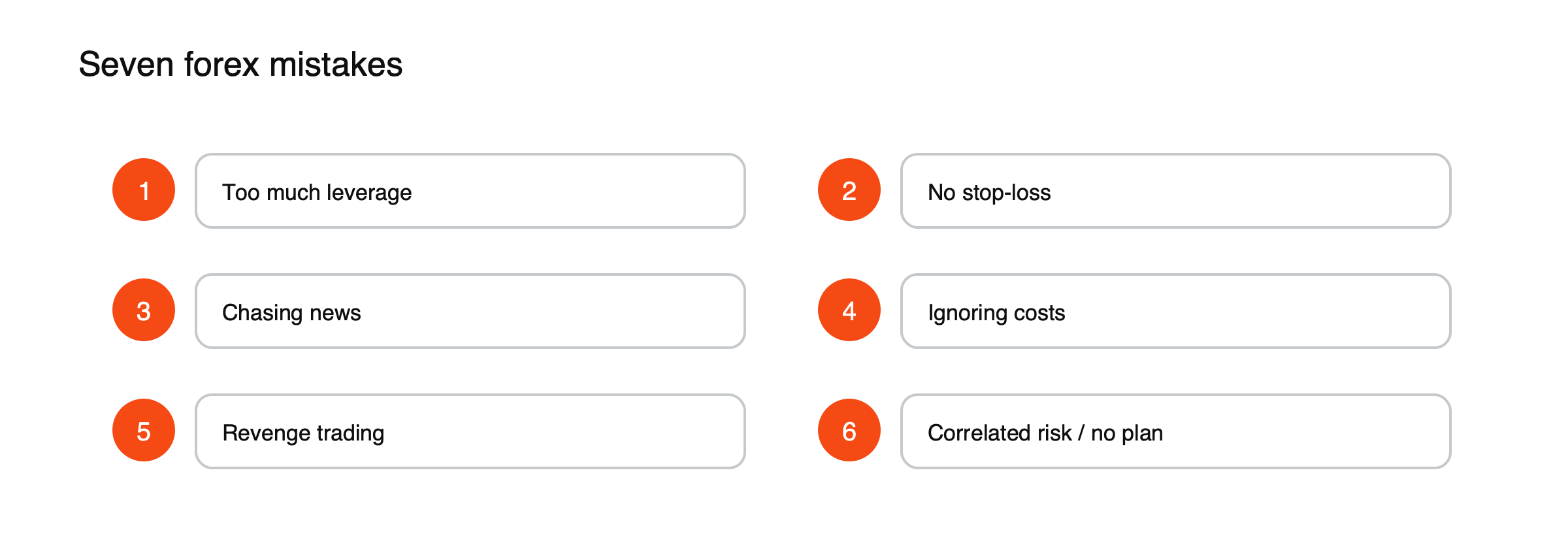
Figure: Seven common forex mistakes.
Fixing the three roots, written limits, decisions made in advance and a routine of recording and reviewing, addresses all seven symptoms at once. That is why experienced traders spend more time on their rules and journal than on finding new setups.
Running the exercise on your own trades
Pick your three worst trades from the last month. For each, write the symptom, then ask why it happened, and why again, until you reach something you could have done differently before the trade began. Most traders find the same one or two roots appearing again and again. Changing those, rather than adding new indicators or strategies, usually has the biggest effect on results. See how to keep a trading journal.
What regulators’ numbers suggest
European regulators found that between 74% and 89% of retail CFD accounts typically lost money, with excessive leverage the main concern. The mistakes above explain much of that figure: most are not about predicting direction but about size, discipline and preparation. See how the forex market works.
One bad week, traced to its roots
Consider a week in which a trader loses 9% of an account. (Illustrative example.) On Monday, a EUR/USD long with no stop drifts 60 pips lower before being closed by hand. On Wednesday, the trader buys GBP/USD seconds after a strong UK release and is caught in a reversal. On Thursday, trying to recover, they double their usual size on AUD/USD, which falls with the other two dollar trades still open. Friday’s review finds three different symptoms, no stop, chasing news and revenge trading plus hidden correlation, but only two roots: no written risk limits and decisions made in the moment. Fixing those two would have prevented most of the week’s losses.
Which root to fix first
If several roots appear, start with risk limits, because they cap the damage from every other mistake. A fixed risk per trade and a daily loss limit turn even poor decisions into small losses. Next comes deciding in advance: a plan, a calendar check and an exit for every trade. Finally, build the routine of recording and reviewing, which shows whether the first two fixes are working and reveals new problems early.
Signs a root cause is returning
- Position sizes creeping up after a few good trades.
- Orders placed before the stop is decided.
- Trades opened in the minutes after a release you had not planned for.
- Skipping journal entries for losing trades.
- Several open positions sharing one currency.
Spotting these early, ideally in the weekly review, allows a correction before the old pattern produces a large loss.
Objections worth answering
“I know my risk without writing it down.” Perhaps on a calm day, but limits kept in your head tend to stretch after losses, exactly when they matter most.
“Stops just get hunted.” Stops placed at obvious levels are often hit; the answer is better placement and smaller size, not no stop at all.
“Reviewing trades takes too long.” A short weekly review of five or ten trades takes under half an hour and often reveals the costliest habit in the whole account.
“My strategy works without a plan.” A strategy is part of a plan, but without rules for size, news and bad days, even a good strategy can be undone by a few impulsive decisions in a single week. Good rules protect the strategy from its trader.
Each objection protects a habit that feels comfortable. Testing the alternative for a month, and comparing results in the journal, usually settles the question.
This article is educational content and does not constitute financial, investment, legal or tax advice. Digital assets are volatile and you may lose the amount you invest.