
How Much Does the Spread Cost on a Forex Trade?
Spread cost = spread in pips × pip value × lots. Worked examples on EUR/USD and GBP/JPY, how spreads change by session and news, and why it adds up.
Forex spread cost is the gap between the buy and sell price, paid on every trade: spread cost = spread in pips × pip value × lots. A 1-pip spread on one standard lot of EUR/USD costs $10; a 3-pip GBP/JPY spread about $20 at USD/JPY 150. A trade must move by the spread to break even.
The formula
Spread cost = spread (pips) × pip value per lot × number of lots
Worked examples (US dollar account)
EUR/USD, 1.0-pip spread, 1 lot: 1 × $10 × 1 = $10.
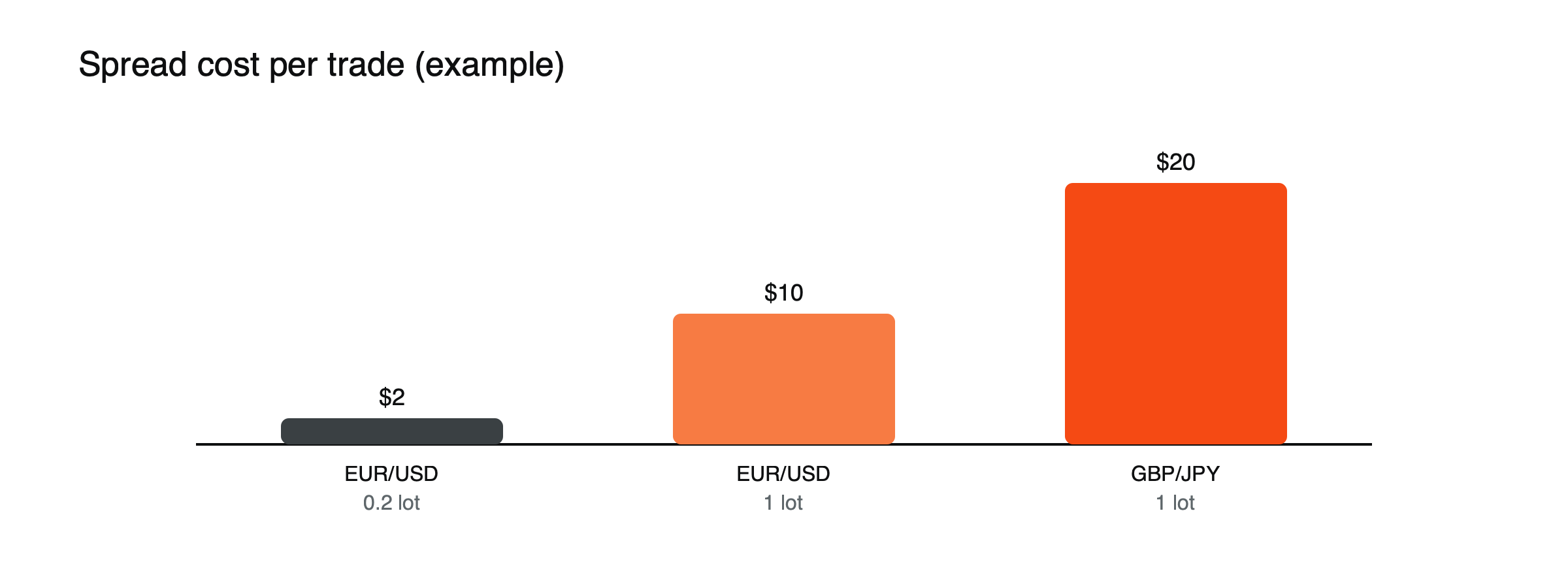
Figure: Spread cost by pair and size (example spreads).
EUR/USD, 1.0-pip spread, 0.2 lots: 1 × $10 × 0.2 = $2.
GBP/JPY, 3-pip spread, 1 lot, USD/JPY at 150: pip value ¥1,000 ÷ 150 = $6.67; cost = 3 × $6.67 = $20.
(Spreads above are example values.)
Spread as a share of your target
A spread matters most relative to what you are trying to make. If you aim for 20 pips with a 1-pip spread, the spread takes 5% of the target. Aim for 50 pips, and the same spread takes 2%. Very short-term strategies, aiming for a few pips, can lose a large share of each gain to the spread, which is why they depend on the tightest spreads available.
Spread-only accounts versus commission accounts
Some accounts charge only through a wider spread; others offer a near-raw spread plus a commission. Suppose account A quotes EUR/USD at a 1.2-pip spread with no commission, while account B quotes 0.1 pips plus $7 per standard lot for the round trip. (Example terms.) On one lot, A costs about $12 and B about $8. The cheaper account depends on your typical size and pairs, so comparing the total cost per round trip, not the headline spread, gives the right answer.
Why spreads change
- Session: spreads are usually tightest when London and New York overlap and widest in quiet hours. See forex trading sessions.
- News: spreads widen around major data releases and central bank decisions.
- Pair: majors are cheapest; exotics far more expensive. See major, minor and exotic currency pairs.
What a news spike can cost
Suppose EUR/USD normally trades with a 0.6-pip spread, but in the seconds around a major data release it widens to 2 pips. A one-lot trade entered at that moment pays about $20 in spread instead of $6, and stops or limit orders can fill at prices that reflect the wider quote. (Example figures.) Waiting a few minutes for spreads to settle is often the cheapest decision a trader can make around news. See what spread widening is.
Why it matters
For a trader making 10 one-lot EUR/USD trades a day at a 1-pip spread, spreads alone cost about $100 a day. Short-term strategies need moves well beyond the spread to be worthwhile.
Other costs. Commissions on some accounts and overnight rollover for positions held past 5 p.m. New York time. See what forex rollover is and what a CFD trade really costs. For pip values, see how to calculate pip value and how the forex market works.
Keeping spread costs down
- Trade major pairs during their busiest hours, when spreads are tightest.
- Avoid entering or exiting in the minutes around scheduled news unless the strategy depends on it.
- Use limit orders where practical, so you choose the price.
- Compare total cost per round trip across account types, including commission.
- Trade less often; the cheapest spread is the one you do not pay.
Spread costs on exotic pairs
Exotic pairs, which combine a major currency with that of a smaller economy, can carry spreads many times wider than majors, sometimes tens of pips, and these widen further in stress. A trade that would be cheap on EUR/USD can cost a meaningful share of the expected move on an exotic pair, so the potential move needs to be larger to justify it.
A month of spread costs
Suppose a trader opens and closes three one-lot EUR/USD trades a day, paying a 1-pip spread, about $10, each time. Over 21 trading days, spreads cost about $630. Trading 0.3 lots instead would cut that to about $189, and trading half as often would halve it again. (Illustrative figures.) For active traders, size and frequency usually matter more than small differences in quoted spreads.
How spreads are set
Brokers receive prices from banks and other liquidity providers and quote their own bid and ask, often adding a markup. Variable spreads follow market conditions, tight in busy markets and wider in quiet or volatile ones. Fixed spreads stay the same in normal conditions but are usually wider on average and may still be adjusted in extreme markets. Knowing which model an account uses explains why the cost of the same trade can change from hour to hour.
Measuring what you actually pay
The quoted spread is only part of the story. Comparing your fill prices with the quotes you saw when placing orders, over a few weeks, shows whether slippage adds to the cost. Trade history exports from most platforms make this easy to check, and it turns the advertised spread into a measured one.
Spreads on crosses
Cross pairs, which exclude the dollar, are often priced by combining two dollar pairs, so their spreads tend to be wider than on majors. EUR/GBP and EUR/JPY are usually tight because they are heavily traded, while less common crosses can cost several times as much. Checking the spread on each cross before trading it avoids unpleasant surprises. A cross that costs three pips to trade needs a correspondingly larger move to cover its spread than a major pair does.
Questions to ask about an account’s spreads
- Are spreads fixed or variable, and what are the typical figures at the hours I trade?
- Is there a commission, and how is it charged?
- How do spreads behave around major news and the daily rollover?
- Does the broker publish average spreads by pair?
- How is slippage handled, in both price directions?
Frequently asked questions
Is the spread paid when opening or closing?
Effectively once per round trip. You buy at the higher ask and sell at the lower bid, so the gap between them is the cost, whether you think of it as paid on entry or exit.
Do brokers make money from the spread?
Many do, especially on spread-only accounts, where the quoted spread includes the broker’s markup over its own prices. Commission accounts usually show tighter spreads and charge separately.
Leverage, margin and cost figures in this article are example values for illustration. Actual terms depend on the provider, the instrument and the rules in your country.
This article is educational content and does not constitute financial, investment, legal or tax advice. Digital assets are volatile and you may lose the amount you invest.