
How to Read a Central Bank Statement
Compare the decision with expectations, look for changed words, read the risks and projections, then listen to the press conference. A step-by-step guide.
To read a central bank statement, compare the decision with what markets expected, set the new text beside the previous statement to spot changed words, read how policymakers describe inflation, growth and risks, check any new projections, and then follow the press conference. Markets react to changes in the outlook, not to the decision alone.
Before you start
Note what markets expect: most outcomes are priced in advance. Have the previous statement open for comparison. See what markets listen for in a central bank meeting.
Reading it, piece by piece
Check the decision against expectations
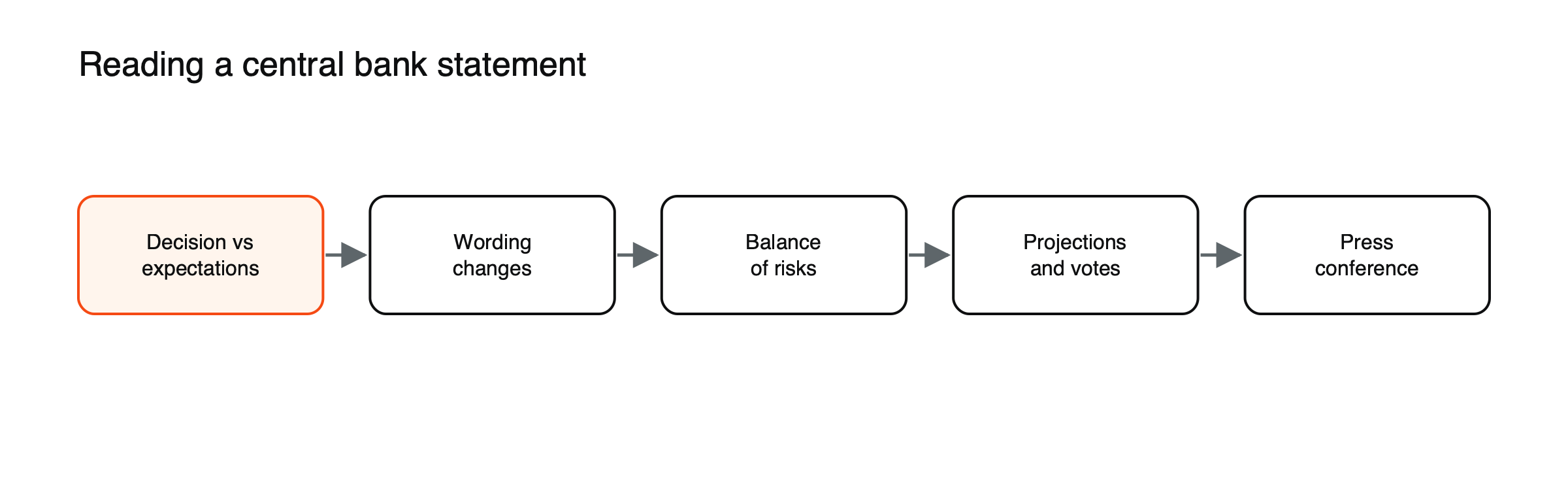
Figure: Reading a statement in five steps.
A hold that markets expected moves little; a surprise move or a different size of move moves a lot.
Compare the wording with the last statement
Look for added or removed words about inflation, jobs and future policy. A single changed phrase can signal a shift.
Read the balance of risks
Is the bank more worried about inflation or about growth? More concern about inflation is hawkish; more about growth is dovish. See hawkish vs dovish.
Check projections and votes
Where published, projections for rates, inflation and growth, and any dissenting votes, show how much agreement there is.
Follow the press conference
The tone of answers often moves markets more than the statement. First reactions can reverse.
A comparison, illustrated
Here is how two consecutive statements might differ. (Illustrative wording.)
| Previous statement | New statement | Likely reading |
|---|---|---|
| “Inflation remains elevated” | “Inflation has eased but remains above target” | Slightly dovish |
| “Further tightening may be appropriate” | “The committee will assess incoming data” | Dovish: hiking bias removed |
| “Labor market remains tight” | “Labor market has cooled” | Dovish |
| Vote 9–0 | Vote 7–2, two members favoring a cut | Dovish |
None of the changes involves the interest rate itself, yet together they tell markets that a cut is moving closer, and the currency would likely weaken.
Where to find the documents
Central banks publish statements, projections and press conference transcripts on their websites as soon as decisions are announced, and minutes or accounts of the meeting a few weeks later. Many also publish a version showing changes from the previous statement, which saves time. Reading the original rather than relying only on headlines avoids misinterpretations, since headlines often focus on the decision rather than the guidance.
The minutes, weeks later
Minutes or accounts describe the debate behind a decision: which arguments were made, how many members held each view and what would change their minds. A decision that looked unanimous can turn out to have hidden disagreements, and markets sometimes move again when the minutes reveal a more hawkish or dovish discussion than the statement suggested.
After the statement
Watch short-term bond yields and the currency together to see how markets read it. See how central bank decisions move currencies and what moves currency prices.
Phrases worth underlining
- References to inflation being “persistent,” “sticky” or “easing.”
- Words about the labor market, such as “tight,” “cooling” or “softening.”
- Any mention of “further” moves or of being “patient.”
- Comments on financial conditions, the currency or global risks.
- Changes in how the bank describes the outlook for growth.
Separating signal from noise
Not every changed word matters. Statements are edited for style as well as substance, and some changes simply update facts. A useful test is whether the change affects how many rate moves the market should expect, and when. If it does, it is signal; if not, it is probably noise. Watching how two-year yields react helps confirm which changes the market considers important.
Common misreadings
- Reading the decision headline without the guidance.
- Treating every small wording change as a signal.
- Judging the reaction in the first minute, before the press conference.
How a statement is usually structured
Most policy statements follow a similar order. They open with an assessment of the economy, then describe inflation and the labor market, state the decision, explain the reasoning and end with guidance about what could come next. Some list how members voted. Because the structure rarely changes, differences stand out when the statements are placed side by side, and the guidance section near the end is usually where the most important changes appear.
How the major central banks publish
| Central bank | Main documents on decision day |
|---|---|
| Federal Reserve | Statement, press conference and, at some meetings, economic projections including officials’ rate forecasts |
| European Central Bank | Monetary policy statement, press conference and, at some meetings, staff projections |
| Bank of England | Policy summary and minutes with the vote split, and quarterly forecasts |
| Bank of Japan | Statement, press conference and, quarterly, an outlook report |
Knowing which documents arrive when helps decide what to read first.
Reading the press conference
In the question-and-answer session, the chair often clarifies points left vague in the statement. Answers to questions about the timing of the next move, the risks to inflation or the strength of the labor market are the most closely watched. A confident tone about inflation falling can be read as dovish even if the statement was neutral, and a warning about persistent price pressures can be read as hawkish. Transcripts or live summaries help catch the exact wording.
Machines read statements too
Many trading firms use software that scans statements within milliseconds, comparing words with previous versions and with lists of hawkish and dovish phrases. That is why the first price move often happens before a human could finish the first paragraph. Retail traders cannot compete on speed and do better by reading carefully and judging whether the first reaction makes sense once the details are clear.
A five-minute routine
Read the decision and compare it with expectations. Scan the changes from the previous statement, focusing on the guidance paragraph. Check the projections and votes if published. Note how two-year yields and the currency have reacted. Then decide whether to wait for the press conference before acting. Repeating the same routine at every meeting makes it quicker and more reliable over time.
Practicing on past statements
Central banks keep archives of past statements. Reading a sequence from a period you remember, such as the start of a hiking or cutting cycle, and noting where the wording first shifted, is an effective way to learn which changes matter and how far ahead they signalled the next move.
A statement read from start to finish
Suppose the ECB holds rates, as expected. (Illustrative scenario.) The opening paragraph still describes inflation as above target, but adds that it is expected to fall toward 2% next year. The labor market is described as “resilient” rather than “tight.” The guidance drops the phrase about keeping rates restrictive “for as long as necessary” and says decisions will be taken meeting by meeting. Staff projections lower next year’s inflation forecast slightly. In the press conference, the president says a cut was not discussed but that the bank is “open” to adjusting policy if the outlook continues to improve.
Put together, every element points in the same dovish direction, even though the rate did not change. Short-term euro yields fall, and EUR/USD drifts lower through the press conference. A trader who read only the decision headline would have seen nothing new; one who compared the text, the projections and the press conference would have understood the move as it happened. The habit of reading all three pieces, every time, is what turns a statement from noise into information. Over several meetings in a row, this routine also shows how a central bank’s language evolves ahead of policy changes, which is often the very clearest early signal of a turning point in interest rates and in the currency itself.
Frequently asked questions
How long does it take to read a statement?
A few minutes, if you compare it with the previous one. Most statements are short, and the important changes are usually in a handful of sentences.
Why do markets sometimes reverse after the press conference?
Because the chair’s answers can soften or harden the message of the statement, changing how markets read the overall stance.
This article is educational content and does not constitute financial, investment, legal or tax advice. Digital assets are volatile and you may lose the amount you invest.