
What Was the Plaza Accord and Why Does It Still Come Up?
In September 1985, five major economies agreed to push the dollar down, and it fell about 40% in two years. What the Plaza Accord did and why it is still cited.
The Plaza Accord was a September 22, 1985 agreement among the US, Japan, West Germany, France and the UK to push the dollar down through coordinated intervention. The dollar had risen about 44% in five years; over 1985–87 it fell about 40%, and the yen rose from about 240 to 150 per dollar. It is still cited in currency debates.
Who took part
Finance ministers and central bank governors of the G5: the United States, Japan, West Germany, France and the United Kingdom. The ministers were James Baker of the United States, who called the meeting, Noboru Takeshita of Japan, Gerhard Stoltenberg of West Germany, Pierre Bérégovoy of France and Nigel Lawson of the United Kingdom. The meeting took place on a Sunday at the Plaza Hotel in New York, and its timing was a surprise to markets.
Before the accord
- 1980–1985: high US interest rates drive the dollar up; the US trade deficit widens and protectionist pressure grows.
- February 1985: the dollar peaks; the DXY reaches a record near 164.
Why the strong dollar became a political problem
In the early 1980s the Federal Reserve kept interest rates very high to defeat inflation, while US government borrowing rose. High returns drew capital into dollars, and the currency climbed steadily. American exporters and manufacturers found themselves priced out of world markets, the trade deficit widened and Congress began considering protectionist measures against imports. A new Treasury team under James Baker, which took office in early 1985, was more willing than its predecessor to act on the exchange rate.
The dollar was already wobbling
The dollar had begun to slip after its February 1985 peak. By late August it had fallen about 21% against the Deutsche Mark, to around DM 2.75, and about 10% against the yen, to around ¥236. In the weeks before the meeting it bounced back, to roughly DM 2.91 and ¥242.5 by September 19. The accord therefore did not reverse a rising trend from scratch; it gave a decisive push to a move that markets had already started to consider.
After the accord
- September 22, 1985: G5 ministers meet at New York’s Plaza Hotel and announce that the dollar should fall.
- Following Monday: the dollar falls about 4% against the other currencies.
- 1985–1987: coordinated intervention and policy shifts continue; the dollar falls about 40%.
- February 1987: the Louvre Accord tries to halt the slide, judging the dollar had fallen far enough.
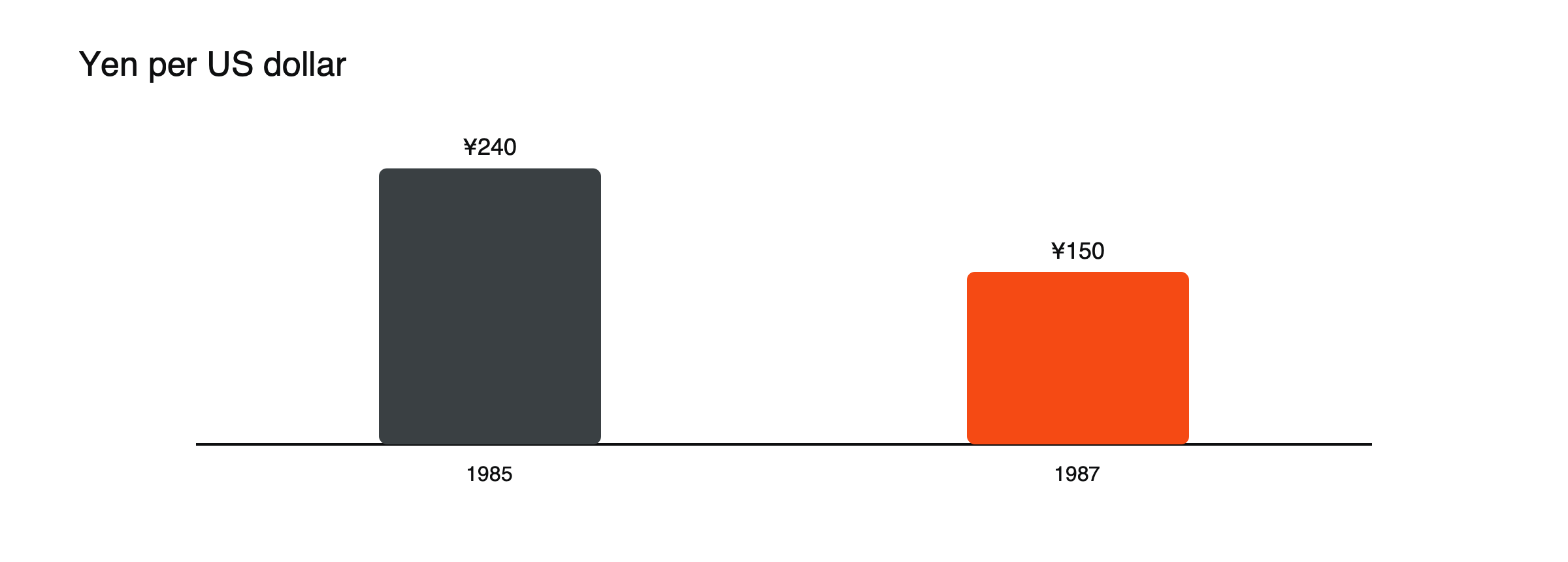
Figure: The yen’s rise after the Plaza Accord.
How much was actually spent
The intervention was smaller than the result might suggest. According to a later study by the economist Takatoshi Ito, total coordinated sales of dollars in the following weeks came to about $10.2 billion, less than the roughly $18 billion that officials had thought might be needed. The United States sold about $3.2 billion, Japan about $3.0 billion, Germany, France and the UK together about $2 billion and other G10 countries about $2 billion. The stated aim of a further 10% to 12% decline in the dollar was reached on schedule.
The yen kept rising
Japanese officials reportedly hoped the yen would strengthen to about ¥200 per dollar. It went much further. The yen reached about ¥150 by 1987 and around ¥120 by the start of 1988, despite the Louvre Accord of February 1987, in which the same countries declared that the dollar had fallen far enough. By one academic estimate, a yen that had been about 13% undervalued in 1985 was about 28% overvalued by 1990.
The dollar and yen, 1985 to 1988
| Date | Yen per dollar, approximately | What was happening |
|---|---|---|
| Late August 1985 | 236 | Dollar already off its February peak |
| September 19, 1985 | 242.5 | Rebound just before the meeting |
| 1987 | 150 | Coordinated policy and intervention |
| Early 1988 | 120 | Yen still rising after the Louvre Accord |
The yen roughly doubled in value against the dollar in little more than two years, a move that reshaped Japanese industry and investment for a generation. Few exchange-rate agreements before or since have moved a major currency so far, so quickly, with so little money spent by the governments involved.
Why it worked
Markets were already questioning the dollar’s strength, the announcement was a clear joint signal and the US changed its policy stance. Coordinated action by major central banks is harder for markets to fight than one country alone.
Why it still comes up
Proposals for a “new Plaza Accord” appear whenever the dollar looks overvalued or trade imbalances widen. Japan’s experience, a sharply stronger yen followed by asset bubbles and later stagnation, is often cited as a warning.
Japan’s bubble and the long hangover
To cushion the blow of a much stronger yen on exporters, Japan kept monetary policy loose. Easy money fed a boom in shares and property: the Nikkei 225, below 12,000 points when the accord was signed, reached its all-time high of about 38,957 on December 29, 1989. When the bubble burst in the early 1990s, Japan entered a long period of weak growth and falling prices often called the “lost decades.” Economists still debate how much blame the Plaza Accord deserves, since domestic policy choices played a large part, but the episode is a standard warning about the side effects of large, rapid currency adjustments.
The Louvre Accord and its limits
The Louvre Accord of February 22, 1987, tried to stabilize currencies at their new levels, with informal ranges for the dollar. It proved harder to enforce than the Plaza deal. Intervention was needed in the spring of 1987 to support the dollar, and the governments involved argued publicly over who should adjust policy. Agreeing to stop a currency’s move turned out to be much harder than agreeing to start one.
Lessons
Currency policy works best when it goes with market forces and is backed by policy changes. See what currency intervention is, what the US Dollar Index is and what moves currency prices.
What it means for traders today
Coordinated action by several major central banks is rare, but when it happens it tends to be powerful, because it combines money, policy signals and political commitment. The Plaza Accord also shows that intervention works best when it pushes in a direction markets already find plausible; the dollar was overvalued and had begun to turn. For traders, talk of a “new Plaza Accord” is worth watching mainly as a signal about policymakers’ tolerance for a strong dollar. Single-country intervention against a strong trend, by contrast, has a much weaker record. See what currency intervention is and what moves USD/JPY.
Frequently asked questions
Why is it called the Plaza Accord?
Because the agreement was reached at the Plaza Hotel in New York City on September 22, 1985.
Was China part of the Plaza Accord?
No. The participants were the United States, Japan, West Germany, France and the United Kingdom. Proposals for a new accord involving China’s currency are sometimes discussed, but China was not part of the original G5 framework.
This article is educational content and does not constitute financial, investment, legal or tax advice. Digital assets are volatile and you may lose the amount you invest.
Sources
- The Plaza Accord, 30 years later (dollar up 44% in five years; fell 40% in 1985–87; Louvre February 1987) — Jeffrey Frankel, NBER Working Paper
- Plaza Accord (signed September 22, 1985; dollar fell 4% the following Monday) — Wikipedia
- The Plaza Accord of 1985 (yen from 240 to 150 per dollar by 1987) — TradingView idea
- The US Dollar Index (high near 164.7 in February 1985) — Fin Still
- The Plaza Agreement and Japan: reflection on the 30th year anniversary (coordinated intervention of about $10.2 billion; US $3.2 billion, Japan $3.0 billion) — Takatoshi Ito, Baker Institute working paper, 2015
- Looking back at the Plaza and Louvre currency accords (dollar down 21% against the mark and 10% against the yen by August 1985; ministers present; Louvre February 22, 1987) — Currency Thoughts, 2010
- Japan forfeits 30 years to the gyrations of the yen (aim of about ¥200; ¥120 by early 1988; undervalued 13% in 1985, overvalued 28% in 1990) — Nippon.com
- The Plaza-Louvre in retrospect (10–12% dollar decline achieved on time) — Peterson Institute for International Economics
- The world’s biggest bubble (Nikkei below 12,000 at signing; all-time high 38,957.44 on December 29, 1989) — Andrew Teasdale