
Why USD/CAD Moves With Oil Prices
USD/CAD has tended to fall when oil rises, as Canada exports oil to the US. Why the link exists, why it has broken down and what else drives the loonie.

USD/CAD has tended to fall when oil prices rise, because Canada is a major oil exporter and the United States has long been its biggest customer. Higher oil means more US dollars converted into Canadian dollars, strengthening the “loonie.” But the link is inconsistent: the correlation has collapsed several times, as interest rates and risk sentiment took over.
Why the link exists
Rising oil prices boost Canada’s export revenue and trade balance. US importers sell dollars to pay for Canadian oil, and investors often treat the Canadian dollar as a proxy for oil. In 2010, the correlation between oil and the Canadian dollar reached about 0.76.
What a correlation of 0.76 means
A correlation measures how consistently two prices move together, from +1, always in step, to −1, always opposite. A reading of about 0.76 between oil and the Canadian dollar, as seen around 2010, means the two moved together most of the time, though not always. A reading near −0.1, as briefly seen in early 2011, means there was effectively no reliable relationship. The same pair of markets can swing between those extremes, which is why a correlation measured over one period is a weak basis for trading in the next. See how currency correlations work.
Why it breaks down
- Rates take over: in 2017, the Canadian dollar followed Bank of Canada rate hikes more than oil.
- Flows are small relative to trading: oil exports are a tiny fraction of daily Canadian dollar turnover.
- US production: as the US produced more of its own oil, Canadian oil became less central to the US trade balance.
- Risk sentiment: the Canadian dollar also behaves as a risk currency.
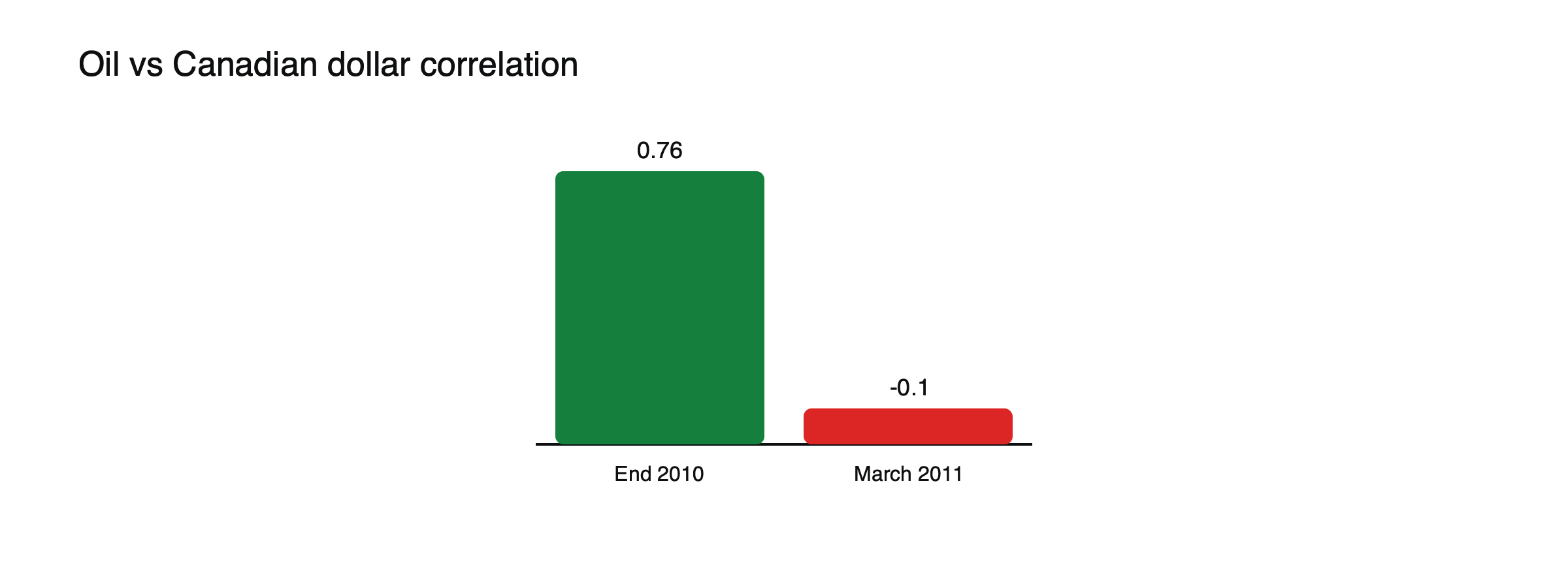
Figure: How quickly the oil link can collapse. Source: The Globe and Mail citing Brown Brothers Harriman.
In early 2011, the correlation briefly turned negative, at about −0.1.
Which oil price matters
Much Canadian crude is heavier oil sold at a discount to the US benchmark, and pipeline limits have at times made that discount very wide. When the gap widens, Canadian producers earn less than headline oil prices suggest, weakening the link between benchmark oil and the Canadian dollar. Traders who follow only the headline price can miss that part of the story.
Other drivers
Bank of Canada vs Fed policy, Canadian jobs and inflation data, and the US economy, which takes most of Canada’s exports.
The rate gap with the Federal Reserve
Suppose the Bank of Canada is expected to cut its policy rate to 3% while the Federal Reserve holds near 4.5%. (Illustrative rates.) Holding US dollars pays more than holding Canadian dollars, and USD/CAD tends to rise even if oil is firm. If Canadian inflation then surprises higher and cuts are priced out, the Canadian dollar can recover quickly. In many years, the two central banks’ relative paths have explained more of USD/CAD’s moves than oil has.
Risk appetite and the loonie
The Canadian dollar also behaves as a moderately risk-sensitive currency. In global sell-offs, investors tend to buy US dollars, so USD/CAD often rises when stocks fall, sometimes alongside falling oil prices, which reinforces the move. In calm, optimistic markets, the loonie tends to firm. That overlap between oil and risk appetite can make the oil link look stronger than it really is.
The USD/CAD data calendar
| Release | Why it matters |
|---|---|
| Canadian labour force survey | Jobs and wages, often released the same day as US jobs data |
| Canadian consumer price inflation | Shapes Bank of Canada expectations |
| Bank of Canada decisions | Set the Canadian side of the rate gap |
| US jobs and inflation data | Move the dollar side of the pair |
| Oil inventory reports and producer decisions | Influence oil prices |
What to watch
Oil prices alongside Bank of Canada meetings, US and Canadian data, and global risk appetite. Treat oil as one input, not a rule. See what moves currency prices, how currency correlations work and why the Australian dollar tracks China and commodities.
Practical notes for trading USD/CAD
USD/CAD is a major pair with good liquidity, most active during North American hours. Because the Canadian dollar is the quote currency, a pip on one standard lot is worth 10 Canadian dollars, about $7.35 at a rate of 1.36. Both currencies are among those treated as major under EU retail rules, so leverage is capped at 30:1. Since US and Canadian jobs data often arrive at the same moment, the pair can make sharp moves when the two reports surprise in opposite directions. See how to calculate pip value.
Canada’s economy beyond oil
Energy is important to Canada, but it is not the whole economy. Manufacturing, mining, forestry, agriculture and a large services sector all matter, and the United States buys most of Canada’s exports across all of them. Strong US demand therefore tends to support the Canadian dollar regardless of oil prices, while a US slowdown weighs on it. Housing and household debt also shape the Bank of Canada’s thinking, much as they do in Australia.
Trade policy and the loonie
Because so much Canadian trade goes to the United States, disputes over tariffs and trade agreements can move the Canadian dollar sharply. Threats of new tariffs raise the risk of slower Canadian growth and earlier rate cuts, and the currency tends to weaken on such headlines. Resolution of disputes can bring quick relief rallies. In those periods, trade news can dominate both oil and interest rates as a driver of USD/CAD.
Drivers in conflict, illustrated
Suppose oil rises 10% over a month on supply worries, which would normally support the Canadian dollar, while the Bank of Canada signals rate cuts because domestic growth is weak. (Illustrative scenario.) USD/CAD might barely move, or even rise, as the rate signal outweighs oil. A trader who bought the Canadian dollar purely on the oil move would be disappointed. Checking which driver the market is responding to, by seeing whether the pair has reacted to recent oil moves at all, avoids that trap.
The broad dollar and USD/CAD
USD/CAD also moves with the US dollar’s overall direction. When the dollar is strengthening against most currencies, perhaps on strong US data, USD/CAD usually rises too, even if Canadian news is neutral. Comparing the pair’s move with the dollar index helps show whether a change is about Canada or about the dollar. See also what the US Dollar Index is.
A quick USD/CAD checklist
- What did oil do recently, and did the pair react?
- What are markets expecting from the Bank of Canada and the Fed?
- Are trade headlines in play?
- Is the US dollar moving broadly against other currencies?
- Are Canadian and US jobs data due at the same time?
Common misreadings
- Treating USD/CAD as an oil trade with a currency label.
- Ignoring the Canadian jobs report because it lands at the same time as the US one.
- Assuming a correlation measured last year still holds.
Frequently asked questions
Why is the Canadian dollar called the loonie?
Because the Canadian one-dollar coin features a loon, a bird common in Canada.
If oil rises, should USD/CAD always fall?
No. Rising oil tends to support the Canadian dollar, but interest rate expectations, US dollar strength and risk sentiment can easily outweigh it.
This article is educational content and does not constitute financial, investment, legal or tax advice. Digital assets are volatile and you may lose the amount you invest.
Sources
- Oil-forex correlations (USD/CAD traditionally negatively correlated with oil; inconsistent) — City Index
- Loonie no longer a petro-dollar, report says (correlation peaked near 0.76, then −0.1; oil exports small relative to CAD turnover) — The Globe and Mail, March 2011
- Why the relationship between oil and the Canadian dollar broke down (US biggest customer; 2017 BoC hikes) — Pound Sterling Live
- Loonie outlook (relationship weaker since about 2012; CAD as a risk proxy) — RBC Wealth Management