
What Is a Pip?
A pip is the standard unit of price movement in a currency pair: 0.0001 for most pairs, 0.01 for yen pairs. What pips and pipettes are and what they are worth.
A pip is the standard unit for measuring how much a currency pair’s price changes. For most pairs it is the fourth decimal place, 0.0001; for pairs quoted in Japanese yen it is the second decimal place, 0.01. If EUR/USD moves from 1.1000 to 1.1025, it has moved 25 pips. Many brokers also quote a fifth decimal, called a pipette.
Pips by pair
| Pair | One pip | Example move |
|---|---|---|
| EUR/USD | 0.0001 | 1.1000 → 1.1025 = 25 pips |
| GBP/USD | 0.0001 | 1.2700 → 1.2650 = 50 pips |
| USD/JPY | 0.01 | 150.00 → 150.40 = 40 pips |
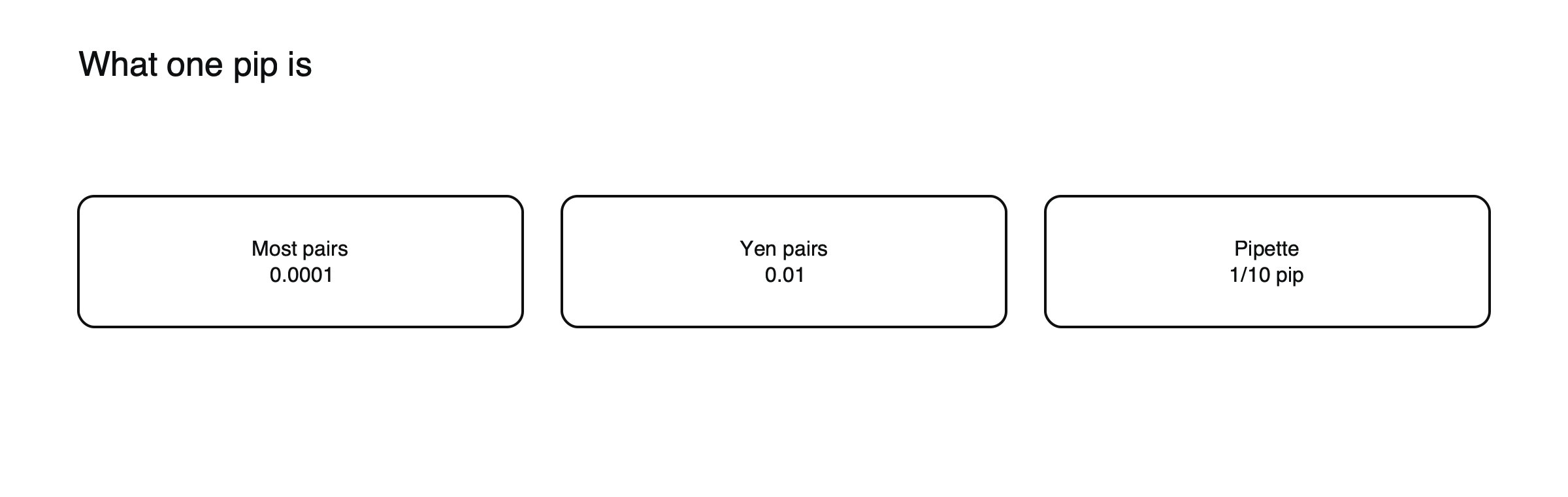
Figure: Pip and pipette sizes.
Counting pips in a trade
- Long GBP/USD from 1.2700 to 1.2765: a gain of 65 pips.
- Short USD/JPY from 150.20 to 149.75: a gain of 45 pips, since the price fell by 0.45 and a yen pip is 0.01.
- Long EUR/USD from 1.1000 to 1.0960: a loss of 40 pips.
Pips make moves comparable across pairs with very different prices, which is why traders talk about stops, targets and spreads in pips rather than in price units.
Pipettes
A pipette is one tenth of a pip: the fifth decimal place for most pairs (0.00001) or the third for yen pairs (0.001). A quote of 1.10253 has 2.5 pips more than 1.10228.
Why pips exist
Exchange rates move in tiny fractions. Quoting every change as 0.0001 or 0.00025 would be clumsy, so the market counts in pips, a fixed unit for each pair. A trader can say a pair moved 80 pips or that a spread is 1.2 pips, and anyone familiar with the market knows roughly what that means, regardless of the pair’s price.
Pips, points and percentages
A pip is not a percentage. Fifty pips on EUR/USD at 1.1000 is about 0.45% of the price, while 50 pips on a pair trading near 0.6500 is a larger percentage move. Index CFDs and commodities are usually measured in points or price units rather than pips. Comparing moves across markets therefore works best in percentage terms, while pips remain the everyday unit within forex.
Typical moves in pips
How many pips a pair moves in a day varies with the pair and the market mood. Major pairs such as EUR/USD often move several tens of pips on an ordinary day and well over a hundred around major news, while some crosses and exotic pairs regularly move far more. Knowing a pair’s typical daily range in pips helps set stops that are not hit by normal noise. See the most volatile currency pairs.
From pips to money
A pip’s cash value depends on the position size and the pair. On one standard lot of EUR/USD (100,000 euros), one pip is worth $10; on a micro lot (1,000), $0.10. See how to calculate pip value on any currency pair and how lot size changes your risk per pip.
Why traders use pips. Pips let traders compare moves, spreads and stop distances across pairs regardless of price level. A 1-pip spread on EUR/USD and a 3-pip spread on GBP/JPY can be compared directly before converting to money.
Beyond currencies. CFDs on indices and commodities use “points” instead, with their own values per point. For the basics, read what a currency pair is and how the forex market works.
Pips and the spread
Spreads on major pairs are usually quoted in pips or fractions of a pip, for example 0.8 pips on EUR/USD in busy hours. A trade must move at least the spread in your favor before it breaks even, so a 1-pip spread on a trade aiming for 10 pips takes a tenth of the expected gain. See how much the forex spread costs.
Exotic pairs and metals
Some brokers quote certain exotic pairs and metals with different decimal places, and the term “pip” may then mean a different unit. Gold, for example, is quoted in dollars and cents per ounce, and brokers define its smallest unit in their own contract specifications. Checking the contract details avoids miscalculating risk on unfamiliar instruments.
Common pip confusions
- Treating a yen pip as 0.0001 instead of 0.01, which makes stops a hundred times too small or large.
- Reading the fifth decimal as a full pip on brokers that quote pipettes.
- Assuming a pip is worth $10 on every pair and account, when its value depends on the position size, the pair and the account currency.
Using pips in a trading plan
Most trade plans are written in pips: an entry, a stop so many pips away and a target so many pips beyond the entry. Writing the plan in pips first makes it easy to compare with the pair’s typical daily range and with the spread, before turning it into money. A stop of 15 pips on a pair that often moves 100 pips a day is likely to be hit by noise, while a target of 200 pips may take days or weeks to reach.
Once the stop distance in pips is set, the position size turns it into an amount of money at risk. Doing the steps in that order, pips first and money second, keeps the plan tied to how the market actually moves rather than to how much you hope to make. See how to calculate pip value on any currency pair and how lot size changes your risk per pip. A simple check before every trade is to ask whether the stop is wider than the spread several times over and narrower than a normal trading day’s range.
Frequently asked questions
Is a pip the same on every broker?
The definition is standard for major pairs: 0.0001, or 0.01 for yen pairs. Brokers may display an extra decimal place, the pipette, but a pip itself is the same.
How many pips is a good trade?
There is no fixed answer. What matters is how many pips you risk against how many you aim for, and how they compare with the pair’s normal daily range and spread.
This article is educational content and does not constitute financial, investment, legal or tax advice. Digital assets are volatile and you may lose the amount you invest.