
Physical vs Synthetic ETFs
Physical ETFs hold the index's securities; synthetic ETFs use swaps with a bank to deliver the index return. How each works and the counterparty risk in swaps.
Physical vs synthetic ETFs differ in how they deliver an index’s return. A physical ETF buys the index’s securities or a sample of them. A synthetic ETF holds collateral and has a bank pay the index return through a swap. Synthetics are more common in Europe and can track hard markets closely, but add counterparty risk.
Side by side
| Physical | Synthetic | |
|---|---|---|
| Holdings | Index securities | Collateral basket plus swap |
| Return source | Owning the securities | Swap counterparty pays index return |
| Main extra risk | Securities lending, if used | Swap counterparty failure |
| Tracking | Can lag in hard-to-access markets | Often very close |
| Transparency | Holdings match the index | Collateral may differ from the index |
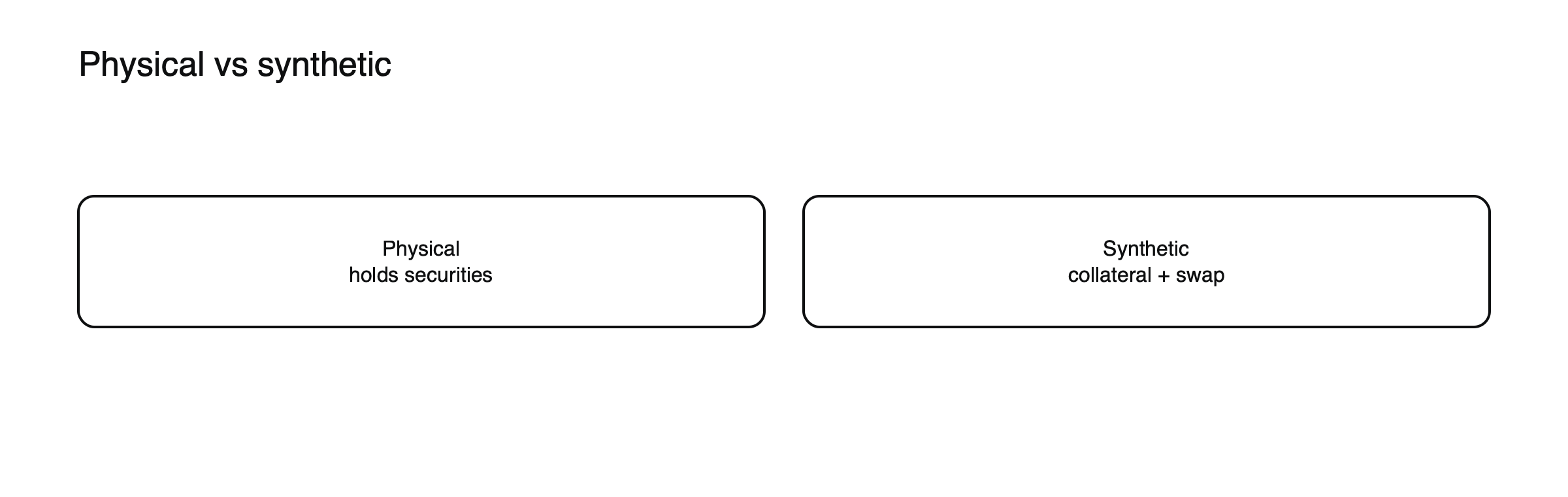
Figure: Two ways to deliver an index return.
How a swap works, illustrated
A synthetic ETF tracking a stock index receives investors’ money and uses it to buy a basket of collateral, which may consist of different shares or bonds. It then enters a swap with a bank: the fund passes the return of the collateral basket to the bank, and the bank pays the fund the return of the index. If the index rises 5% and the collateral 3%, the bank pays the 2% difference, and the fund delivers the index’s 5%, less fees. If the collateral outperforms, the fund pays the difference to the bank. (Example values.)
How swap risk is limited
In the EU, UCITS rules limit exposure to any single swap counterparty and require collateral, and many synthetic ETFs use several counterparties.
The counterparty limit
Under UCITS rules in the EU, a fund’s net exposure to a single derivatives counterparty is limited, generally to 10% of its assets when the counterparty is a bank. Swaps are reset regularly, so that any amount owed by the bank is paid before it grows beyond that limit. If a counterparty failed, the fund would rely on its collateral, which is usually valued daily and may exceed the amount at risk.
Securities lending. Physical ETFs may lend out securities for extra income, which brings its own, usually small, counterparty risk.
Choosing a structure
For major indices, physical ETFs are common and simple. Synthetic structures can make sense for markets that are costly or slow to access directly, or where tax treatment favors them.
See what tracking difference is in an ETF, accumulating vs distributing ETFs and what an ETF is.
Full replication and sampling
Physical ETFs can hold every security in an index, known as full replication, or a representative sample. Full replication tracks closely but can be costly for indices with thousands of members or illiquid securities; sampling reduces costs but may increase tracking error. Synthetic structures avoid the problem altogether by receiving the index return through the swap.
Tax considerations
In some cases, synthetic ETFs can deliver index returns with less withholding tax on dividends than physical funds, because the swap counterparty, not the fund, holds the underlying shares. Rules in this area have tightened over time and differ by market, so the tax advantage varies. Tracking difference over several years shows the net effect. See what tracking difference is in an ETF.
Securities lending, illustrated
A physical ETF lends 20% of its holdings to other investors, earning fees equal to 0.03% of its assets a year, with collateral worth more than the lent securities. The income offsets part of the fund’s fee. If a borrower failed and the collateral fell short, the fund could lose part of the lent value, a small but real risk. Funds publish their lending levels and collateral policies. (Example values.)
Commodity ETFs and similar products
Products tracking commodities often face similar choices: holding the physical commodity, as many gold products do, or using futures or swaps. Physical commodity products avoid futures roll costs but carry storage costs.
How the market has evolved
Synthetic ETFs were popular in Europe in the 2000s, when they offered cheap, close tracking of many indices. After the 2008 financial crisis, concerns about counterparty risk and transparency led many investors to prefer physical funds, and providers shifted toward physical replication for mainstream indices. Synthetic structures remain common for some markets and strategies where they offer clear advantages in cost or tracking.
Collateral transparency
Synthetic ETFs publish the composition of their collateral baskets, often daily. The collateral may bear little resemblance to the index, for example an index of emerging market shares backed by large developed market shares. Reviewing what the collateral is, and how quickly it could be sold, shows how much protection it would provide if the swap counterparty failed.
Funded and unfunded swaps
In the more common unfunded structure, the fund owns the collateral basket and swaps its return for the index return. In a funded structure, the fund pays cash to the counterparty, which posts collateral in return, often held with a third party. The two structures differ in who owns the assets and how collateral is held, which matters in a counterparty failure.
Costs compared
Synthetic ETFs may have low expense ratios and tracking differences, but swap fees paid to counterparties are part of their cost. Physical ETFs have trading and custody costs, sometimes offset by lending income. Comparing tracking difference over several years captures these effects better than the headline fee alone.
Common misreadings
- Assuming the collateral matches the index.
- Treating physical funds as free of counterparty risk.
A counterparty failure, illustrated
Suppose a synthetic ETF worth $100 million is owed $4 million by its swap counterparty when the bank fails, after a strong month for the index. (Illustrative scenario.) The fund owns a collateral basket worth about $96 million, which it can sell, and has a claim on the bank for the $4 million owed. The loss is limited to whatever part of that claim is not recovered, rather than the whole fund. Frequent swap resets and counterparty limits are designed to keep that exposed amount small.
Index changes and replication
When an index changes its members, a physical ETF must trade to match, incurring costs. A synthetic ETF’s swap counterparty takes on that task, with costs reflected in the swap fee. For indices with frequent changes or hard-to-trade members, this can favor synthetic structures.
What the factsheet shows
Factsheets state the replication method, the counterparties for synthetic funds, securities lending levels for physical funds and the fund’s tracking difference. Reading these lines takes a minute and answers most questions about structure. See how to read an ETF factsheet.
Bond and money market ETFs
Most bond ETFs are physical, holding a sample of the bonds in their index, because bond indices are too large and illiquid to replicate fully. Synthetic structures are more common for some money market and short-term rate products, where they can provide a simple, close-tracking return.
Choosing in practice
For mainstream indices such as large equity markets, physical funds are widely available, cheap and simple. Where a synthetic fund shows clearly better tracking difference for a harder market, and its counterparty and collateral arrangements are clear, it can be a reasonable choice.
Checking a synthetic fund
Before buying a synthetic ETF, look at who the swap counterparties are, how often swaps reset, what the collateral consists of and how the fund’s tracking difference compares with physical funds on the same index. If any of these points is unclear from the fund’s published documents, a physical alternative may be the simpler and safer choice.
Frequently asked questions
Are synthetic ETFs riskier?
They add counterparty risk, limited by rules and collateral, in exchange for close tracking. Physical ETFs that lend securities also carry some counterparty risk.
How can I tell which type an ETF is?
The fund’s factsheet and key information document state its replication method, usually as physical, sampled or synthetic.
This article is educational content and does not constitute financial, investment, legal or tax advice. Digital assets are volatile and you may lose the amount you invest.