
What Is a Thematic ETF?
Thematic ETFs invest in trends such as AI or clean energy. Why they attract money, why most have underperformed or closed and how to evaluate one before buying.
A thematic ETF invests in companies tied to a trend such as AI, clean energy or cybersecurity rather than a whole market. They draw money when a theme is popular, but Morningstar found that over 15 years more than three-quarters of thematic funds closed and only about one in 10 survived and beat global stocks.
How they work
An index provider or manager selects companies tied to the theme, often across several sectors and countries, and the ETF tracks that selection.
Why they often disappoint
- Late launches: many funds launch after a theme has already rallied.
- Expensive holdings: popular themes are often richly valued.
- Higher fees: asset-weighted thematic fees were over 0.6% a year, compared with about 0.35% for other funds.
- Narrow portfolios that swing sharply.
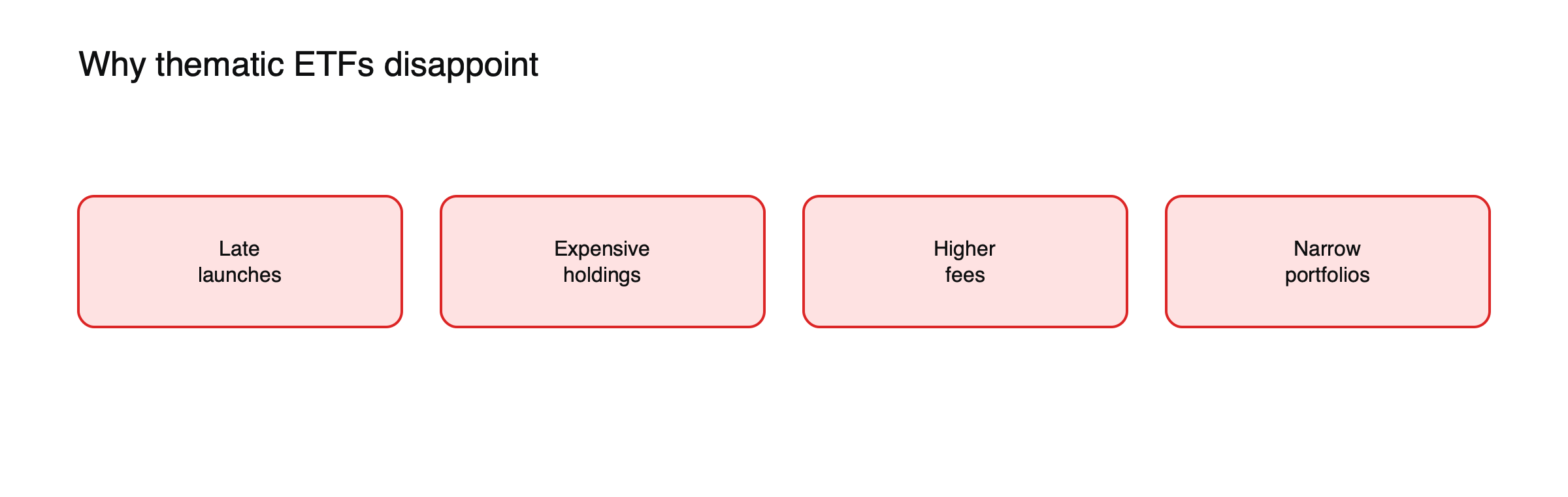
Figure: Common thematic pitfalls.
A cautionary example. Record numbers of thematic funds launched in 2021, near the peak of the growth-stock boom, and many investors bought in near the top of funds such as ARK Innovation.
The numbers behind the warning
Morningstar counted 1,952 thematic funds worldwide at the end of 2021, after a record 589 launches that year. Looking back over 15 years, it found that more than three-quarters of thematic funds had closed, and only about one in ten had both survived and beaten a broad global equity fund. Asset-weighted fees on thematic funds were above 0.6% a year, against about 0.35% for other funds. The pattern suggests that picking a promising theme is very different from earning good returns from it.
The launch-timing problem, illustrated
Suppose a theme’s leading shares double over two years, attracting attention and investor money. A new thematic fund launches at the end of that run, buying the same shares at much higher valuations. If the theme simply delivers what was already expected, the shares may move sideways; if it disappoints, they may fall sharply. The fund’s investors, arriving late, bear most of that risk. (Illustrative scenario.)
How to evaluate one
Check how holdings are chosen, overlap with funds you already own, fees, liquidity, and whether the theme’s prospects are already in prices. See stock valuation mistakes.
Overlap with existing holdings
Many thematic funds hold the same large companies found in broad indices, especially in technology-related themes. An investor holding a broad market ETF and a thematic fund may own the same companies twice. Comparing the thematic fund’s top holdings with your broad fund’s largest positions shows how much genuinely new exposure it adds.
Selection methods
Some thematic indices select companies by revenue from the theme, others by keyword screening of company reports or by analyst judgment. The method decides what the fund holds: a fund screening by revenue may hold small, pure-play companies, while one screening by keywords may include large firms with only minor exposure. Reading the methodology explains why two funds on the same theme can behave very differently.
See sector ETFs vs broad market ETFs and what an ETF is.
Volatility and size
Thematic funds are often concentrated in younger, faster-growing and more speculative companies, which makes them more volatile than broad markets. Many funds are small, which can mean wider trading spreads and a higher risk of closure. When a fund closes, investors receive the value of their holdings but may face taxes and the need to reinvest.
Using thematic funds sensibly
Investors who want exposure to a theme often limit it to a small part of a portfolio, alongside broad core holdings, and decide in advance how long they will hold and what would make them sell. Treating a thematic fund as a long-term core holding exposes a portfolio to the risks that have caught many thematic investors.
Thematic funds through CFDs
CFDs on some large thematic ETFs allow short-term long or short positions on a theme. Because these funds can swing sharply, positions are usually sized small, and financing makes long holding periods expensive.
A theme’s life cycle
Themes often follow a pattern: early enthusiasm as a new technology or trend emerges, rapid price gains as investors pile in, a wave of fund launches near the peak, then disappointment as growth proves slower or competition fiercer than hoped. Some themes eventually deliver; many companies within them do not. Recognizing where a theme sits in that cycle helps judge whether its prospects are already reflected in prices.
Checking valuations
Comparing a thematic fund’s average valuation, such as its price-to-earnings or price-to-sales ratio, with a broad market index shows how much growth is already expected. Very high valuations leave little room for disappointment. Many thematic funds hold companies that are not yet profitable, which makes them especially sensitive to interest rates and sentiment.
Thematic and active funds
Some thematic ETFs are actively managed, with managers choosing holdings; others track rules-based indices. Active thematic funds can be even more concentrated and volatile. In both cases, the fund’s results depend on both the theme and the specific companies selected.
Deciding when to exit
Because themes can fade, it helps to decide in advance what would make you sell: a change in the theme’s prospects, valuations reaching extremes or the fund’s assets shrinking toward closure risk. Without a plan, investors often hold on through long declines, hoping for a recovery.
Common misreadings
- Assuming a strong theme guarantees strong returns.
- Judging a fund by its best recent year.
Common themes
Popular themes in recent years have included artificial intelligence, robotics, cybersecurity, clean energy, electric vehicles, genomics, cloud computing and space exploration. Some overlap heavily with technology indices; others hold smaller, more specialized companies. A theme’s popularity often rises and falls with media attention and recent returns.
Fees over ten years, illustrated
On $10,000 growing 7% a year before fees, a thematic fund charging 0.6% would leave about $18,596 after ten years, while a broad index fund charging 0.03% would leave about $19,616, a gap of about $1,020 from fees alone. (Example values.) The thematic fund must outperform by more than that just to break even with the broad fund, before considering its higher volatility. See how much an ETF’s expense ratio costs over 10 years.
Themes and interest rates
Many thematic funds hold young growth companies whose profits lie mostly in the future. Their valuations are therefore highly sensitive to interest rates: when rates rise, the value of distant profits falls, and such funds can drop sharply, as many did in 2022. When rates fall, they can rebound strongly. See why tech stocks are so sensitive to bond yields.
Liquidity and spreads
Smaller thematic funds may trade thinly, with wider bid-ask spreads than major index ETFs. Some also hold small, less liquid companies, which can widen the gap between the fund’s price and its holdings’ value in volatile markets.
A thematic checklist
- How are companies selected?
- How much overlap with existing holdings?
- What does it cost compared with a broad fund?
- How large and liquid is it?
- When would you sell?
Thematic CFDs
CFDs on large thematic ETFs allow short positions as well as long ones, which some traders use to bet against themes they believe are overvalued. The same volatility that makes themes risky to own makes them risky to short: a theme can rally sharply on news or renewed enthusiasm. Sizing such positions small and keeping holding periods short limits both financing costs and the damage from sudden rallies. Guaranteed stops, where available, can cap the cost of a rally against a short position.
Frequently asked questions
Are all thematic ETFs poor investments?
No. Some have performed well, but long-run data show that most have closed or lagged broad markets, so the odds are against the typical fund.
How is a thematic ETF different from a sector ETF?
A sector ETF follows a standard industry classification; a thematic ETF selects companies linked to an idea across several sectors.
This article is educational content and does not constitute financial, investment, legal or tax advice. Digital assets are volatile and you may lose the amount you invest.
Sources
- Morningstar’s wake-up call for theme-dreamers (over 15 years more than three-fourths of thematic funds shut and one in 10 survived and outperformed; higher fees) — Investor Daily (I&C)
- Thematic funds continue to capture investors’ imagination (1,952 thematic funds end-2021; record 589 launches in 2021; most underperformed) — Morningstar
- Thematic funds: worth their outsized fees? (asset-weighted thematic fees over 0.6% vs about 0.35%; long-run success rates 15%–18%) — WealthManagement.com, 2024