
Why the DAX Is So Sensitive to Global Trade
Germany leans on manufacturing, autos, chemicals and exports, so the DAX reacts strongly to global demand, China, tariffs and energy prices. How the links work.
The DAX is sensitive to global trade because Germany’s economy relies heavily on manufacturing and exports, from cars and machinery to chemicals. Its members are tied to the industrial cycle, Chinese demand and energy prices, so manufacturing surveys, the IFO index, tariff news and energy shocks move it more than many indices.
The channels
- Manufacturing cycle: German purchasing manager surveys and the IFO index often move the DAX on release.
- China: a major market for German autos and machinery; Chinese slowdowns weigh on those members.
- Tariffs: trade barriers hit exporters’ sales and supply chains. In April 2025, tariff announcements triggered a global sell-off before a rebound.
- Energy: German industry was hit by the 2022 gas price surge, when European gas reached about ten times normal levels. See how energy shocks travel through inflation, rates and currencies.
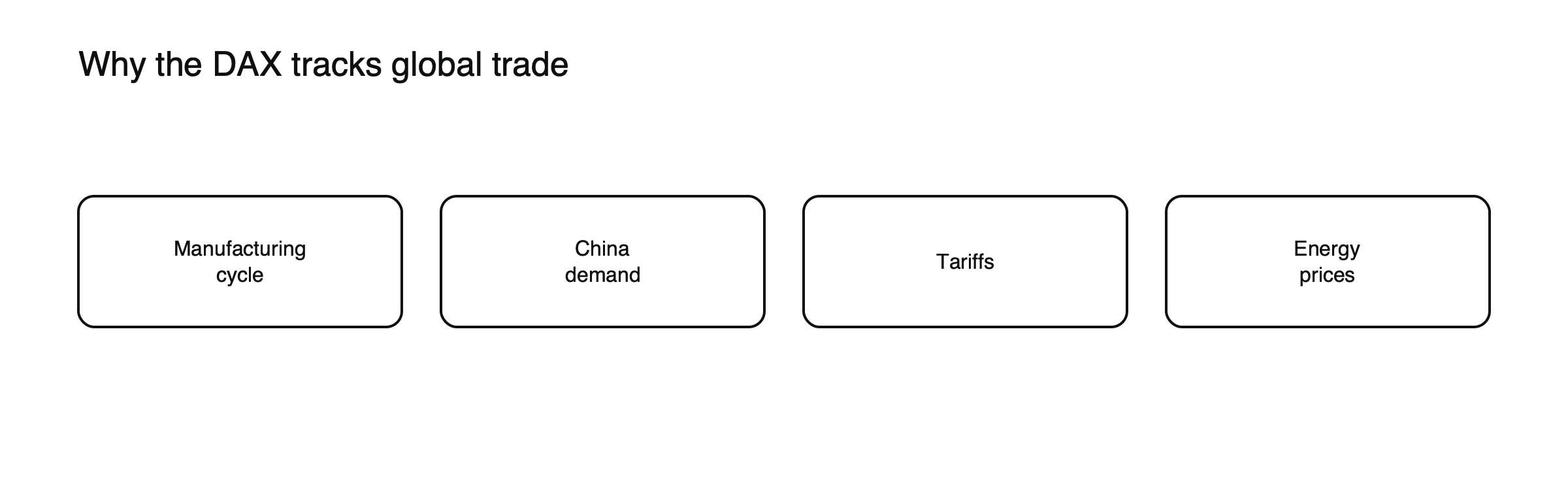
Figure: How global trade reaches the DAX.
A tariff shock, illustrated
Suppose the United States imposes a 25% tariff on European cars. (Illustrative scenario.) A German carmaker selling a large share of its vehicles in the US must either raise prices and lose sales or absorb part of the cost and accept lower margins. Analysts cut profit forecasts, and the shares fall; suppliers of parts and machinery follow. Because carmakers and their suppliers are significant DAX members, the index falls more than broader European indices on the announcement, even before any tariff takes effect.
Supply chains
German manufacturers rely on parts and materials from across Europe and Asia and sell finished goods worldwide. Disruptions to supply chains, such as the chip shortages and shipping bottlenecks of 2021 and 2022, can cut production even when demand is strong, weighing on industrial shares. Easing bottlenecks, conversely, can lift output and earnings quickly.
Global manufacturing surveys
Beyond German data, global purchasing managers’ indices, especially those for China, the United States and the euro area, move the DAX because they signal demand for German machinery, chemicals and vehicles. A run of improving global surveys often coincides with DAX outperformance; deteriorating surveys with underperformance.
The euro factor
The DAX is priced in euros. A weaker euro can help exporters’ competitiveness, but non-euro investors see returns reduced when converting back.
Fiscal policy at home
German fiscal policy can also move the index. In 2025, Germany loosened its constitutional limits on borrowing to allow much higher spending on defense and infrastructure. Shares of defense, construction and industrial companies rose strongly as investors anticipated years of new orders. Domestic spending of this kind can partly offset weakness in exports.
Dividends in the index
Because the headline DAX includes reinvested dividends, its long-term chart rises faster than price-only indices; compare like with like. See what the DAX 40 is.
When German weakness does not mean a weak DAX
DAX companies are global, so the index can rise even when the German economy is weak, if global demand and markets are strong.
See how tariffs move markets and what moves stock market indices.
Trading the DAX around trade news
Trade announcements often arrive outside European hours, so the DAX frequently gaps at the open after news from Washington or Beijing. Traders holding Germany 40 positions during periods of trade tension often reduce size or widen stops, and watch US futures overnight for clues to the open. See how to plan index trades around market opens.
Germany’s export model
For decades, Germany’s economy has been built around exporting high-quality manufactured goods: cars, machinery, chemicals, electrical equipment and medical technology. Exports make up a much larger share of its economy than in the United States, and many large DAX members earn most of their revenue abroad. That model made German industry a major winner from globalization and from China’s growth, but it also leaves the DAX exposed when global trade slows, when China’s demand weakens or when trading partners raise barriers.
Energy-intensive industry
Chemical companies and other energy-intensive manufacturers depend on affordable natural gas and electricity. When energy prices surged in 2022, some cut production, and their shares fell. Long-term energy costs remain one of the main questions for German industry’s competitiveness, and energy policy decisions, such as on gas supply or electricity prices for industry, can move these shares.
German data that moves the index
Beyond business surveys, the DAX reacts to factory orders, industrial production and trade data, which show whether manufacturing demand is turning. Because these releases often confirm trends already signaled by surveys, their market impact is usually smaller, but large surprises, especially in orders from abroad, can still move industrial shares.
The index and the economy, illustrated
Suppose German output stagnates for a year while US and Asian demand for luxury cars, industrial software and medical equipment grows strongly and the euro weakens. (Illustrative scenario.) The DAX could rise 15% while the German economy barely grows, because its largest members sell mainly abroad and report profits boosted by the weaker currency. The reverse can also happen: strong domestic demand combined with a global slowdown and a strong euro can leave the DAX lagging.
Global trade indicators
Traders watching the DAX often follow wider measures of global trade: shipping and container freight rates, export figures from manufacturing economies such as South Korea and Taiwan and global industrial metal prices. These tend to move ahead of or alongside German industrial earnings.
Common misreadings
- Treating the DAX as a gauge of the German economy alone.
- Ignoring Chinese demand and trade policy.
Trade policy is set in Brussels
Germany does not negotiate trade deals on its own: the European Union negotiates for all its members. Tariff disputes and agreements between the EU and the United States, China or other partners therefore affect German exporters directly, and EU-level announcements can move the DAX as much as national ones. German carmakers have sometimes lobbied against EU tariffs on Chinese electric vehicles, fearing retaliation against their own sales in China.
Around tariff deadlines
When tariffs are threatened with a deadline, markets often swing between fear and relief as negotiations progress. Traders holding DAX positions through such periods face the risk of sudden gaps when deals are announced or collapse, often outside European trading hours. Smaller sizes and wider stops are common approaches during these windows.
A trade-news checklist
- Are any tariff announcements or deadlines pending?
- What are the latest Chinese demand signals?
- Are global manufacturing surveys improving or deteriorating?
- What are gas and electricity prices doing?
- Is the euro strengthening or weakening?
The less trade-sensitive members
Not every DAX member is an exporter of physical goods. Software, insurance, telecommunications, healthcare and utilities companies also carry significant weights, and their earnings depend more on subscriptions, premiums or regulated prices than on global trade. On days when trade news hits carmakers and chemical companies, these members can cushion the index. Knowing which members are moving explains why the DAX sometimes falls less on tariff news than its industrial reputation suggests. Utilities and telecommunications companies, in particular, depend mainly on domestic customers, so they often behave defensively when global trade worries dominate, and can even lead the index on days when exporters struggle most.
Frequently asked questions
Why does the DAX react to Chinese data?
Because China is a major market for German cars, machinery and chemicals, so Chinese demand directly affects the earnings of large DAX members.
Can the DAX rise during a German recession?
Yes. Its members earn much of their revenue abroad, so strong global demand or a weaker euro can lift the index even when the domestic economy is weak.
This article is educational content and does not constitute financial, investment, legal or tax advice. Digital assets are volatile and you may lose the amount you invest.
Sources
- What is the DAX index (FTSE heavier in energy, mining and financials; German PMI, IFO and euro area GDP move the DAX; euro denomination) — CMC Markets
- DAX (headline index includes dividends) — STOXX
- Europe’s energy crisis (gas about ten times normal in 2022) — Foreign Policy, August 2022
- How the stock market made back its losses after the trade war escalated (April 2025 sell-off and rebound) — AP via Fortune