
How to Plan Index Trades Around Market Opens
Check overnight futures, note the gap, expect wide spreads early, let an opening range form, then trade with defined risk: planning index trades at the open.
To plan index trades around market opens, check overnight futures, estimate the gap from the prior close, expect wide spreads and fast moves early, let an opening range form, then set entries and stops for that volatility. The cash open, such as 9:30 a.m. New York time for US indices, is often the day’s most volatile part.
Before you start
Know your index’s cash session hours and when key data releases fall; US jobs and inflation data come out at 8:30 a.m. New York time, an hour before the open.
Planning it, step by step
Check overnight futures
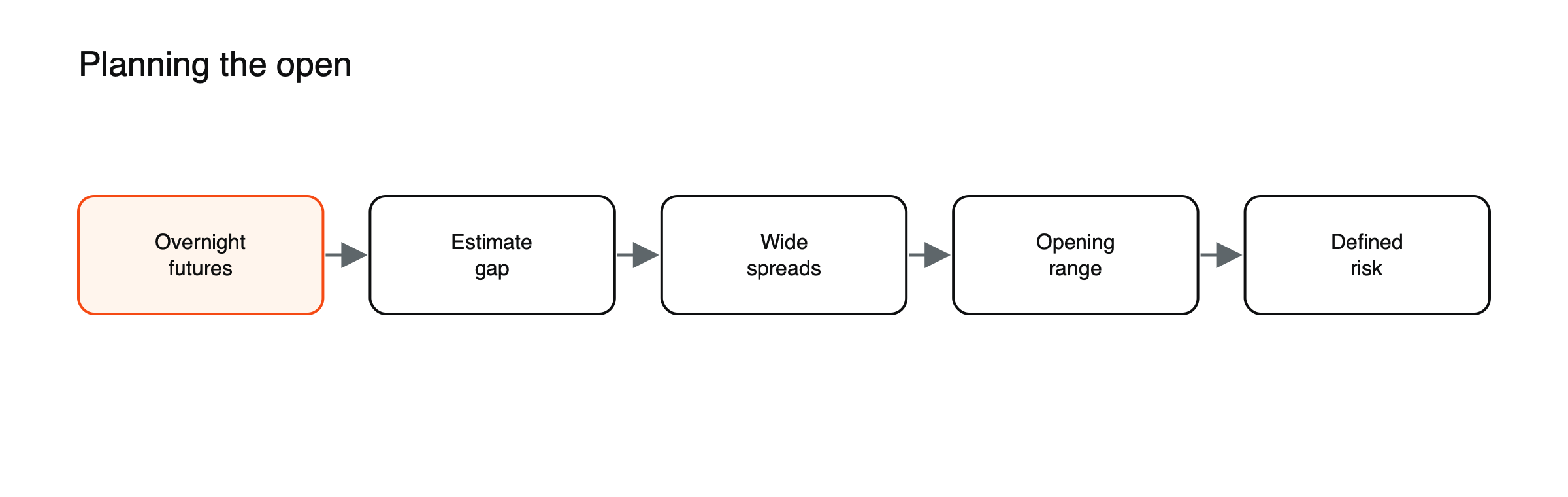
Figure: Planning around the open.
Futures trade almost around the clock; their level shows where the cash index is likely to open.
Estimate the gap
Compare indicated opening level with the prior close. Large gaps can trigger stops. See why prices gap over weekends.
Expect wide spreads early
Liquidity builds in the first minutes; spreads and slippage are larger right at the open.
Let an opening range form
Many traders wait 15 to 30 minutes and use the high and low of that range as reference levels.
Trade with defined risk
Set stops outside normal early swings and size accordingly. See how to calculate the value of a point.
An opening gap, illustrated
A US index closed at 5,000. Overnight, weak earnings from a large member and a jump in bond yields push futures down, and the index is indicated to open around 4,950, a 1% gap. A trader long at $2 per point with a stop at 4,970 sees the stop filled near 4,950 at the open, a loss of about $100 instead of the planned $60. After 20 minutes, the index has traded between 4,935 and 4,965; the trader waits for a move above 4,965 before considering a new entry, with a stop below 4,935. (Illustrative figures.)
Main opening times
| Market | Cash open (local time) |
|---|---|
| United States | 9:30 a.m. New York |
| United Kingdom | 8:00 a.m. London |
| Germany | 9:00 a.m. Frankfurt |
| Japan | 9:00 a.m. Tokyo |
| Hong Kong | 9:30 a.m. Hong Kong |
Daylight saving changes on different dates in different countries, so the gaps between openings shift for a few weeks each year.
Data before the open
Major US economic releases, including jobs and inflation data, come out at 8:30 a.m. New York time, an hour before the cash open. Index CFDs and futures react immediately, so the cash open reflects the data. Many traders avoid entering in the minutes around these releases and wait for the open to show how the market has absorbed them.
Common mistakes
Chasing the first move, using tight stops at the open, and forgetting that circuit breakers can halt the market in extreme falls. See how circuit breakers work and how stock index CFDs work.
Circuit breakers
US markets have market-wide circuit breakers that pause trading if the S&P 500 falls by set percentages from the previous close, the first level being 7%. In March 2020, these halts were triggered several times early in the session. When trading resumes, prices can gap again. Index CFDs may continue to quote prices during a halt, based on futures, but liquidity and spreads can be extreme.
Opening ranges and strategies
Some traders use the high and low of the first 15 or 30 minutes as reference levels, entering when price breaks out of the range and placing stops on the other side. Others trade fades, betting that an exaggerated opening move will partly reverse. Both approaches depend on the day’s context, such as whether there is major news, and neither works reliably every day.
The rest of the session
Volume usually peaks near the open and the close, with quieter trading in the middle of the day. The last hour often brings renewed activity as funds adjust positions, especially on days of index rebalancing or options expiry. Knowing this rhythm helps set realistic expectations for how much an index might move at different times.
Overnight leads by region
Each market opens in the light of what happened elsewhere overnight. Asian indices often react to the previous US session; European indices to Asia and US futures; US indices to Europe and to their own futures. A sharp fall on Wall Street usually means weaker openings in Tokyo and Frankfurt, though local news can change the picture. Watching the chain helps anticipate gaps.
Weekend gaps
News over weekends, from elections to policy announcements or geopolitical events, is priced in all at once when futures reopen on Sunday evening and cash markets on Monday morning. Monday gaps can be larger than weekday ones. Some traders reduce index positions before weekends when major events are scheduled. See why prices gap over weekends.
Reading pre-open indications
Before the open, futures, index CFDs and pre-market trading in large shares give indications of where the cash index will start. These indications are useful but not exact: the opening auction, which matches many orders at once, can produce an opening level somewhat different from the indication, especially after big news.
A pre-open checklist
- Where are futures relative to the prior close and fair value?
- Which data or results are due before or shortly after the open?
- How wide are spreads on your index CFD right now?
- Where would existing stops be filled if the market gapped?
The first hour, illustrated
Suppose a US index typically moves about 60 points between its high and low over a whole day. (Illustrative figures.) On many days, a large share of that range is set in the first hour, when news from overnight and early data are absorbed and opening orders are executed. A stop placed 20 points from the entry at 9:35 a.m. is far more likely to be hit by noise than the same stop placed at noon. Matching stop distances to the time of day helps avoid being shaken out early.
Opening auctions
Major exchanges open with an auction that collects buy and sell orders and matches them at a single price. The opening auction sets the first official prices of the day for many member shares, and therefore the starting point of the cash index. Large imbalances in the auction, for example after major news, can produce opening prices well away from the last indications, and they explain why the first prints of the day are sometimes surprising.
Keeping a record of opens
Noting the gap, the first-hour range and the eventual close for the indices you trade builds a useful picture of how they usually behave after the open. Over just a few months, patterns clearly emerge, such as how often gaps fill, which helps set realistic expectations for each new trading session.
Frequently asked questions
Should I trade the first minutes after the open?
Many traders avoid them because spreads are wide and moves can reverse sharply. Waiting for an opening range to form usually gives more reliable reference points.
Why do index CFDs move before the cash market opens?
Because they follow index futures, which trade almost around the clock and react to overnight news and data.
This article is educational content and does not constitute financial, investment, legal or tax advice. Digital assets are volatile and you may lose the amount you invest.