
Why the FTSE 100 Often Moves Opposite to the Pound
Many FTSE 100 companies earn abroad, so a weaker pound raises their sterling earnings and often lifts the index. How the link works and when it breaks down.
The FTSE 100 often moves opposite to the pound because many of its largest companies, in energy, mining, pharmaceuticals and consumer goods, earn most revenue abroad. When sterling falls, those earnings are worth more in pounds and the shares tend to rise; when it strengthens, the reverse can weigh on the index.
How the link works
- A company earns dollars or euros abroad.
- The pound weakens.
- Those earnings convert into more pounds.
- Analysts raise sterling profit estimates; the share price rises.
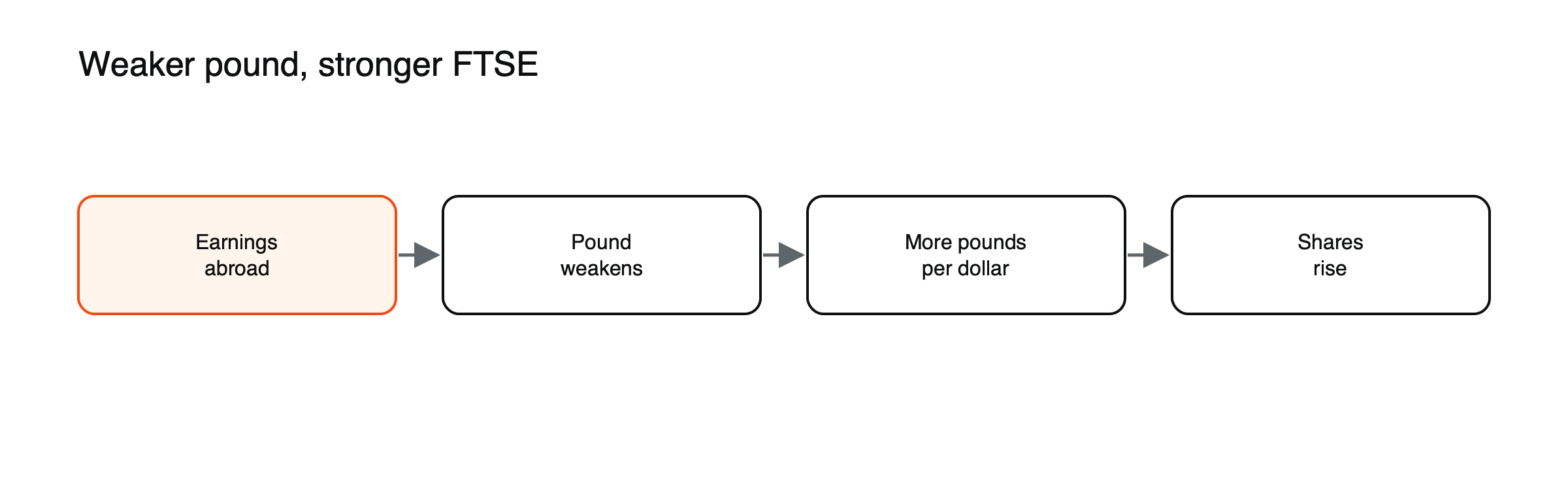
Figure: How a weaker pound can lift the FTSE 100.
Which indices react this way
The FTSE 100’s overseas earners make it far more sensitive to currency moves than the DAX, whose members rely less on revenue from abroad according to some market commentators. Mid-cap UK indices, focused on domestic companies, often move with the pound instead.
Translation and transaction effects
Currency moves affect companies in two ways. The translation effect changes the sterling value of profits earned abroad when they are reported, which is the main reason the FTSE 100 rises when the pound falls. The transaction effect changes costs and prices when companies buy or sell across currencies: a UK retailer importing goods priced in dollars faces higher costs when the pound weakens. Companies with overseas earnings and domestic costs benefit most from a weak pound; those importing goods for sale in the UK suffer.
Foreign investors see it differently
For a dollar-based investor, a falling pound reduces the value of UK shares, partly offsetting index gains. CFD traders with non-sterling accounts face the same currency effect.
A dollar investor’s view, illustrated
Suppose the FTSE 100 rises 5% over a month in sterling terms while the pound falls 4% against the dollar. (Illustrative figures.) A dollar-based investor’s return is roughly 1.05 × 0.96 − 1, about 0.8%. The index looked strong at home, but most of the gain disappeared after conversion. Conversely, a period when the FTSE 100 is flat but the pound rises 4% gives the dollar investor a 4% gain. Judging the index from abroad means combining both moves.
Hedging the currency
Investors who want exposure to UK shares without sterling risk can hedge the currency, for example with a short GBP/USD position sized to the value of their FTSE holdings. CFD traders with non-sterling accounts can do the same. Hedging removes the currency effect but also its benefits, and it carries costs, so many investors hedge only partly or not at all.
Measuring the link
Traders measure the relationship with rolling correlations between the FTSE 100 and GBP/USD or the trade-weighted pound. The correlation has often been negative, but it varies: it weakens when global risk sentiment dominates and both fall together. Checking a recent measure is more useful than assuming a fixed pattern. See how currency correlations work.
The 2016 referendum
After the UK voted to leave the European Union in June 2016, sterling fell sharply, by about 17% against the dollar by October. The FTSE 100, helped by its overseas earners, recovered quickly from its initial drop and rose to records in sterling terms, while more domestically focused UK shares lagged. It remains the clearest recent example of the inverse relationship.
When the pattern fails
- Global sell-offs: if a falling pound coincides with global risk aversion, the FTSE 100 can fall too.
- UK-specific crises: in September 2022, a gilt sell-off and record-low pound came with stress in UK markets.
- Commodity moves: oil and metal prices can outweigh currency effects for energy and mining heavyweights.
See what the FTSE 100 is, what moves GBP/USD and what moves stock market indices.
Which members are most exposed
Oil and gas producers, miners, global pharmaceutical companies, drinks and tobacco groups and large consumer goods companies earn most of their revenue outside the UK, often in dollars. They tend to benefit most from a weak pound. UK banks, housebuilders and domestic retailers earn mainly in sterling and react more to the UK economy and interest rates.
What drives sterling
Because the pound matters so much for the FTSE 100, the drivers of sterling indirectly move the index: Bank of England interest rate decisions, UK inflation and wage data, government borrowing and political events. A hawkish Bank of England surprise can lift the pound and weigh on the FTSE 100’s overseas earners on the same day, even though it says nothing about their businesses. See what moves GBP/USD.
The FTSE 100 and FTSE 250 on a pound move, illustrated
Suppose the pound jumps 2% against the dollar after strong UK data. (Illustrative scenario.) The FTSE 100 might fall about 0.5%, as the sterling value of overseas earnings declines, while the FTSE 250 rises about 1%, because domestic companies benefit from the stronger economy and lower import costs. On a day of sterling weakness, the pattern often reverses. The gap between the two indices is one of the clearest ways to see the currency effect at work.
Commodities versus the currency
For energy and mining heavyweights, commodity prices usually matter more than sterling. If oil falls 5% on the same day the pound weakens 1%, energy shares will probably fall despite the currency boost. Disentangling the two effects explains many days when the FTSE 100 does not behave as the currency alone would suggest.
Trading the relationship
Some traders combine UK 100 and GBP/USD positions, for example holding the index while shorting sterling to express a view that a weaker pound will lift UK multinationals. Such combinations depend on the relationship holding, which it often does not in global sell-offs, so they need careful sizing.
Common misreadings
- Assuming the inverse link holds every day.
- Ignoring commodity prices when explaining FTSE 100 moves.
Interest rate differences
The gap between UK and US interest rates is one of the main drivers of GBP/USD. When the Bank of England is expected to keep rates higher than the Federal Reserve, the pound tends to strengthen, weighing on the FTSE 100’s overseas earners; when expected UK rates fall relative to US rates, the pound tends to weaken, supporting them. Rate expectations therefore link UK monetary policy to the index through the currency as well as through banks and valuations.
A pound-watch checklist
- Is a Bank of England decision or UK inflation release due?
- What is driving sterling today: UK news or global sentiment?
- Are commodity prices moving strongly?
- How is the FTSE 250 behaving relative to the FTSE 100?
- Is your account in sterling, or will results be converted?
Over the long run
Over several decades, the pound has weakened substantially against the dollar, while the FTSE 100 has risen in sterling terms. For dollar-based investors, that long-term currency decline has reduced the index’s returns, while sterling-based investors have benefited from the overseas earnings it boosted. The same index can therefore tell quite different long-term stories depending on the currency used to measure it, which is why comparisons across markets should always state the currency. For CFD traders, the most practical lesson is to always judge UK 100 results in the currency of their own account, not just in pounds.
Frequently asked questions
Does a falling pound always lift the FTSE 100?
No. If the pound falls because of a global sell-off or a UK financial crisis, the index can fall too. The inverse relationship is strongest when currency moves are driven by UK-specific factors in otherwise calm markets.
Should UK 100 CFD traders watch GBP/USD?
Yes. Sterling’s moves are one of the main drivers of the index, alongside commodity prices and global sentiment.
This article is educational content and does not constitute financial, investment, legal or tax advice. Digital assets are volatile and you may lose the amount you invest.
Sources
- All you need to know about the DAX (much of FTSE 100 income from overseas; currency moves affect the FTSE more than the DAX) — Pepperstone
- What is the DAX index (FTSE heavier in energy, mining and financials; German PMI, IFO and euro area GDP move the DAX; euro denomination) — CMC Markets
- GBP/USD jumps after BoE intervention (record low 1.0359 in September 2022) — MarketPulse
- Flash crash of the pound baffles traders (sterling down 17% since the June referendum) — Markets Media, October 2016