
What Is an IPO and How Do New Listings Trade?
An IPO is a company's first sale of shares to the public. How pricing and allocation work, why first-day pops average about 18% and why many lag later.
An IPO, or initial public offering, is a private company’s first sale of shares to the public and listing on an exchange. Banks set an offer price and allocate shares mostly to institutions; trading often opens well above it. US IPOs have averaged a first-day gain of about 18% since 1980 but tended to underperform afterward.
How an IPO works
- Filing: the company files a prospectus with the regulator, such as an S-1 with the US SEC.
- Roadshow: management markets the shares to investors.
- Pricing: underwriters set the final price the evening before trading, based on demand.
- Allocation: shares go mainly to institutions and favored clients.
- Listing: public trading begins, usually at a different price.
Why IPOs “pop”
Underwriters tend to price below expected market value to ensure demand. The gain mostly goes to those allocated shares at the offer price, not to buyers at the open.
The pop, illustrated
Suppose a company prices its IPO at $20 a share, and trading opens at $28. Investors allocated shares at $20 are up 40% before they can sell; buyers at the open pay $28 and start from there. If the shares close the first day at $26, those who bought at the open are down about 7%, while those allocated at the offer are still up 30%. (Illustrative figures.) The first-day gain largely belongs to those who received allocations, mostly large institutions.
After the first day
Research by Jay Ritter found IPOs from 1980 to 2023 delivered an average three-year market-adjusted return of about −20%. Lock-up expiries, typically 90 to 180 days after listing, let insiders sell and can weigh on prices.
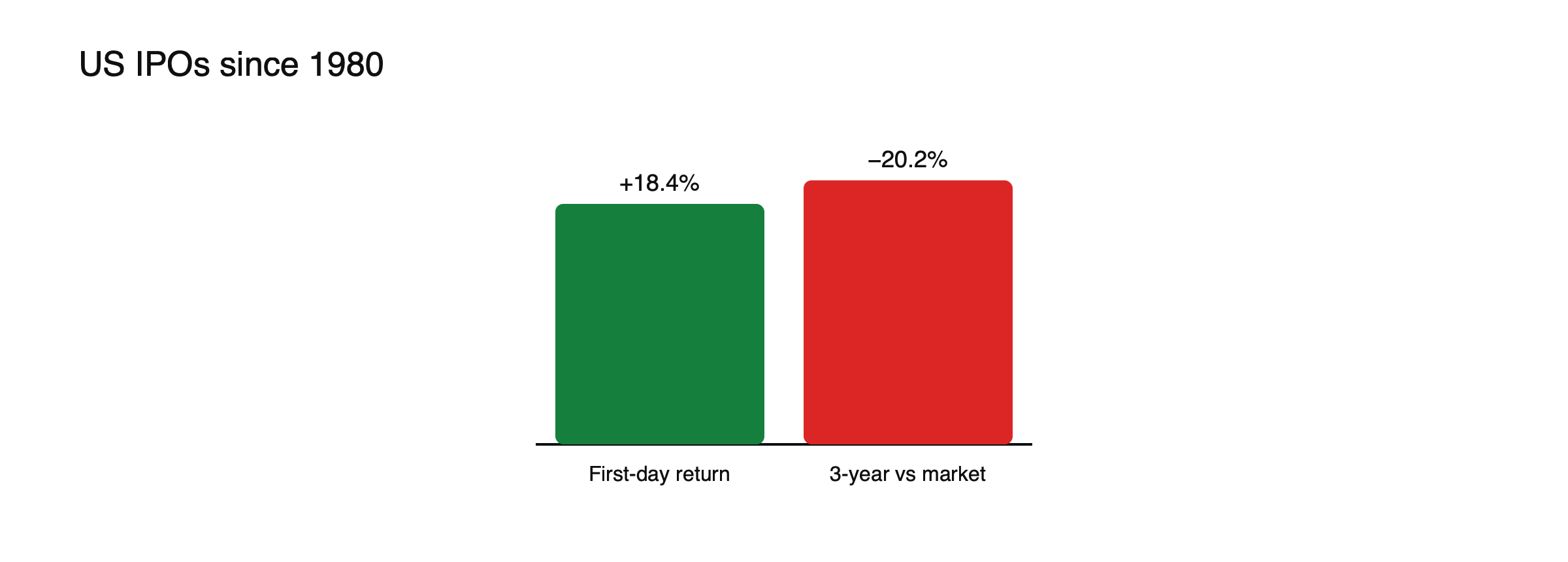
Figure: The first-day pop vs later performance. Source: Jay Ritter via PortfolioPilot.
Lock-up expiry, illustrated
Suppose founders, employees and early investors hold 70% of a company’s shares after its IPO, and they agreed not to sell for 180 days. As the date approaches, investors anticipate a wave of selling, and the shares may weaken in advance. On expiry, even modest selling can push the price down if trading volume is low compared with the newly sellable shares. Lock-up dates are published in the prospectus, so they can be planned for. (Illustrative figures.)
Other ways to go public
Not every listing is a traditional IPO. In a direct listing, existing shareholders sell shares directly on the exchange without new shares being issued or underwriters setting a price. A special purpose acquisition company, or SPAC, is a listed shell company that raises money and later merges with a private company, taking it public. SPAC listings surged in 2020 and 2021, and many of the companies taken public that way later performed poorly.
Reading a prospectus
The prospectus describes the business, its finances, risks, how the money raised will be used and who will own the shares after the IPO. Key points to check include revenue growth and losses, how much of the company insiders are selling, special voting arrangements that give founders control and the lock-up terms. The risk factors section, though long, often reveals what could go wrong.
Risks for CFD traders. New listings have no price history, wide spreads and high volatility; CFDs may only be offered after listing, at the open price.
See what moves stock prices, how stock CFDs work and what a short squeeze is.
IPO cycles
IPOs come in waves. Companies tend to list when markets are strong and valuations high, which helps them raise more money, and hold back in weak markets. Busy IPO periods, such as 1999–2000 and 2020–2021, have often been followed by weak performance for the new listings. A surge in listings is sometimes read as a sign of a market near its peak.
When new listings join indices
Once listed, a company may be added to major indices after meeting their rules on size, trading history and, for some indices, profitability. Index inclusion can bring buying from funds that track the index, which can lift the price around the change. Rules differ between index providers and can take months to be met.
Trading new listings with CFDs
Providers usually offer CFDs on new listings only after trading begins, sometimes after a delay, and margin requirements may be higher than for established shares. The first days often bring very wide price swings and spreads. Without price history, technical levels are meaningless, and the share’s reaction to its first earnings report as a public company can be dramatic. Small positions and wide stops are common precautions. See how stock CFDs work.
How the offer price is set
During the roadshow, underwriters collect orders from institutional investors at various prices, a process called bookbuilding. If demand is strong, the offer may be several times oversubscribed, and the price can be set at or above the top of the initial range. Weak demand can lead to a lower price or a postponed listing. Allocations are decided by the underwriters, which is why large, regular clients usually receive the most shares in popular deals.
The over-allotment option
Many IPOs include an option for underwriters to sell extra shares, typically up to about 15% of the offering, if demand is strong. If the price falls after listing, underwriters can buy shares in the market to support it and close their position; if it rises, they exercise the option and buy the extra shares from the company. The mechanism helps stabilize prices in the first weeks.
Analyst coverage after the IPO
Banks involved in the IPO usually begin research coverage after a quiet period of several weeks. These initiations, often positive, can move the shares. Investors tend to give more weight to coverage from analysts at banks that were not involved in the offering.
Common misreadings
- Assuming the first-day pop is available to all buyers.
- Treating a popular IPO as a safe investment.
- Ignoring lock-up dates.
Valuing a company at its IPO
Underwriters and investors usually value a new listing by comparing it with similar listed companies, using measures such as price to sales for fast-growing firms or price to earnings for profitable ones. Because the company and its advisers choose when to list, valuations at IPO tend to be full, reflecting favorable conditions. Comparing the IPO valuation with listed peers helps judge how much optimism is already in the price.
Hype and retail demand
Well-known consumer brands and fashionable technology companies can attract heavy attention from individual investors, who often cannot get allocations and buy at the open instead. That demand can push early prices far above the offer, and above any reasonable valuation, before the shares settle. Buying at the height of first-day excitement has historically been one of the riskier ways to invest in new listings.
Beyond the first year
Once lock-ups have expired and the company has reported several quarters as a public company, its shares usually trade like any other, driven by results, guidance and valuation. Some IPOs of the past became long-term winners; many others never regained their early prices. Judging a recent listing on its business and results, rather than its debut, is the more reliable approach.
Frequently asked questions
Can individual investors buy shares at the IPO price?
Sometimes, through brokers that receive allocations, but most shares go to institutions. Individuals usually buy once trading begins.
Why do many IPOs underperform after the first day?
Companies often list when conditions are favorable and valuations high, and lock-up expiries add selling. Research covering decades has found below-market returns in the years after listing on average.
This article is educational content and does not constitute financial, investment, legal or tax advice. Digital assets are volatile and you may lose the amount you invest.
Sources
- Who really wins when a company goes public (average first-day return 18.4% for 1980–2022; three-year market-adjusted return −20.2% for 1980–2023) — PortfolioPilot, citing Jay Ritter
- How IPOs work (S-1, roadshow, pricing the evening before; lock-ups typically 180 days) — StockAlarm
- Should you buy an IPO? (average first-day return 18%–19% since 1980; lock-up expiry effects) — Julius Baer