
What Was the Bitcoin Block Size War?
The Bitcoin block size war ended in 2017 with SegWit, the Bitcoin Cash split and a cancelled 2x hard fork. Here is the timeline and what it settled.
The Bitcoin block size war was a multi-year fight, peaking in 2017, over whether to raise the limit on how much data each block can hold. It ended with SegWit activating in August 2017, a split that created Bitcoin Cash on August 1, 2017, and the cancellation of a planned “2x” hard fork on November 8, 2017.
Where the limit came from
In 2010, Satoshi Nakamoto added an explicit limit of 1 MB per block, largely as a safeguard against spam and attacks at a time when blocks were nearly empty. For years the limit made no practical difference. As usage grew in the mid-2010s, blocks began to fill up, and the limit became the main constraint on how many transactions Bitcoin could process. When blocks are full, users bid against each other with higher fees, and some transactions wait. See how blockchain transaction fees work.
Two views of what Bitcoin should be
The argument was technical on the surface and philosophical underneath.
The big-block camp saw Bitcoin as cheap digital cash for everyday payments. If blocks were full, the obvious fix was to make them bigger, so more transactions fit on-chain and fees stayed low. Supporters included prominent developers, several large mining operations and businesses that wanted cheap payments.
The small-block camp put verification first. Bigger blocks mean more data for every full node to download, store and check. If running a node became too expensive for ordinary users, only large companies would verify the chain, and Bitcoin would drift toward the trusted intermediaries it was meant to replace. Many of Bitcoin’s protocol developers and node-running users were in this camp, preferring to scale through more efficient transactions and second layers.
Both sides wanted Bitcoin to succeed. They disagreed about which risk mattered more: high fees, or a network that only large operators could afford to verify.
The first attempts: XT, Classic and Unlimited
On June 22, 2015, developer Gavin Andresen published BIP 101, a proposal to raise the limit to 8 MB and then double it every two years. In August 2015 it was released in Bitcoin XT, an alternative version of the Bitcoin software, which would switch to the new rules once 75% of recent blocks signaled support. That support never came. XT’s adoption faded, and its co-founder Mike Hearn quit working on Bitcoin, declaring the experiment a failure. By January 2017, fewer than 30 nodes were still running XT.
Bitcoin Classic followed, with its first full release on February 10, 2016, proposing a one-time increase to 2 MB, and Bitcoin Unlimited offered another route later in 2016. In the same month that Classic launched, an informal meeting in Hong Kong produced an agreement among some miners and developers to activate SegWit and later raise the block size to 2 MB, but it lacked broad support among developers and was not carried out. None of these efforts gathered the wide agreement a change to Bitcoin’s rules needed.
SegWit: the change on the table
Segregated Witness (SegWit), specified in BIP 141, offered a different path. It moved signature data into a separate part of each transaction that counts at reduced weight, which effectively raised capacity to roughly 2 to 4 MB of data without a simple increase in the old limit. It also fixed a long-standing technical problem called transaction malleability, which made second-layer systems such as the Lightning Network far easier to build.
SegWit was designed as a soft fork: old nodes would keep accepting new blocks. But activation required most miners to signal support, and for a long time they did not.
Soft forks and hard forks, and why the difference mattered
Much of the war turned on how a change would be introduced, not just what it would do. A soft fork tightens the rules in a way that older software still accepts: nodes that do not upgrade keep following the chain, even if they do not understand every new feature. A hard fork loosens or changes the rules so that older software rejects the new blocks. Unless everyone upgrades, a hard fork can split the network into two chains with a shared history.
Raising the block size limit directly required a hard fork, because old nodes would reject blocks larger than 1 MB. SegWit was built as a soft fork, which is why its supporters saw it as the safer route. The risk of a chain split, with exchanges, wallets and users forced to choose sides, hung over every proposal.
The 2017 timeline
| Date | Event |
|---|---|
| May 23, 2017 | The New York Agreement is announced: activate SegWit, then raise the block size to 2 MB about three months later (“SegWit2x”) |
| July 2017 | Miners activate SegWit through a compromise mechanism, BIP 91, avoiding a chain split |
| August 1, 2017 | BIP 148, a “user-activated soft fork,” begins enforcing SegWit signaling on nodes that adopted it |
| August 1, 2017 | The big-block camp splits off and launches Bitcoin Cash as a separate chain |
| August 2017 | SegWit activates on Bitcoin at block 481,824 |
| November 8, 2017 | Organizers suspend the 2x hard fork, citing insufficient consensus |
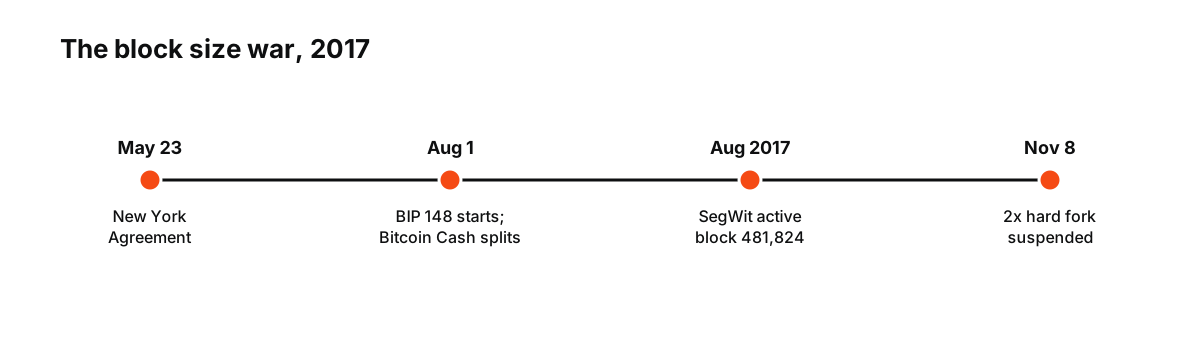
Figure: The decisive months of the block size war in 2017.
Holders of BTC at the moment of the August split received the same amount of the new Bitcoin Cash coin, because both chains shared the same history up to that point.
How the split looked to ordinary holders
For someone simply holding bitcoin, August 1, 2017 brought an unusual situation: the same private keys now controlled coins on two separate chains. Anyone with their own keys could access both. Holders on exchanges depended on each platform’s decision about whether, when and how to credit the new coins, and some took weeks to do so.
A chain split also creates a technical hazard. If a transaction valid on one chain can be copied and broadcast on the other, a user who meant to move coins on one network could accidentally move them on both. The safeguard against this is called replay protection, and how well a new chain implements it decides how safely users can separate their coins. Splits since then have shown that the practical work of a fork falls heavily on wallets, exchanges and individual holders, not just on miners and developers.
Why the 2x fork failed
The New York Agreement was signed by dozens of companies and miners representing a large share of hashing power. It still failed, because a hard fork only works if the people running nodes, and the exchanges and users relying on them, choose to follow the new rules. In the months before November, signatories withdrew, some shifted their effort to Bitcoin Cash, and it became clear that the economic weight of the network would not follow a 2 MB chain.
The episode is often summarized this way: miners produce blocks, but nodes decide which blocks are valid. See how Bitcoin mining works for that division of roles.
What the block size war changed
Governance by users. It showed that changing Bitcoin’s core rules needs broad agreement among users, not just miners or companies.
A lasting split. Bitcoin Cash continued as its own network with larger blocks, and further forks followed from it in later years. See what a blockchain fork is.
A path for scaling. With SegWit active, later upgrades such as Taproot became possible, and second layers grew. See Bitcoin address types for where SegWit and Taproot addresses came from.
A conservative culture. Bitcoin’s development has since favored slow, carefully reviewed soft forks over contested hard forks.
The question it never fully settled
The war decided how Bitcoin’s rules change, not what Bitcoin is for. Fees still rise sharply when demand for block space surges, and the debate over whether Bitcoin should be primarily a settlement layer for large transfers or a payment network for everyone continues in new forms, now mostly about second layers rather than block size. For how the network that emerged from all this works, see what Bitcoin is.
This article is educational content and does not constitute financial, investment, legal or tax advice. Digital assets are volatile and you may lose the amount you invest.
Sources
- BIP 141: Segregated Witness (Consensus Layer) — Bitcoin Improvement Proposals, GitHub
- BIP 148: Mandatory Activation of SegWit Deployment (August 1, 2017) — Bitcoin Improvement Proposals, GitHub
- Bitcoin Core source, chainparams.cpp (SegWit activation height 481,824) — Bitcoin Core, GitHub
- 2x or No 2x, That Was the Question — Cointelegraph, November 2017
- Bad News Bears: Cryptocurrency Stories of 2017 (New York Agreement, Bitcoin Cash fork, SegWit2x cancellation) — Bitcoin Magazine
- Block size limit controversy (1 MB limit introduced by Satoshi Nakamoto in 2010; SegWit raised effective capacity to 2–4 MB) — Bitcoin Wiki
- Bitcoin XT (BIP 101 published June 22, 2015; released August 2015; under 30 nodes by January 2017) — Bitcoin Wiki
- Bitcoin Classic released (first full release February 10, 2016; 2 MB) — Tech Monitor
- Block size war (BIP 91 compromise in July 2017; Bitcoin Unlimited 2016) — LearnBitcoin
- What is the block size problem? (Hong Kong agreement, February 2016) — Gigazine, May 2016