
How Health Factor and Liquidation Price Work in DeFi Lending
Health factor shows how close a DeFi loan is to liquidation. The formula, how to find your liquidation price and a worked liquidation example with numbers.
A health factor measures how safe a DeFi loan is: health factor = (collateral value × liquidation threshold) ÷ debt. Above 1 the loan is safe from liquidation; below 1 anyone can repay part of it and take collateral at a discount. From the same formula you can work out the exact collateral price at which your loan becomes liquidatable.
The formulas
Health factor = (collateral value × liquidation threshold) ÷ total debt
The liquidation threshold is a percentage set for each collateral asset by the protocol’s governance. With several collateral assets, each is weighted by its own threshold.
Liquidation price (one collateral asset, stablecoin debt) = debt ÷ (collateral amount × liquidation threshold)
The examples below use an illustrative 80% threshold and ignore interest and fees. Actual thresholds vary by asset and protocol.
Worked example 1: a cautious loan
You deposit 10 ETH at $3,000 each ($30,000) and borrow 15,000 USDC.
- Health factor = $30,000 × 0.80 ÷ $15,000 = 1.6
- Liquidation price = $15,000 ÷ (10 × 0.80) = $1,875
ETH would have to fall 37.5% before the loan could be liquidated.
Worked example 2: borrowing more
Same collateral, but you borrow 20,000 USDC.
- Health factor = $24,000 ÷ $20,000 = 1.2
- Liquidation price = $20,000 ÷ 8 = $2,500
Now a fall of about 16.7% is enough. Borrowing a third more cut the safety margin by more than half.
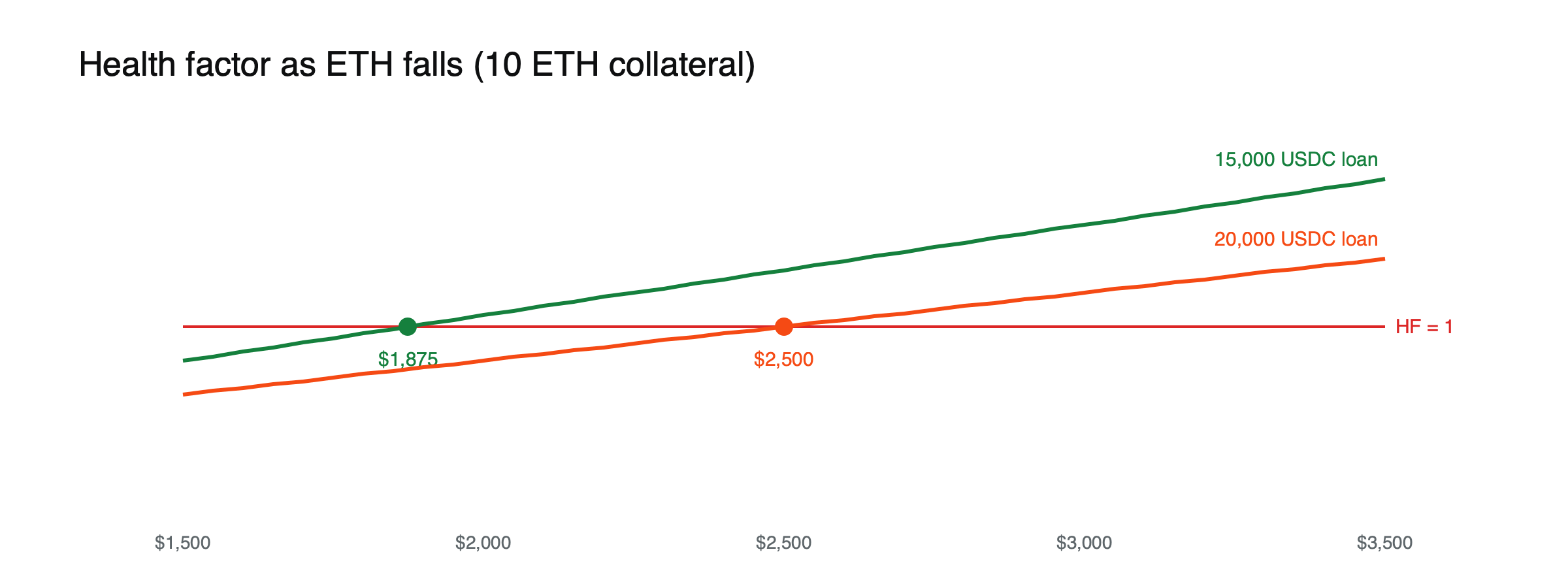
Figure: Health factor falls with the ETH price; the bigger loan hits 1 much sooner (illustrative 80% threshold).
Worked example 3: what a liquidation costs
ETH falls to $2,400 with the 20,000 USDC loan still open.
- Health factor = 10 × $2,400 × 0.80 ÷ $20,000 = 0.96, below 1.
A liquidator repays $10,000 of your debt, half of it, under a 50% close factor. In return they take $10,000 of ETH plus a 5% bonus (illustrative): $10,500, or 4.375 ETH.
- You keep 5.625 ETH ($13,500) and owe $10,000.
- New health factor = $13,500 × 0.80 ÷ $10,000 = 1.08.
- The bonus cost you $500 on top of losing the collateral that repaid the debt.
If prices keep falling, the position can be liquidated again.
Worked example 4: two kinds of collateral
Suppose you deposit $10,000 of ETH with an 80% liquidation threshold and $5,000 of wrapped bitcoin with a 75% threshold, and borrow $8,000 of stablecoins. (Illustrative thresholds.)
- Weighted collateral = $10,000 × 0.80 + $5,000 × 0.75 = $11,750
- Health factor = $11,750 ÷ $8,000 ≈ 1.47. Many lending apps show this figure.
Each asset contributes according to its own threshold, so a fall in the riskier asset, the one with the lower threshold, hurts the health factor less per dollar than a fall in the asset with the higher one.
Worked example 5: borrowing a token that rises
Now suppose you deposit $20,000 of USDC with an 80% threshold and borrow 3 ETH when ETH is worth $3,000, a debt of $9,000.
- Health factor = $20,000 × 0.80 ÷ $9,000 ≈ 1.78
- If ETH rises to $4,500, the debt is worth $13,500 and the health factor falls to about 1.19.
- The position becomes liquidatable if ETH reaches about $5,333, where the debt equals $16,000.
Borrowing a volatile asset is effectively a bet against it: if it rises, your loan becomes riskier even though your collateral has not changed.
What happens during a liquidation, step by step
- The oracle reports a new price, and your health factor falls below 1.
- Bots that monitor positions see that yours is now eligible.
- One of them sends a transaction that repays part of your debt, up to the protocol’s close factor.
- The protocol transfers collateral worth the repaid amount plus the liquidation bonus to the liquidator.
- Your position remains open with less collateral and less debt; if prices keep falling, the process can repeat.
All of this can happen within seconds of the price update, which is why reacting after an alert is often too late if the buffer was thin.
Stablecoin collateral versus volatile collateral
Using stablecoins as collateral and borrowing volatile tokens reverses the usual risk: the danger comes from the borrowed token rising rather than the collateral falling, as worked example 5 shows. Using volatile collateral and borrowing stablecoins is the more common setup, and the risk comes from the collateral falling. Knowing which side of your position can move is the first step in setting a safe buffer.
Interest and price feeds
Two quieter forces also move a health factor. Interest accrues on the debt continuously, so a position left alone for months slowly becomes riskier even if prices do not move. And the protocol uses prices from its oracle, not from any particular exchange, so a brief spike or gap in the oracle’s feed can trigger liquidation even if the price on your favorite exchange looked safe. See what a blockchain oracle is.
How to keep a position safe
- Borrow well below your limit; there is no universally safe health factor, because it depends on how volatile your collateral is.
- Add collateral or repay debt as the health factor falls.
- Watch both sides: if you borrow a volatile token, its price rising also lowers your health factor.
- Use alerts, since markets move outside working hours.
Why leverage makes it worse
Borrowing to buy more crypto adds leverage and makes liquidation more likely: a lower starting health factor leaves less room for prices to fall. Our list of crypto beginner mistakes covers why leverage catches out new users. For the full mechanics, read how DeFi lending and borrowing works. For the bigger picture, see what DeFi is.
This article is educational content and does not constitute financial, investment, legal or tax advice. Digital assets are volatile and you may lose the amount you invest.
Frequently asked questions
What health factor should I aim for?
There is no universal number. A useful approach is to ask how far your collateral could realistically fall in a bad week, then set a health factor that would survive that fall with room to spare. Collateral that swings more needs a higher starting buffer.
Can I be liquidated if I am asleep or offline?
Yes. Liquidations are triggered by anyone who sees an eligible position, at any hour. Alerts, automated tools and a large buffer are the main protections.
Sources
- Liquidations (health factor formula; below 1 can be liquidated; 50% close factor; liquidation bonus set by governance) — Aave documentation
- Liquidations concepts (example: $10,000 ETH, 80% threshold, $6,000 borrowed = 1.333; no universally safe level) — Aave documentation
- Liquidation (bonus typically 5%–10% on Aave V3; repeated partial liquidations) — Otomato