
What Is a Liquidity Pool?
A liquidity pool is a smart contract holding two or more tokens that traders swap against. How pools work, how providers earn fees, and the risks they take on.
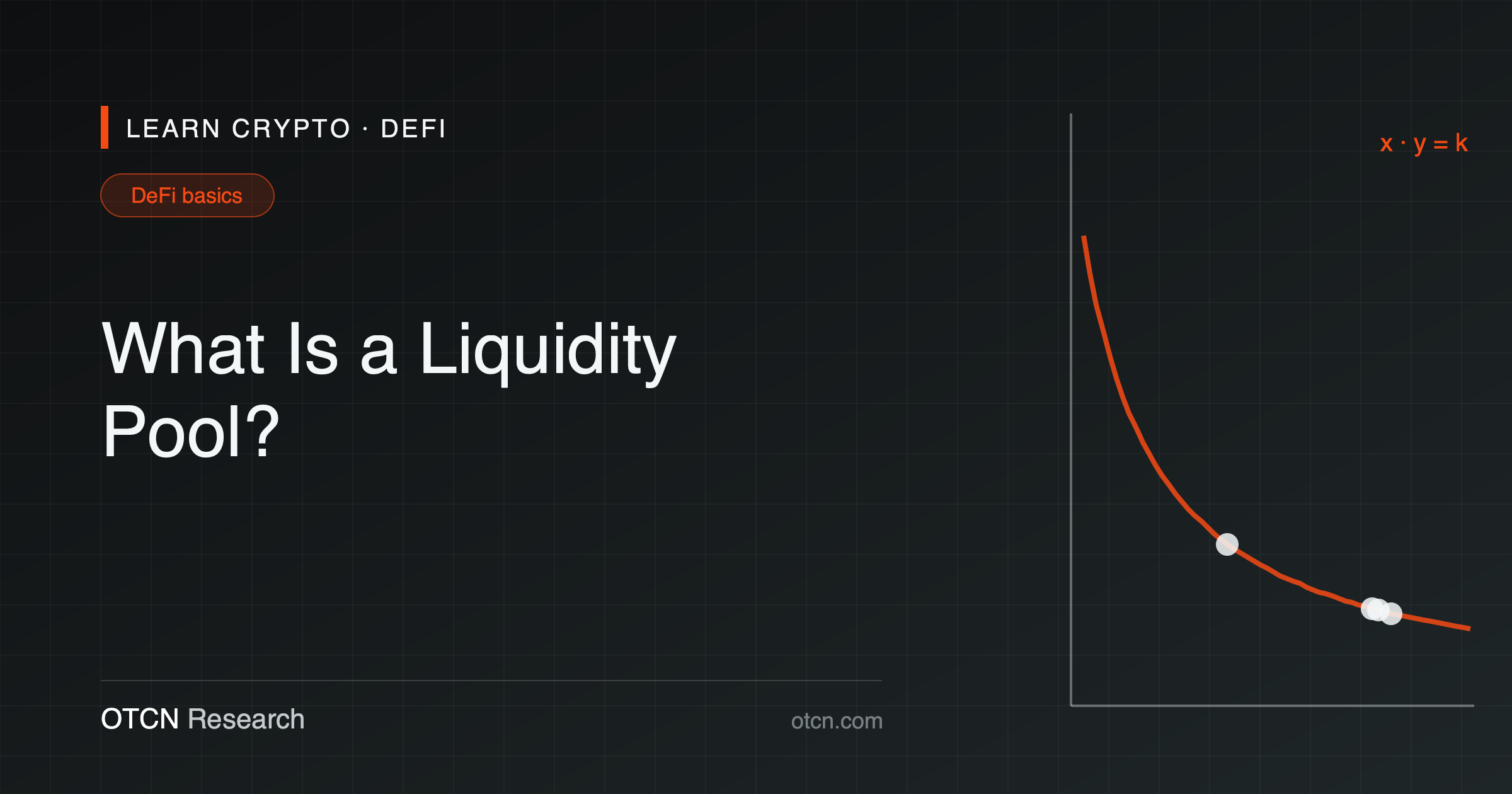
A liquidity pool is a smart contract that holds two or more tokens so people can trade between them without an order book. Anyone can deposit tokens and become a liquidity provider, earning a share of trading fees. Pools make decentralized exchanges work, but providers face risks such as impermanent loss and code bugs.
How a pool works
A typical pool holds two tokens, for example ETH and USDC. When you trade, you send one token into the pool and take the other out. A formula, usually the constant product rule explained in what an automated market maker is, sets the price from the ratio of the two balances. Each trade shifts that ratio and therefore the price.
Who supplies the tokens
Liquidity providers deposit both tokens, usually in equal value. In return, they receive LP tokens or, in newer designs, a position record that represents their share of the pool. Each trade pays a small fee that stays in the pool, so providers’ share of the pool grows over time. When they withdraw, they get back their share of whatever the pool holds at that moment, which may be a different mix of tokens than they deposited.
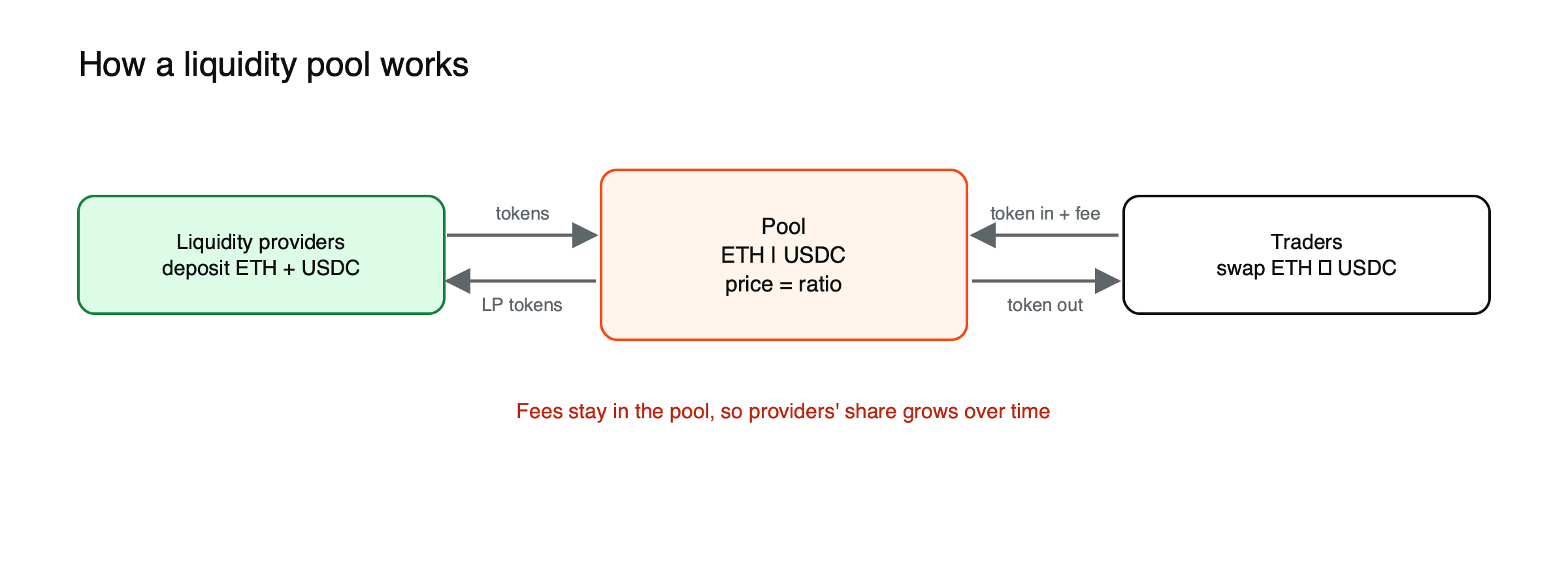
Figure: Who puts tokens into a pool and where the fees go.
Uniswap v3, launched in May 2021, introduced concentrated liquidity: providers can choose a price range, so their funds work harder but stop earning fees if the price moves outside that range.
Becoming a liquidity provider, step by step
- Choose a pool for a pair you are willing to hold, and check its fee tier and recent volume.
- Approve both tokens so the pool’s contract can take them from your wallet.
- Deposit both tokens, usually in equal value at the current price, or choose a price range in concentrated pools.
- Receive a record of your share, either LP tokens or a position that the app tracks for you.
- Earn fees as traders use the pool; in some designs they accumulate automatically, in others you claim them.
- Withdraw by returning your share, receiving both tokens in whatever proportion the pool now holds.
Types of pools
- Standard two-token pools use the constant product rule and suit most pairs.
- Stable pools use formulas designed for assets that should trade near the same value, such as two dollar stablecoins, keeping prices tight.
- Weighted pools hold tokens in uneven proportions, such as 80% and 20%.
- Concentrated pools let each provider choose a price range.
Reading a pool’s statistics
Most interfaces show a pool’s total deposits, its trading volume over the past day or week, its fee tier and an estimated fee return. The ratio of volume to deposits is a useful quick signal: a pool that trades a large share of its value each day earns more fees per dollar deposited than one that sits idle. Fee returns shown on screen are usually based on recent activity, so a quiet week can cut them sharply.
Why pool size matters
The more tokens in a pool, the less each trade moves the price. A $10,000 trade barely moves a pool holding hundreds of millions of dollars but can shift a small pool dramatically. Before you trade, check the pool’s size and the price impact your wallet or exchange shows. For trading costs, see what slippage is in crypto trading.
Risks for liquidity providers
- Impermanent loss: when prices move, a provider can end up worse off than if they had simply held the tokens. See what impermanent loss is and how to calculate it.
- Smart contract risk: bugs or exploits can drain a pool.
- Bad tokens: pools can be created for any token, including scams. A token that collapses leaves providers holding it. See what a rug pull is.
- Fees may not cover losses, especially in volatile pairs.
Providing liquidity or simply holding?
Becoming a liquidity provider makes sense when you are comfortable holding both tokens, expect their prices to stay within a reasonable range of each other and want to earn fees from trading. It makes less sense if you expect one token to rise sharply against the other, because the pool will steadily sell your winner as it rises. For many people, comparing the pool’s recent fee income with the impermanent loss from a plausible price move, and with the simple alternative of holding, is the clearest way to decide.
Liquidity across many pools
Most tokens trade in more than one pool, often across several exchanges and blockchains. Aggregators search these pools and split a trade between them to get the best price, which is why the price you see in a swap app can be better than any single pool would give. For liquidity providers, it means competition: fees flow to the pools that offer the best prices, so a small pool with a high fee tier may see little volume if a larger, cheaper pool for the same pair exists. Checking where most of a pair’s trading happens is worth doing before choosing a pool to join.
Pools and new tokens
When a new token launches, its first market is usually a pool created by the team or an early supporter. How much is deposited, and whether that liquidity is locked, decides how easily the token can be traded and whether the creators could pull the funds. Thin or unlocked pools are a common feature of scams. See what a rug pull is.
Pools vs order books
Order books, used by centralized exchanges, match buyers and sellers who post prices. Our guide to what liquidity is in crypto covers how both models create liquidity. For the bigger picture, read what DeFi is.
This article is educational content and does not constitute financial, investment, legal or tax advice. Digital assets are volatile and you may lose the amount you invest.
Frequently asked questions
Do I need to deposit both tokens?
In most pools, yes, in proportion to the current price. Some protocols offer single-token deposits that swap half for you, which adds a trade and its costs.
Can a pool run out of a token?
Not entirely in a constant product pool: the price of the scarce token rises steeply as it runs low, so it never reaches zero. In practice, a small pool can become so imbalanced that trading it is very expensive.