
What Is Tokenized Private Credit?
Tokenized private credit puts loans to businesses or consumers on a blockchain. How it works, how big it is, distributed vs represented value and the risks.
Tokenized private credit is lending to businesses or individuals outside public bond markets, with the loans or shares in a lending pool recorded as blockchain tokens. Investors earn interest paid by borrowers. In September 2026, about $8 billion was freely tradable on public networks, while far more was recorded on-chain without being tradable.
How it works
- A lender or fund makes loans, for example to small businesses, consumers or crypto firms.
- The loans, or shares in a pool of them, are issued as tokens.
- Borrowers pay interest, which flows to token holders after fees.
- If borrowers default, holders absorb the losses, sometimes after a junior layer.
Who borrows
The borrowers behind tokenized credit vary widely: fintech lenders funding consumer and small-business loans, companies financing invoices and trade shipments, property developers, and crypto trading firms borrowing to fund market making. Each carries very different risks. A pool of short-term invoices from established companies behaves nothing like a pool of loans to a handful of trading firms, even if both are described as private credit.
Diversification inside a pool helps, but only up to a point. Fifty loans to small businesses in one sector and one country can default together in a downturn, so the spread of borrowers across industries and regions matters as much as their number.
Senior and junior: how losses are shared
Many pools split investors into layers. Suppose a $10 million pool has a junior layer of $2 million and a senior layer of $8 million. (Illustrative figures.) The junior layer earns a higher rate because it absorbs losses first.
- If defaults cost $500,000, the junior layer loses 25% of its money and senior holders lose nothing.
- If defaults cost $2.5 million, the junior layer is wiped out and senior holders lose $500,000, about 6% of their stake.
Knowing which layer you hold, and how thick the layer below you is, matters more than the headline rate. Junior positions are often held by the manager or by specialist investors precisely because they are risky; when a pool offers retail investors the junior layer at an attractive rate, that is worth questioning before buying.
Distributed vs represented
Data providers separate two numbers. Distributed value counts tokens that holders can move and trade on public blockchains: about $7.96 billion for credit in September 2026. Represented value counts loans recorded on a blockchain but not freely transferable: about $37.8 billion. The second figure shows how much traditional finance is using blockchains as a record-keeping tool.
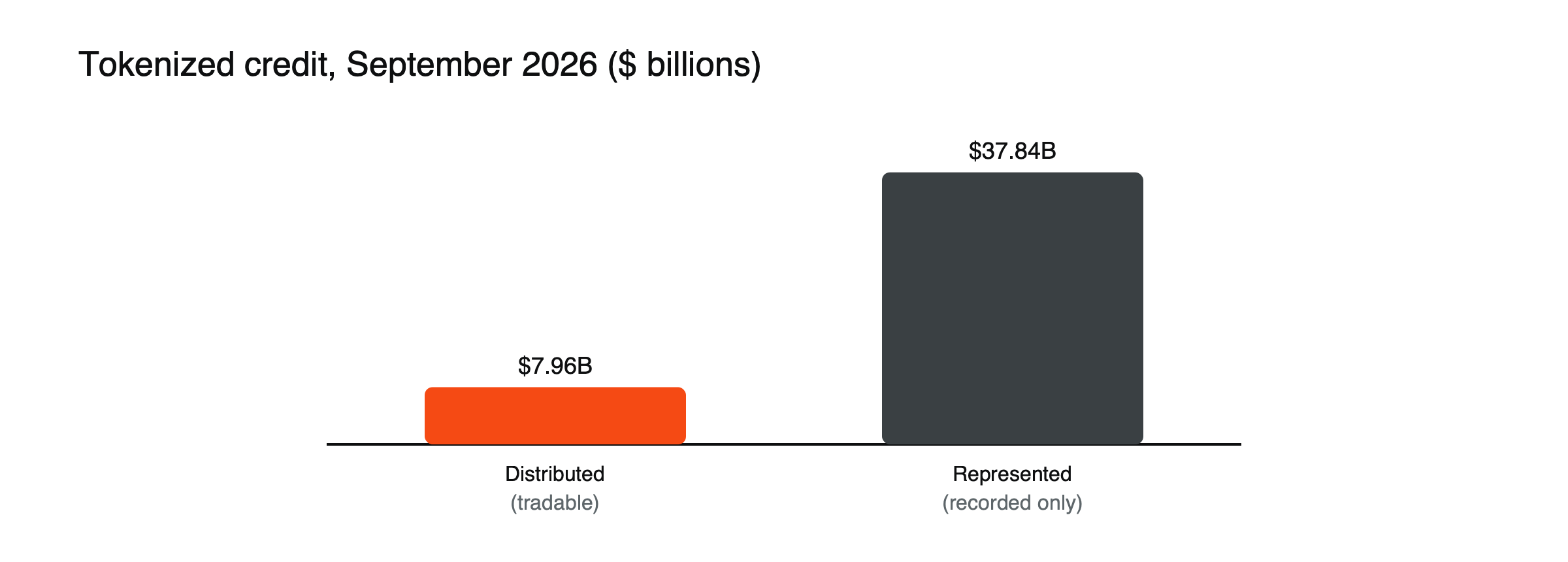
Figure: Distributed vs represented tokenized credit. Source: rwa.xyz via Eco, September 15, 2026.
Why it grew
Private credit was the largest tokenized category in early 2025, about 61% of tokenized real-world assets by one count, before Treasury products overtook it. Lenders use tokenization to reach new investors and settle faster; investors are drawn by interest rates above government debt.
What sets the rate
A private credit yield is built from several parts: the general level of interest rates, a premium for the chance that borrowers default, a premium for tying money up in loans that are hard to sell, and fees for the manager and platform. When a pool pays well above government bond yields, each of those parts is doing work. A rate that looks generous may simply reflect weaker borrowers or longer lock-ups, which is compensation for risk rather than a bargain.
Lessons from crypto lending’s bad year
In 2022, several on-chain credit pools that had lent to crypto trading firms suffered defaults when the market collapsed and firms tied to failed exchanges could not repay. Loans that had been made with little or no collateral, on the strength of borrowers’ reputations, proved hard to recover. Later products leaned more toward real-world borrowers, collateral and established managers, but the episode showed how quickly credit risk can turn into losses when borrowers are concentrated in one industry.
How performance is reported
Good managers report regularly on how a pool is doing: how many loans are late, how many have defaulted, how much has been recovered and how concentrated the borrowers are. Some publish pool-level data on-chain, so repayments and losses can be seen as they happen. The absence of regular, detailed reporting is itself a risk signal, because in private credit problems often build quietly before they show up as defaults.
Compared with a bond fund
| Tokenized private credit pool | Public bond fund | |
|---|---|---|
| Borrowers | Private companies or individuals | Governments and listed companies |
| Pricing | Periodic valuations | Daily market prices |
| Liquidity | Limited; lock-ups common | Daily, in normal markets |
| Information | Manager reports, varying detail | Public filings and ratings |
| Typical yield | Higher | Lower |
Risks to know
- Credit risk: borrowers can default, and recoveries can take years.
- Liquidity risk: loans cannot always be sold quickly; redemptions may be limited.
- Transparency: loan-level information is often limited.
- Manager risk: returns depend on how well the lender selects and monitors borrowers.
A higher rate means higher risk, not a free return. See where DeFi yield comes from and how to check what backs a tokenized asset. For the wider category, read what RWA tokenization is.
This article is educational content and does not constitute financial, investment, legal or tax advice. Digital assets are volatile and you may lose the amount you invest.
Questions to ask before investing
- Who are the borrowers, and how concentrated is the pool?
- Is there collateral, and who would enforce it after a default?
- Which layer do you hold, and how large is the layer below you?
- How long is your money locked, and how do redemptions work?
- How much loan-level information does the manager publish, and how often?
Frequently asked questions
Is tokenized private credit safer than lending in DeFi?
It is different rather than automatically safer. It relies on real-world borrowers, legal contracts and a manager’s judgment, while DeFi lending relies on overcollateralization and automatic liquidations. Each can fail, in different ways.
Can I sell my position early?
Sometimes, if the token trades on a secondary market or the pool allows redemptions, but liquidity is often limited and may disappear when it is most needed.