
How Stablecoin Rules Differ Between the EU and the US
The EU regulates stablecoins under MiCA and the US under the GENIUS Act. Compare reserves, licensing, yield bans, disclosure, timing and impact on users.
Comparing stablecoin regulation EU vs US, both agree on the basics: full reserves, licensed issuers, redemption rights and no interest for holders. They differ in timing, supervision and treatment of foreign stablecoins. MiCA’s stablecoin rules have applied since June 30, 2024; the US GENIUS Act takes effect by January 18, 2027.
The EU: MiCA
Under the EU’s Markets in Crypto-Assets Regulation, a stablecoin tied to one official currency is an “e-money token.” Its issuer must be authorized as an electronic money institution or a bank in an EU country, keep reserves separate from its own money and let holders redeem at par. Issuers may not pay interest for holding the token. Stablecoins tied to baskets of assets fall under separate, stricter “asset-referenced token” rules. MiCA also limits how much a large non-euro stablecoin can be used as a means of exchange inside the EU. Our guide to what MiCA is covers the wider law.
The US: the GENIUS Act
The GENIUS Act, signed on July 18, 2025, creates a federal framework for “payment stablecoins.” Issuers need a license from federal or approved state regulators and must hold 1:1 reserves limited to a closed list of assets: cash, insured bank deposits, Treasury bills maturing within 93 days, short-term repurchase agreements and certain money market funds. They must publish monthly reserve reports examined by an accounting firm and certified by executives, and may not pay holders interest or yield. In a bankruptcy, holders have priority claims on the reserves.
Side by side
| EU (MiCA) | US (GENIUS Act) | |
|---|---|---|
| In force | Stablecoin rules since June 30, 2024 | Effective by January 18, 2027 at the latest |
| Issuer | Authorized e-money institution or bank | Licensed federal or state issuer |
| Reserves | Full backing, segregated | 1:1, closed list of cash-like assets |
| Interest to holders | Prohibited | Prohibited |
| Disclosure | Required, with supervisor oversight | Monthly public reports, examined and certified |
| In bankruptcy | Redemption rights protected | Holders have priority on reserves |
| Platforms | Exchanges list only compliant tokens for EU users | From July 18, 2028, service providers offer only permitted stablecoins |
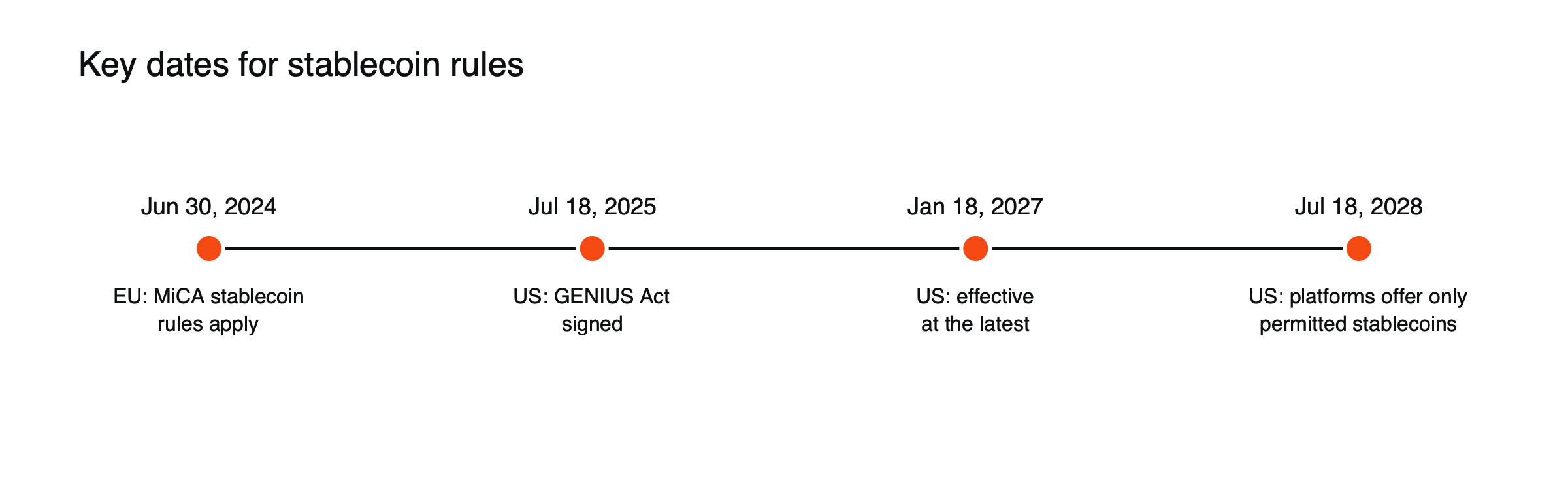
Figure: Key dates in the EU and US stablecoin rules.
Key dates
| Date | Event |
|---|---|
| June 30, 2024 | MiCA’s stablecoin rules begin to apply in the EU |
| July 18, 2025 | The GENIUS Act is signed into law in the US |
| By January 18, 2027 | GENIUS Act takes effect, or 120 days after final rules if earlier |
| July 18, 2028 | US service providers may offer only permitted payment stablecoins |
Where they really differ
Timing. The EU acted first; US rules are still being written and phase in through 2028.
Who supervises. The EU uses national authorities under a single rulebook. The US splits oversight between federal and state regulators.
Foreign stablecoins. MiCA restricts the use of large non-euro stablecoins in EU payments. The US law sets its own conditions for foreign issuers whose tokens are offered to US users.
Limits on foreign-currency stablecoins in the EU
MiCA does more than license issuers. It also limits how widely stablecoins tied to non-EU currencies can be used for payments inside the EU: once a token linked to a foreign currency exceeds roughly €200 million in daily payment transactions in the EU, the issuer faces restrictions on further issuance. The aim is to protect the euro’s role in European payments. The US law has no equivalent cap on euro or other foreign-currency tokens, reflecting the dollar’s position as the currency most stablecoins already use.
What happened to tokens that did not comply
Regulation changes what platforms can list. In the EU, crypto service providers must offer only authorized stablecoins to EU users, so tokens whose issuers did not obtain authorization were removed from trading for EU customers on a number of regulated platforms. In the US, a similar shift is scheduled: from July 2028, service providers may offer only payment stablecoins that meet the GENIUS Act’s requirements, which will push issuers to obtain licenses or comparable foreign approvals.
Foreign issuers serving US users
The GENIUS Act does not simply exclude stablecoins issued abroad. Foreign issuers can be permitted to serve US users if they are subject to a regulatory regime that US authorities judge comparable and if they meet additional conditions, such as being able to comply with lawful orders from US authorities. How strictly comparability is assessed will shape whether large offshore stablecoins remain widely available on US platforms after the transition period.
What issuers must tell you
Both regimes emphasize disclosure. Under MiCA, issuers publish a white paper and keep it up to date, and supervisors can require changes. Under the GENIUS Act, issuers publish monthly reports on tokens outstanding and the composition of reserves, examined by a registered public accounting firm and certified by senior executives. For users, this means the basic information needed to judge a regulated stablecoin, what backs it and how to redeem it, should be public and recent.
What is still unsettled
Both frameworks leave open questions that implementing rules and supervisory practice will answer over the next few years. They include how yield-bearing products built on top of stablecoins are classified, how decentralized stablecoins without a single issuer fit in, how quickly foreign regimes are recognized as comparable, and how supervisors treat stablecoins used mainly in decentralized finance rather than for payments. Until those details settle, the practical position for users is that availability and protections can differ from one platform and region to another.
What it means for users
- Fewer, better-documented stablecoins on regulated platforms in both regions.
- No interest from payment stablecoins, which pushes yield products into separate, regulated forms. Our guide to yield-bearing stablecoins explains them.
- Different token lists by region: a stablecoin available in one place may not be offered in another.
What happens next
Rules continue to develop through implementing regulations in both regions, so details here may change. For the basics, read what a stablecoin is.
This article is educational content and does not constitute financial, investment, legal or tax advice. Digital assets are volatile and you may lose the amount you invest.
Frequently asked questions
Do these rules make stablecoins risk-free?
No. They require reserves, disclosure and redemption rights, which make failures less likely and losses smaller, but they cannot remove market, operational or issuer risk entirely. A regulated stablecoin can still trade below its peg in a crisis.
Which rules apply to me?
Mostly the rules where the platform serving you is regulated. An EU resident using an EU-licensed exchange will see the MiCA list of tokens; a US user will see tokens that meet US rules once they apply. Holding tokens in a self-custody wallet is generally not restricted, but the platforms you use to buy, sell or redeem them are.
Sources
- Best Euro Stablecoins 2026 (MiCA e-money token rules in force June 30, 2024) — Eco
- MiCA’s €200M daily cap (Article 50 interest ban; limits on non-euro stablecoins) — BlockEden, May 2026
- Euro Stablecoins Hit Record Highs Under MiCA (segregated reserves; redemption rights) — BeInCrypto via Yahoo Finance, 2026
- GENIUS Act (reserve list; effective earlier of January 18, 2027 or 120 days after final rules; bankruptcy priority) — Paxos
- What Is the GENIUS Act? (signed July 18, 2025; July 18, 2028 platform deadline) — Transak