
What Happened in the May 2021 Crypto Crash?
In May 2021 bitcoin fell from a record near $65,000 to about $30,000 at one point. The timeline from Tesla's reversal to China's warning and what it showed.
The May 2021 crypto crash took bitcoin from a record of about $64,800 in mid-April to around $30,000 at its worst on May 19, 2021. Tesla’s halt to bitcoin payments on May 12 and a warning from Chinese authorities on May 18 set off heavy selling. On May 19, ether fell about 40% and dogecoin about 45%.
The rally that came before
The crash cannot be understood without the rally before it. Bitcoin had risen several times over in the year to April 2021, helped by companies adding it to their balance sheets, including Tesla’s $1.5 billion purchase announced in February, and by a wave of new retail investors. Meme coins such as dogecoin rose even faster on social media enthusiasm. Many traders had piled into leveraged long positions, confident that the rally would continue. That combination of high prices, crowded positioning and heavy leverage left the market vulnerable to any shock.
Timeline
- February 8, 2021: Tesla says it has bought $1.5 billion of bitcoin and will accept it for car purchases.
- April 13–14: bitcoin hits a record of about $64,800.
- May 12: Tesla suspends bitcoin payments, citing environmental concerns about mining.
- May 18: Chinese authorities reiterate that digital currencies cannot be used for payments, and a banking association warns members about crypto risks.
- May 19: bitcoin falls about 30% at one point to around $30,000, wiping out more than $500 billion from its peak market value before recovering toward $37,000. Ether drops about 40% and dogecoin about 45%. Coinbase shares fall to a record low.
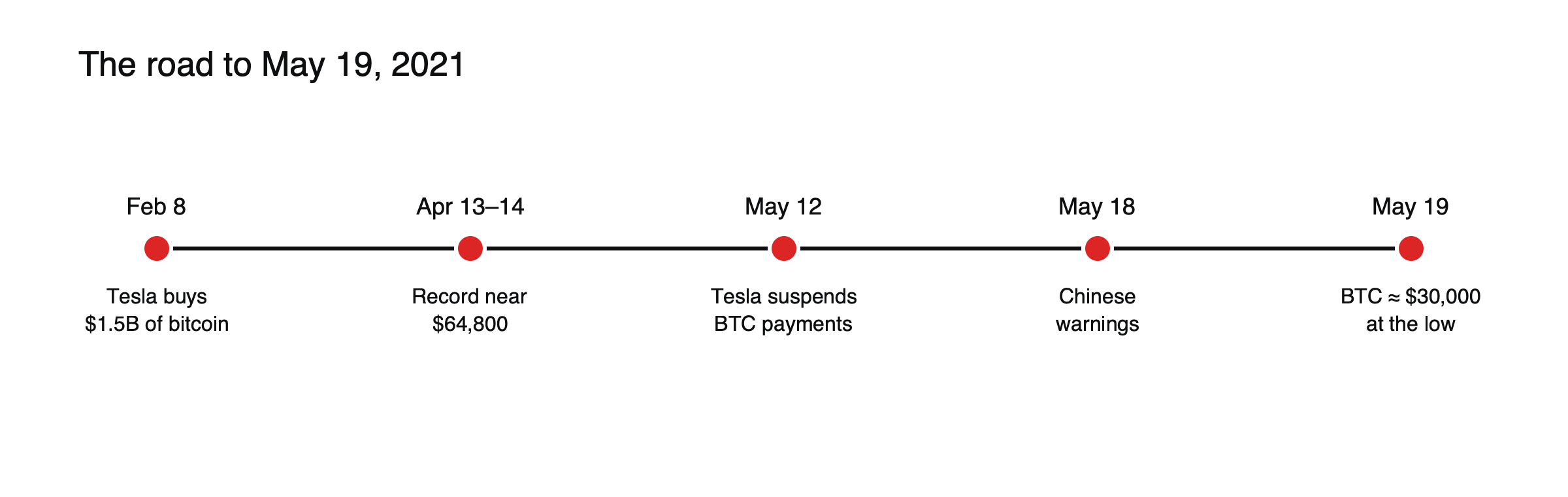
Figure: From record high to crash in five weeks.
The losses in numbers
Bitcoin’s fall from its April record erased more than $500 billion of its market value at the worst point on May 19, and the wider crypto market lost around $1 trillion over the week, according to CNN’s tally. On-chain data showed something else unusual: bitcoin holders who sold during the sell-off locked in about $2.56 billion of net losses in total, the largest such figure on record at the time, well above the $1.38 billion of March 2020 and the $0.95 billion of November 2018. Many of those sellers had bought near the top only a few short weeks earlier.
Why the fall was so sharp
Leverage. Many traders held leveraged long positions after a strong rally. As prices fell, forced liquidations added to the selling. See what causes liquidation cascades.
Concentrated sentiment. The rally had been fueled partly by high-profile endorsements, so their reversal had an outsized effect.
Regulatory fear. Headlines from China, then a large source of mining and trading, added to uncertainty.
China’s crackdown and the mining exodus
The selling did not end on May 19. On May 21, China’s Financial Stability and Development Committee, chaired by Vice Premier Liu He, said it would crack down on bitcoin mining and trading. Bitcoin fell about 8% within an hour of the news, and was down more than 6% at about $38,300 later that day. Mining pools began halting operations in China, regional authorities in Inner Mongolia set up hotlines for reporting mining activity, and large mining companies started preparing to move equipment abroad, much of it to North America. The crackdown began one of the largest relocations in bitcoin’s history, as a network once concentrated in China spread to other countries over the following months. See what bitcoin’s hash rate is.
What followed
Bitcoin recovered from its May 19 low within hours to the high $30,000s, but the market stayed volatile for weeks. Bitcoin was still well above its level of a year earlier, a reminder that sharp crashes inside longer rallies are common in crypto.
How the cascade played out
The mechanics on May 19 followed a familiar pattern, magnified by the amount of leverage in the market. Falling prices pushed the most leveraged long positions past their liquidation prices. Exchanges closed them with market orders, which pushed prices lower and triggered the next layer of liquidations. Order books thinned as market makers widened their quotes, so each forced sale moved the price further. Within hours, the fall had become far steeper than the news alone would have justified, before buyers stepped in and prices rebounded from the lows. See what causes liquidation cascades.
The network kept running
Bitcoin’s network itself was largely unaffected by the price crash, though it faced its own pressures. On May 19, hash rate at major Chinese mining pools dropped by as much as 23%, a fall widely attributed to power outages in Sichuan, before mostly recovering. The much larger shift came in the following months, as China’s crackdown pushed miners to move abroad.
How it compares with other crashes
The May 2021 crash was larger in dollar terms than March 2020’s Black Thursday, when pandemic panic drove bitcoin down by about half in a day, but it happened inside a longer bull market rather than at its start. It was followed by a recovery to new highs later in 2021, unlike the 2022 collapses of TerraUSD and FTX, which marked a deeper bear market. See what happened on Black Thursday 2020.
What it meant for regulators
The episode gave regulators around the world a vivid example of crypto’s volatility and of how much leverage retail traders could access. China moved from warnings to a broad ban on mining and trading later in 2021. Elsewhere, officials pointed to the crash when arguing for tighter rules on leveraged products and on how crypto was marketed to the public.
Who was hurt most
The heaviest losses fell on traders using leverage, whose positions were closed automatically as prices dropped, and on recent buyers of altcoins and meme coins, which fell much further than bitcoin. Newcomers who had joined during the spring rally, often through apps that made buying easy and leverage readily available, were among the hardest hit. Long-term holders who had bought earlier saw large paper losses but were often still in profit compared with a year before.
What it showed
- Single headlines can move the whole market when positioning is crowded.
- Altcoins usually fall harder than bitcoin in sell-offs.
- Leverage turns a drop into a crash, because forced selling does not wait for better prices.
For how leveraged positions are closed, read how to calculate a liquidation price. For the wider pattern, see what a crypto market cycle is and what perpetual futures are.
This article is educational content and does not constitute financial, investment, legal or tax advice. Digital assets are volatile and you may lose the amount you invest.
Lessons for traders today
- Check how crowded a trade is before adding to it; high funding rates and open interest after a long rally are warning signs. See what open interest is and what a funding rate is.
- Keep leverage low or avoid it around major news and in markets that have risen sharply.
- Assume liquidity disappears in a crash, so stop orders may fill far from where they were set.
- Separate long-term holdings from trading positions, so a forced sale of one does not touch the other.
Sources
- Bitcoin’s plunge intensifies (May 12 Tesla suspension; record of $64,829 in mid-April; down more than 30% to about $30,000) — NBC News, May 19, 2021
- Crypto in free fall (ether −40%, dogecoin −45%; PBoC statement) — Business Today, May 19, 2021
- Bitcoin’s m-cap plunges more than $500 billion (recovery toward $37,000; Tesla February 8 announcement; Coinbase record low) — Business Standard, May 19, 2021
- Explainer: why has the price of bitcoin been falling (China Banking Association warning; high above $64,800 on April 13) — AP via Spectrum News, May 2021
- Bitcoin tumbles as China says to crack down on mining, trading activities (May 21, 2021; down more than 6% at $38,293; Liu He) — Reuters via Business Standard
- China’s crypto crackdown spurs market volatility (May 21 State Council statement; bitcoin −8% within an hour; record $2.56 billion net losses vs $1.38 billion in March 2020 and $0.95 billion in November 2018) — 21Shares, May 25, 2021
- Crypto mining armageddon (mining pools halting China operations; Inner Mongolia reporting hotline; firms preparing to move to North America) — TechNode, May 25, 2021
- A crypto crash wiped out $1 trillion this week (headline) — CNN Business via Google News, May 22, 2021