
What Is Open Interest in Crypto?
Open interest is the value of futures or options contracts still open. How it rises and falls, how it differs from volume and how traders read it with price.
Open interest is the total number, or dollar value, of futures or options contracts that are open and not yet closed or settled. It shows how much money is committed to derivatives on an asset right now. Unlike trading volume, which counts every trade, open interest only rises when new positions are created and only falls when positions are closed.
How open interest changes
Every contract has a buyer and a seller. What happens to open interest depends on whether each side is opening or closing a position.
| Buyer | Seller | Open interest |
|---|---|---|
| Opens a new long | Opens a new short | Rises |
| Opens a new long | Closes an existing long | Unchanged |
| Closes an existing short | Opens a new short | Unchanged |
| Closes an existing short | Closes an existing long | Falls |
Liquidations also reduce open interest, because they close positions by force.
Contracts, coins or dollars
Open interest can be shown in contracts, in coins or in dollars, and the choice changes what it seems to say. Suppose traders hold perpetual positions on 50,000 BTC. At a price of $60,000, that is $3 billion of open interest; if the price rises to $66,000 with no new positions, it becomes $3.3 billion. (Illustrative figures.) Dollar open interest rises with price on its own, so comparing open interest in coins, or alongside the price, shows whether positions are really growing.
Open interest vs volume
Volume is how much traded in a period; open interest is how much remains open at a moment. A day of heavy trading between people closing positions can show high volume and falling open interest. See how to read trading volume.
How traders read it with price
- Price up, open interest up: new money is opening positions behind the move.
- Price up, open interest down: shorts are closing, which can fade once they are done.
- Price down, open interest up: new shorts are opening, or longs are adding.
- Price down, open interest down: positions are being closed, often through liquidations.
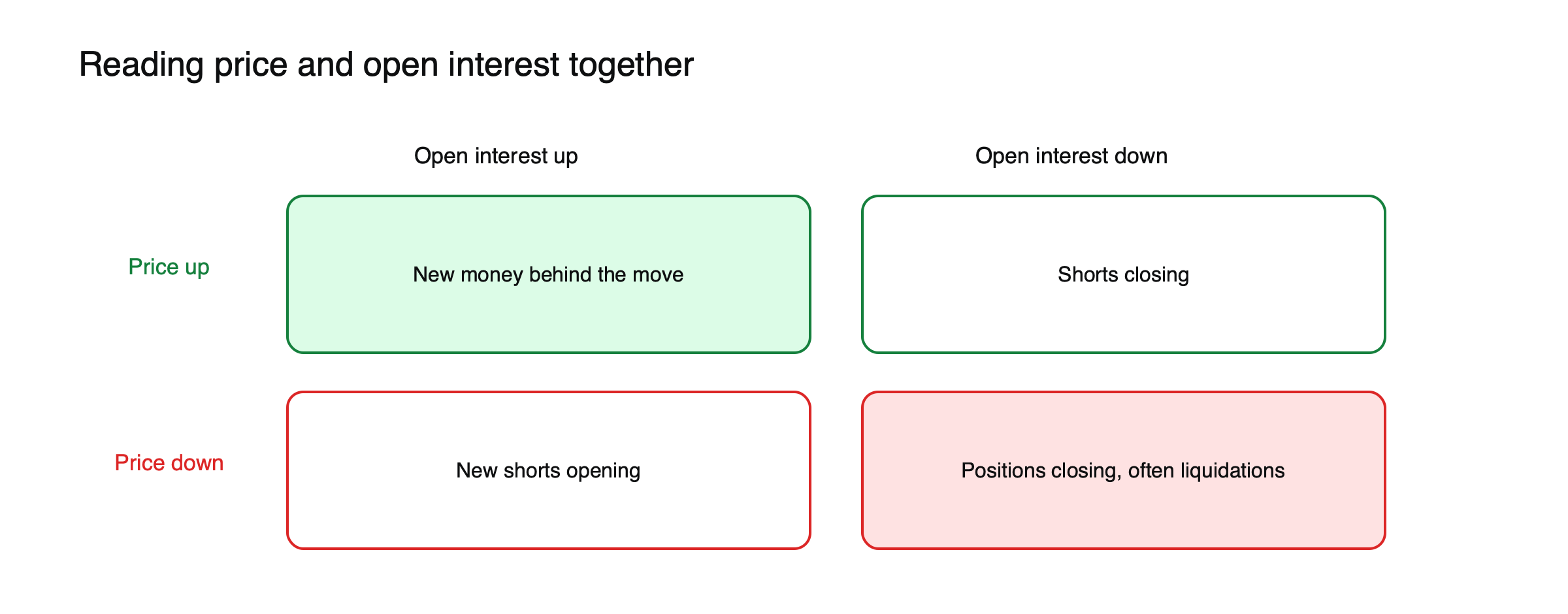
Figure: Common readings of price and open interest together. Tendencies, not rules.
These are tendencies, not rules. Open interest says nothing about whether longs or shorts are right.
A week, read through open interest
Suppose bitcoin rises 8% over four days while open interest in coins climbs 25% and funding rises well above normal. (Illustrative scenario.) New leveraged longs are piling in behind the move. On the fifth day, the price drops 5% in an hour and open interest falls 15%. That combination points to long positions being closed or liquidated rather than to a calm change of view. Neither phase says what comes next, but together they describe how crowded the market became and how quickly it unwound.
Why high open interest matters
A lot of open, leveraged positions means a lot of potential forced selling or buying if price moves sharply. Combined with high funding rates, it can signal crowded positioning. See how funding rates are calculated and what causes liquidation cascades.
Open interest against market size
Analysts often compare total futures open interest with the asset’s market value, sometimes called an estimated leverage ratio. A rising ratio means more leveraged positions relative to the coins themselves, and has tended to make markets more prone to sharp liquidation-driven moves. It is a rough measure, since some open interest is hedged against spot holdings rather than outright speculation.
Options open interest
Options open interest can be broken down by strike price and expiry date, showing where large numbers of contracts sit. Traders watch big concentrations around monthly and quarterly expiries, because the hedging activity of option dealers near those strikes can influence price movements as expiry approaches. See what crypto options are.
Around major events
Open interest often builds ahead of scheduled events, such as central bank decisions, large token unlocks or quarterly options expiries, as traders position for the outcome. A sharp move after the event can then unwind those positions quickly, which is why volatility around such dates often exceeds what the news alone would suggest. Watching open interest build into an event gives a sense of how much forced buying or selling could follow.
What open interest cannot tell you
Open interest shows how much is committed, not who is right or which side is larger, since every contract has both a long and a short. It does not distinguish hedgers from speculators, and it can be inflated by trading between related accounts on some venues. It also varies by exchange, so a jump on one platform may reflect traders moving from another. Treat it as context for price and funding, not as a signal on its own. For most traders, the practical use of open interest is as a warning light: when it is high and rising alongside extreme funding, it is a good reason to reduce leverage.
Examples of scale
In late June 2025, open interest in bitcoin options across venues exceeded $45 billion, with Deribit holding nearly 90% of it. Aggregate bitcoin perpetual open interest rose above $60 billion in late 2024. Such figures change daily; check a current data source before relying on them. For the bigger picture, read what perpetual futures are.
This article is educational content and does not constitute financial, investment, legal or tax advice. Digital assets are volatile and you may lose the amount you invest.
Where to find it
Exchanges publish open interest for their own contracts, and data providers aggregate it across venues, often with breakdowns by exchange, in coins and in dollars. Because each exchange counts only its own positions, using an aggregated source gives the clearest picture of the whole market.
Frequently asked questions
Is rising open interest bullish?
Not on its own. It means more positions are open, long and short in equal measure, since every contract has both sides. Combined with price direction and funding, it can suggest which side is more eager, but it does not predict direction.
Does spot trading affect open interest?
No. Open interest counts only derivatives contracts. Spot trades change ownership of coins but do not create or close contracts.