
How to Keep a Trading Journal
A trading journal records each trade, your reasons and the result. What to log, how to review it, and why it helps you see mistakes your memory hides.
To keep a trading journal, record every trade with its date, asset, size, entry and exit prices, fees, your reason for entering, planned exit and result, then review it on a fixed schedule. A journal shows what really happens to your money, because traders tend to overrate their skill and remember wins more than losses.
Why a journal helps
Research on retail traders is sobering. A study of Brazilian futures day traders who kept at it for at least 300 days found that 97% lost money, with no sign that they improved with experience. Barber and Odean’s research found that the most active traders underperformed by about 6.5 percentage points a year, largely because of trading costs. A journal is how you find out whether you are the exception, using your own numbers.
Setting it up
Choose a simple format
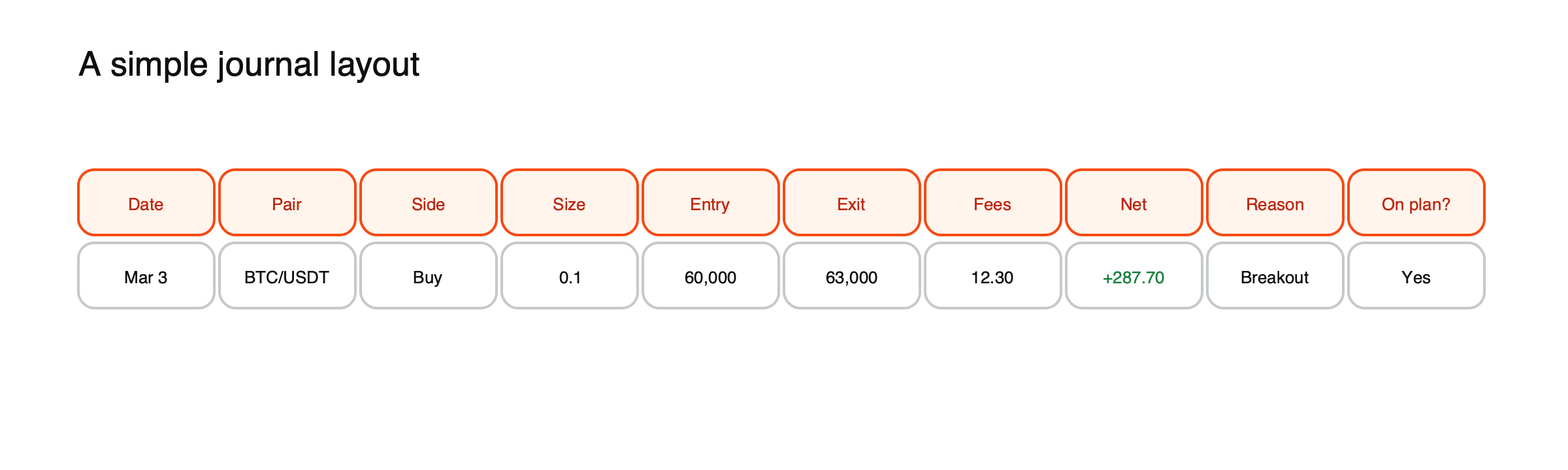
Figure: One row per trade, the same columns every time (example values).
A spreadsheet is enough. Use one row per trade and the same columns every time.
Record the facts of each trade
- Date and time, asset and trading pair.
- Direction (buy or sell), size, entry and exit prices.
- All fees, including trading, network and, for derivatives, funding.
- Net profit or loss in money and as a percentage.
Record your reasoning before the result
Write why you entered, where you planned to exit and what would prove you wrong. Write it before the trade closes, so hindsight cannot rewrite it.
Note what you did and how you felt
Did you follow your plan, move your stop or trade because of a headline? Short notes are enough.
Review on a schedule
Each week or month, total your results after fees, check your win rate and average win versus average loss, and look for repeated mistakes. See how to calculate profit on a crypto trade after fees.
A sample entry
| Field | Example |
|---|---|
| Date | 12 March, 14:20 UTC |
| Asset and direction | ETH/USDT, long |
| Size and entry | 1 ETH at $3,050 |
| Planned exit and stop | Target $3,300; stop $2,950 |
| Reason | Bounce from support zone; RSI turning up |
| Exit and result | Closed at $3,180; +$124 after fees |
| Notes | Exited early on a headline; did not follow plan |
(Illustrative entry.) The last line is often the most valuable: it records whether you did what you planned.
Numbers worth calculating
- Win rate: share of trades that made money.
- Average win and average loss: the size of typical outcomes.
- Expected result per trade: win rate × average win − loss rate × average loss.
- Largest drawdown: the deepest fall in your account from a previous high.
- Fees as a share of gross profit: how much of your trading edge goes to costs.
A monthly review, illustrated
Suppose a month’s journal shows 40 trades, 45% of them winners, with an average win of $120 and an average loss of $90. (Illustrative figures.) Expected result per trade is about $4.50, roughly $180 for the month. The fee column, however, totals $160, so almost all of the edge went to costs. The notes show that the worst losses came from trades opened within an hour of a previous loss. Two clear actions follow: trade less often, and stop for the day after a loss.
Journaling mistakes to avoid
- Recording only some trades, usually the winners or the interesting ones, which makes results look better than they are.
- Writing the reason after the result, when hindsight quietly rewrites why you entered.
- Tracking too many fields, so that keeping the journal becomes a chore and stops after a week.
- Never reviewing it, which turns the journal into a diary rather than a tool.
- Ignoring fees and funding, which hides the most common reason active traders lose money.
Turning reviews into rules
The point of reviewing is to change behavior. When the journal shows a repeated pattern, such as losses after trading late at night, oversized positions after a winning streak or trades taken outside your planned setups, write a rule that addresses it and add a column to track whether you followed it. Over a few months, the journal shows not only which trades work but which rules you actually keep.
What to look for in a review
- Are fees eating most of your gains?
- Do some setups, assets or times of day lose consistently?
- Do you break your own rules after losses?
A journal also makes record-keeping for taxes easier. See how to keep crypto transaction records. For common pitfalls, read common crypto trading mistakes, and for the basics, what a cryptocurrency exchange is.
This article is educational content and does not constitute financial, investment, legal or tax advice. Digital assets are volatile and you may lose the amount you invest.
A lighter journal for long-term investors
Investors who buy and hold for years do not need trade-by-trade statistics, but a short record still pays off. For each purchase or sale, note the date, amount, price and the reason in one sentence. Once a quarter, add a line on how the holding fits your overall plan and whether anything has changed. When prices swing sharply, rereading why you bought, and what you said would make you sell, makes it much easier to stick to a plan instead of reacting to headlines.
When the journal says stop
Sometimes the honest conclusion from a journal is uncomfortable: after several months, the trading has not beaten simply holding, once fees and time are counted. That is useful information, not failure. Many people who track their results carefully end up trading less, sizing positions smaller or moving most of their money into a simple long-term approach, keeping only a small amount for active trading. The journal is what makes that decision possible on evidence rather than on hope or frustration.
Keeping it safe
A trading journal contains sensitive information: your balances, exchanges, trading habits and sometimes wallet addresses. Store it somewhere private, avoid sharing screenshots that reveal account details, and never record passwords, seed phrases or API keys in it. A backup copy kept separately protects the record that your tax calculations and reviews depend on. If you share the journal with a mentor, remove those details.
Tools
A spreadsheet works well and costs nothing. Dedicated journaling apps can import trades from exchanges, calculate statistics automatically and tag trades by setup, which saves time for frequent traders. Whatever the tool, the discipline of writing the reasoning before the result matters more than the software.
Frequently asked questions
How long before a journal is useful?
A few weeks of consistent entries can already reveal costly habits, but judging whether a strategy works needs many more trades, often dozens or hundreds, because short runs of wins or losses are common by chance.
Should long-term investors keep a journal?
A simpler version helps them too: recording why they bought, what would make them sell and how the position fits their plan makes it easier to stick to that plan through large price swings.