
What Is Spot Trading in Crypto?
Spot trading means buying or selling crypto for immediate delivery at the current price. How spot orders work, how they differ from derivatives, what they cost.
Spot trading means buying or selling a cryptocurrency for immediate delivery at the current market price, called the spot price. Buy 0.1 bitcoin on the spot market and you own 0.1 bitcoin once the trade settles, to hold, withdraw or sell. Unlike futures, there is no contract, no expiry and no leverage unless you borrow.
How a spot trade works
- Choose a trading pair, such as BTC/USDT, meaning bitcoin priced in USDT. See what a crypto trading pair is.
- Place an order. A market order fills immediately at the best available prices; a limit order waits for your chosen price. See market order vs limit order.
- The exchange matches your order with sellers or buyers in its order book.
- You receive the asset in your exchange account, where you can keep it or withdraw it to your own wallet.
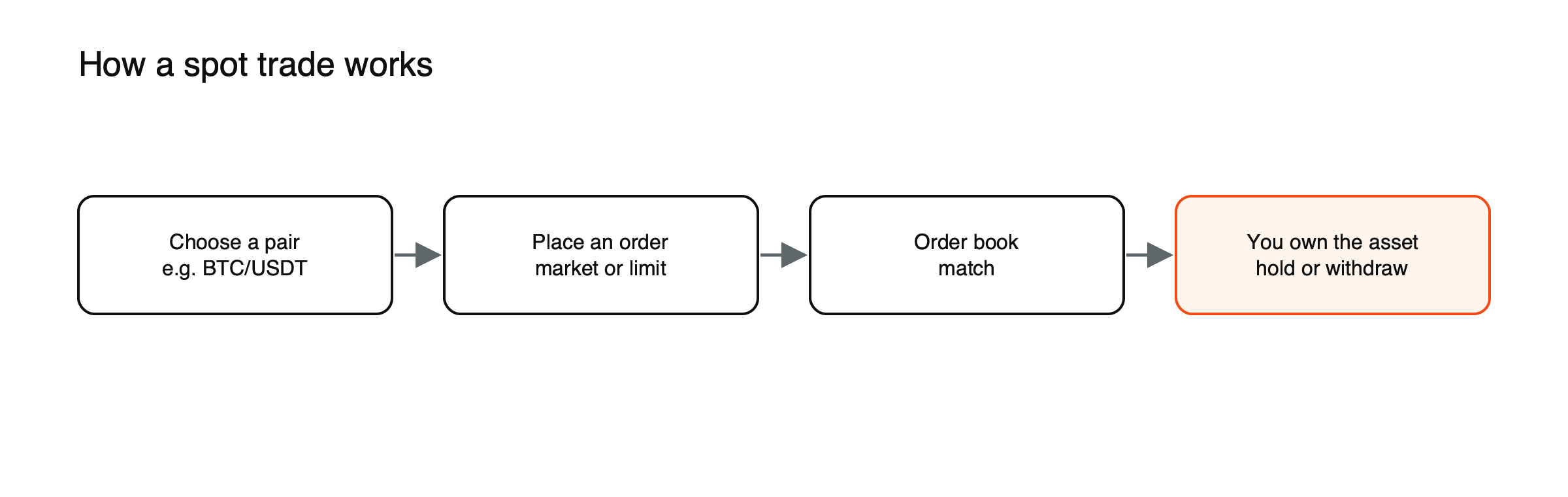
Figure: The four steps of a spot trade.
A first spot trade, worked through
You buy $1,000 of bitcoin at $60,000 with a market order on an exchange charging a 0.1% fee. (Illustrative figures.) After the $1 fee, you receive about 0.01665 BTC. If the best offer was slightly above the last traded price, the spread adds a further small cost you will not see listed as a fee. The coins appear in your exchange account at once. If you later want them in your own wallet, the withdrawal adds a network fee, and the exchange may set a minimum withdrawal amount.
Market and limit orders in practice
A market order is simple and certain to fill, but in a thin market it can fill at worse prices than the screen suggested. A limit order lets you choose your price and often qualifies for lower maker fees, but it may not fill if the market never reaches your level. Many spot traders use limit orders for planned purchases and market orders only when speed matters more than price.
Reading the order book before you trade
For anything larger than a small purchase, a quick look at the order book helps. The gap between the best bid and best offer shows the spread. The amounts listed at each price level show how far a market order of your size would move the price. If your order would eat through several levels, splitting it or using limit orders can save money. See what an order book is.
Stablecoin pairs and currency pairs
Most crypto trading happens against stablecoins such as USDT or USDC, and on some exchanges against national currencies such as dollars or euros. Stablecoin pairs often have deeper liquidity, while currency pairs make it simpler to move money to and from a bank. When comparing prices, check which pair you are looking at, since a small gap between a stablecoin and the dollar shows up in the price.
Spot vs derivatives
| Spot | Derivatives (futures, perpetuals, options) | |
|---|---|---|
| What you get | The asset itself | A contract based on the asset’s price |
| Leverage | None, unless you borrow | Commonly available |
| Can you withdraw the coin? | Yes | No |
| Can you profit from falling prices? | Only by selling what you own | Yes, by going short |
| Biggest risk | Price falls on what you hold | Liquidation of your margin |
For how perpetual contracts work, see what perpetual futures are.
What spot trading costs
- Trading fees, usually a percentage of the trade, often lower for limit orders that add liquidity. See trading fees explained.
- The spread, the gap between the best buy and sell prices.
- Slippage when a large market order moves through several price levels.
- Network fees when withdrawing to a wallet.
Spot trading on decentralized exchanges
Spot trading also happens on decentralized exchanges, where you swap tokens directly from your own wallet through liquidity pools rather than an order book. You keep custody throughout, but you pay network fees, face price impact in small pools and must check token contracts yourself. See how to use a DEX.
Moving coins off the exchange
Spot trading gives you real coins, which means you can withdraw them to a wallet you control. Many long-term holders do so once they have finished buying, to remove the risk of an exchange failure. Traders who buy and sell often may keep a working balance on the exchange and move the rest. See custodial vs non-custodial wallets.
When “spot” includes borrowing
Some exchanges offer margin trading on spot markets, lending you funds to buy more than your balance allows. That adds leverage, interest and the risk of forced selling, even though you are trading spot pairs. Plain spot trading without borrowing keeps your maximum loss to what you put in.
Keeping track of your purchases
Every spot purchase sets a cost basis: the price you paid, including fees, for that particular lot of coins. When you sell, the gain or loss is measured against it. Exchanges usually provide a downloadable history, but they do not know about coins you moved in from elsewhere, so combining records from all your accounts and wallets gives the full picture. Doing this regularly, rather than once a year, catches missing transfers while they are easy to trace and makes it far simpler to answer the basic question of how much you have actually made or lost. Tax software and spreadsheets can import exchange histories directly, which reduces manual entry but still needs checking for both gaps and duplicates.
Risks to know
- Price risk: the asset can fall sharply, and crypto often does.
- Custody risk while assets sit on an exchange; you can move them to your own wallet.
- Liquidity risk in small tokens, where selling can move the price a lot.
Who spot trading suits
Spot trading is the simplest way to own crypto, and the losses are limited to what you put in. For how exchanges work, read what a cryptocurrency exchange is.
This article is educational content and does not constitute financial, investment, legal or tax advice. Digital assets are volatile and you may lose the amount you invest.
Frequently asked questions
Is spot trading taxed?
In many countries, selling or swapping crypto bought on the spot market can create a taxable gain or loss. Keeping records of every purchase and sale makes the calculation easier. See how to keep records of your crypto transactions.
Can I lose more than I invest in spot trading?
Not without borrowing. The most you can lose is what you spent, if the asset falls to zero.