
What Happened When FTX Collapsed?
FTX went from a $32 billion exchange to bankruptcy in days in November 2022 after customer funds were used by Alameda. The timeline, trial and repayments.
The FTX collapse took an exchange valued at about $32 billion in early 2022 into bankruptcy within days in November 2022, after it emerged that customer deposits had been used by its sister trading firm, Alameda Research. Founder Sam Bankman-Fried was convicted of fraud and sentenced to 25 years in prison in March 2024.
Two companies that were never really separate
FTX was a crypto exchange, best known for derivatives trading, that grew at extraordinary speed after its launch and reached a private valuation of about $32 billion in early 2022. Alameda Research was a trading firm founded earlier by the same founder, Sam Bankman-Fried. On paper they were separate businesses: one held customers’ money, the other traded its own. In practice, the boundary between them barely existed, and that was the core of what went wrong. FTX also issued its own token, FTT, which both companies held in large amounts and which made up much of the value on Alameda’s balance sheet.
Timeline
- November 2, 2022: a report shows Alameda’s balance sheet is heavily made up of FTX’s own token, FTT.
- November 6: Binance says it will sell its FTT. Customers rush to withdraw.
- By November 8: FTX halts withdrawals; FTT has fallen more than 85%.
- November 11: FTX, Alameda and more than 130 affiliated companies file for bankruptcy; Bankman-Fried resigns.
- December 2022: Bankman-Fried is arrested in the Bahamas and later extradited to the US.
- November 2023: a jury convicts him on seven counts of fraud and conspiracy.
- March 28, 2024: he is sentenced to 25 years. The judge finds customers lost $8 billion.
- 2024–2025: the bankruptcy estate’s plan provides for most customers to receive about 118% of their claims, valued at November 2022 prices.
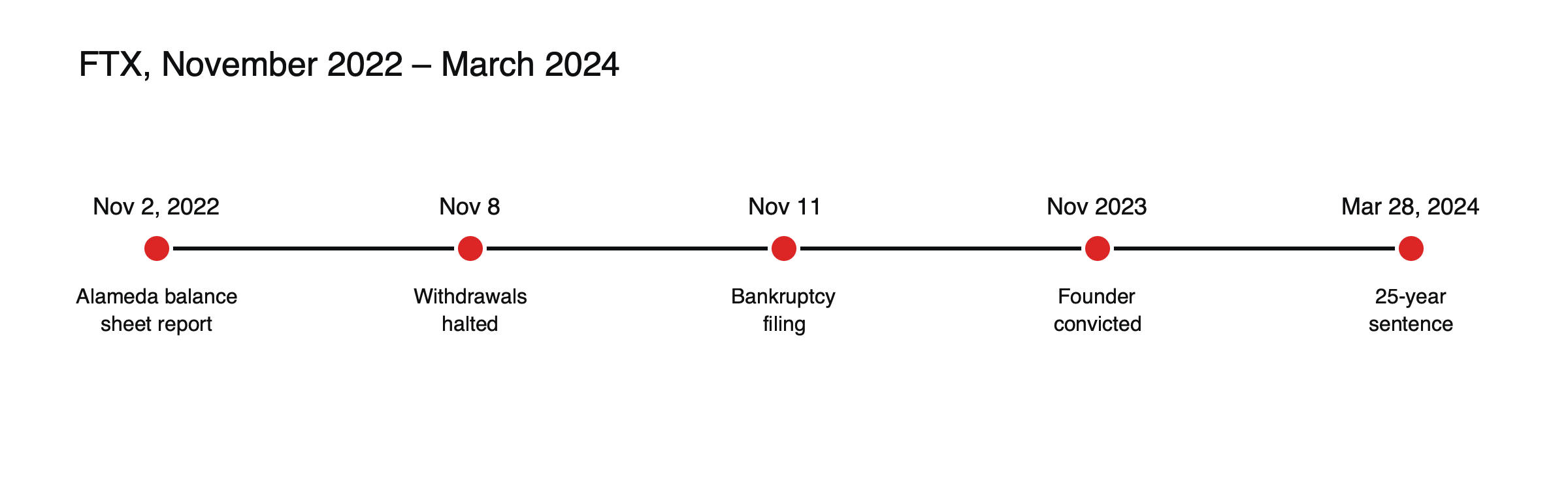
Figure: From first report to bankruptcy in nine days, then to sentencing.
See what an exchange token is for FTT’s role.
Why it collapsed in days, not months
An exchange that holds every customer’s coins one for one can survive a rush of withdrawals, because it simply hands the coins back. FTX could not, because a large part of what customers had deposited was no longer there to hand back. Once the report about Alameda’s balance sheet and Binance’s announcement triggered withdrawals, the gap appeared almost immediately. The value of FTT, which had propped up the group’s balance sheets, fell more than 85% within days, removing the collateral that might otherwise have been sold or borrowed against. A rescue deal with Binance was announced and abandoned within about a day. With no buffer, no lender of last resort and no time, the exchange stopped withdrawals and filed for bankruptcy within a week of the first report.
What the new CEO found
After the bankruptcy filing, John J. Ray III, who had overseen the wind-down of Enron, took over as chief executive. His first sworn declaration to the court described the worst controls he had seen in his career, citing what he called “a complete failure of corporate controls.” Among his findings: FTX had never had official audits; employees requested payments through an online chat platform, where supervisors approved spending by replying with emojis; his team could not even compile a complete list of who had worked for the group; and there was no effective separation between FTX and Alameda. Much of the financial information the companies had produced could not be trusted, so the new team rebuilt the records from cash transactions upward.
What went wrong
Customer money was not held separately. Former executives testified that Bankman-Fried directed them to use FTX customer funds to cover Alameda’s losses and investments. The group’s balance sheet relied on its own token, which lost its value once confidence broke.
How the recovery came together
Over the following two years, the bankruptcy estate recovered cash, sold investments and clawed back funds, assembling between about $14.7 billion and $16.5 billion for distribution against roughly $11.2 billion owed to creditors. A Delaware bankruptcy judge approved the repayment plan in October 2024, in what Ray described as the largest and most complex bankruptcy distribution in history, reaching creditors in more than 200 jurisdictions. The first payments, to customers with claims of up to $50,000, began in February 2025, with further rounds after that.
Who was held responsible
Sam Bankman-Fried was convicted on seven counts and sentenced to 25 years in prison. Caroline Ellison, who ran Alameda and became a key witness against him, was sentenced to two years. Other senior executives who cooperated with prosecutors also pleaded guilty. The court’s findings settled the central question: customer money had been taken and used, not lost by accident.
The repayment twist
Repayment of about 118% sounds like a full recovery, but claims were valued in dollars at November 2022 prices, when bitcoin traded around $16,000. Customers who held crypto on FTX missed the later price rise.
The ripple effects
The collapse hit the whole market. Bitcoin fell to around $16,000, close to its low for the cycle, and confidence in centralized platforms collapsed. Crypto lenders and funds that had deposited money on FTX or lent to Alameda faced losses of their own, and several failed in the following weeks. Regulators who had been debating crypto rules for years gained a clear example of what happens when customer funds are not protected.
What proof of reserves can and cannot show
Many exchanges responded by publishing proof of reserves: evidence that they control enough assets to cover customer balances. That helps, but it is only half the picture. Showing assets without an equally reliable view of liabilities, including loans and obligations the exchange may have, can paint a reassuring picture that is incomplete. A full audit of the company remains the stronger test. See what proof of reserves is.
Warning signs that were visible
With hindsight, several risks were public before the collapse. An affiliated trading firm sat next to the exchange, with no independent oversight of how they dealt with each other. The group’s balance sheets leaned heavily on its own token, whose value depended on confidence in the same companies. The exchange operated mainly from jurisdictions with lighter supervision and had never published audited accounts. None of these alone proved fraud, but together they described a structure in which customers had to take a great deal on trust.
What it changed
- Segregation of customer funds became a focus for regulators.
- Proof of reserves spread across exchanges. See what proof of reserves is.
- Self-custody gained supporters. See custodial vs non-custodial wallets.
For an earlier failure, read what happened to Mt. Gox. For the basics, see what crypto custody is.
This article is educational content and does not constitute financial, investment, legal or tax advice. Digital assets are volatile and you may lose the amount you invest.
What it means for anyone using an exchange
- Ask whether customer assets are held separately from the company’s own money, and whether anyone independent checks.
- Be wary of platforms whose finances rely on their own token, or that sit alongside affiliated trading firms.
- Watch for slow or paused withdrawals, which are often the first visible sign of trouble.
- Keep long-term holdings in a wallet you control, and only what you need for trading on any exchange.
FTX’s customers eventually received more than their claims in dollar terms, which is unusual in a bankruptcy. That outcome depended on the recovery of assets and a rising market, not on any protection customers had at the time.
Sources
- Special Report on the FTX Debacle (November 2022 timeline) — 21Shares
- Most customers of FTX will get their money back with interest ($32 billion valuation; November 11 bankruptcy; December arrest; 118% for claims of $50,000 or less) — Babel
- Sam Bankman-Fried sentenced to 25 years ($8 billion customer losses; testimony on use of customer funds) — The Globe and Mail, March 2024
- FTX returns money to most customers (bitcoin at $16,080 in November 2022) — NBC Montana / AP, May 2024
- FTX funds will be distributed soon (plan approved; ~119% recovery; $14.7–16.5 billion; $8 billion hole; Ellison two years) — Banking Dive, October 2024
- FTX begins initial fund distributions to customers (convenience class up to $50,000; plan approved October 2024) — The Block, February 2025
- FTX creditors will earn 119% in bankruptcy settlement ($11.2 billion owed; more than 200 jurisdictions) — PYMNTS, October 2024
- Declaration of John J. Ray III summarized (no official audits; payment approvals by emoji; no effective separation of FTX and Alameda) — David Gerard, November 2022
- FTX’s new bankruptcy boss slams “complete failure of corporate controls” — City A.M., November 2022