
Spot vs Futures Prices in Commodity Markets
Spot prices are for delivery now; futures prices are for delivery later and include storage, financing and expectations. How they differ and why it matters.
Spot vs futures prices differ in timing: spot is for delivery now, futures for delivery at a set later date. The gap reflects storage, financing and expectations about supply and demand. In April 2020, the expiring May WTI contract settled at −$37.63 while June settled at $20.43, showing how far apart dates can be.
Side by side
| Spot | Futures | |
|---|---|---|
| Delivery | Now | A set future date |
| Where quoted | Physical markets, benchmarks | Exchanges |
| Includes | Current supply and demand | Carry costs and expectations |
| Expiry | None | Each contract expires |
| Typical CFD link | Cash or spot CFDs | Futures-based CFDs |
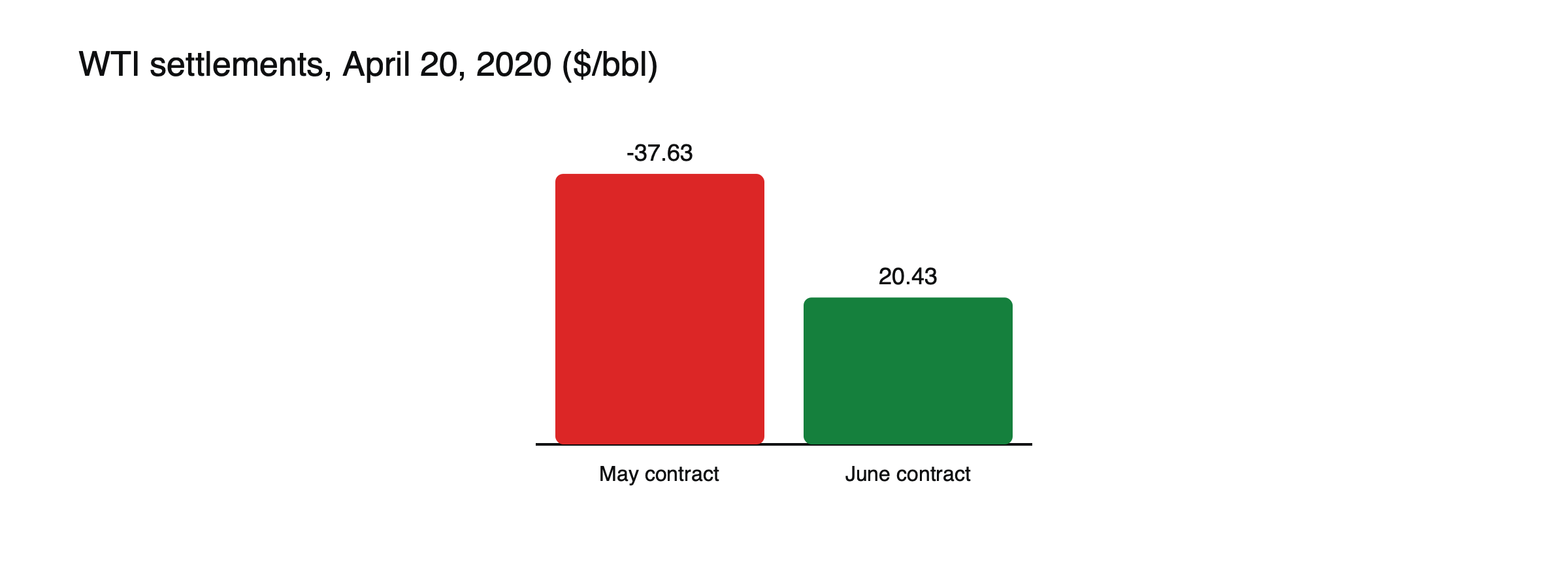
Figure: Two delivery dates, two very different prices. Source: Hart Energy.
Why futures differ from spot
- Cost of carry: storage, insurance and financing usually make later delivery more expensive.
- Convenience yield: when supplies are tight, holding the physical commodity now is worth more, pushing spot above futures.
- Expectations about future supply and demand.
See what contango and backwardation are.
The relationship in numbers
Suppose gold trades at $2,400 an ounce for immediate delivery, US interest rates are 4.5% and storage and insurance cost very little. (Illustrative figures.) A futures contract for delivery in a year should trade near $2,400 × 1.045, about $2,508, because a buyer who waits a year can earn interest on the money in the meantime. If the futures price were much higher, traders could buy gold now, store it and sell the future at a profit; if it were much lower, they could do the reverse. This cost-of-carry relationship keeps futures and spot prices tied together for commodities that are easy to store.
When storage breaks the link
For commodities that are costly or impossible to store in large amounts, such as electricity or, at times, crude oil when tanks are full, the link between spot and futures loosens. Prices for immediate delivery can then swing far more than later prices, as in April 2020, when the expiring oil contract fell below zero while later months stayed positive.
Convergence at expiry
As a futures contract approaches its delivery date, its price converges toward the spot price, because on the last day both describe the same thing: the commodity delivered now. Traders holding expiring futures must close, roll or prepare for delivery. CFD providers roll or close futures-based positions before this point, but the convergence explains why a futures-based CFD’s price can move differently from a spot quote in the final weeks of a contract.
Why it matters for CFD traders. A futures-based CFD’s price can jump at each roll even if nothing happens in the market; a cash CFD shows the carry through daily financing instead. See how a futures roll adjusts a commodity CFD price.
Which price is the real one?
«Spot is the real price» is not always true: for many commodities, the most traded futures contract sets the benchmark that spot deals reference.
Benchmarks in practice
Many physical commodity deals are priced from futures or from benchmark assessments rather than from a single spot market. Crude oil cargoes are often priced against benchmarks such as Brent, and gold has an official daily price set in London. These benchmarks link the physical and futures markets and help explain why quoted spot prices sometimes differ slightly between sources. See what the LBMA gold price is and WTI vs Brent.
Choosing between cash and futures-based CFDs
For short holding periods, a cash CFD that follows the near-term price is usually simpler and cheaper. For holding through several months, a futures-based CFD on a later contract can be cheaper, because the carry is built into the price rather than charged every night, though spreads are often wider and positions must be rolled at expiry. Comparing the expected financing on a cash CFD with the roll costs on a futures-based one, for your planned holding period, shows which suits the trade. See how a futures roll adjusts a commodity CFD price.
Common misreadings
- Treating the futures price as a forecast of the future spot price.
- Comparing prices from a cash CFD and a futures-based CFD as if they should match.
- Forgetting that roll adjustments change a futures-based CFD’s price without any change in the market.
The basis
The difference between a spot price and a futures price is called the basis. It reflects storage, financing, insurance, transport and the balance of supply and demand at the delivery location. Producers and users who hedge with futures watch the basis closely, because a hedge protects against changes in the futures price but not against changes in the basis. When the basis moves sharply, as it did for oil in 2020, even well-hedged businesses can face unexpected gains or losses.
Delivery locations matter
Futures contracts specify where the commodity is delivered. The main US crude contract is delivered at Cushing, Oklahoma, a storage hub; when tanks there filled up in April 2020, the expiring contract’s price collapsed even though oil elsewhere still had buyers. Spot prices in other locations can differ from the futures price by transport costs and local conditions. Knowing where a benchmark is delivered helps explain moves that seem out of line with the wider market.
Arbitrage and its limits
When futures and spot prices drift too far apart, traders with storage, transport or financing can profit by buying in one market and selling in the other, which pulls prices back together. That arbitrage only works for those with physical access and capital. When storage is full, transport is blocked or financing is scarce, the gap can stay wide for longer than models suggest, which is when spot and futures prices tell the most different stories.
Gold’s spot and futures prices
For gold, the gap between spot and futures is usually small and steady, close to the cost of financing, because gold is cheap to store and widely held. A gold futures price above spot by roughly the interest rate for the period is normal, not a sign of expected gains. Sharp changes in that gap are very unusual and can point to stress in physical supply or in funding markets, which makes them worth noting.
Frequently asked questions
Why does my oil CFD price differ from the news headline?
News often quotes the front-month futures contract, while your CFD may track a cash price or a different month. Small differences are normal.
Does the futures price predict where spot will go?
Not reliably. It mainly reflects today’s spot price plus carrying costs and current supply conditions, not a forecast.
This article is educational content and does not constitute financial, investment, legal or tax advice. Digital assets are volatile and you may lose the amount you invest.