
How Stock CFDs Work
A stock CFD tracks a share price without owning the shares. How long and short stock CFDs work, margin and leverage limits, dividends, financing and risks.
Stock CFDs are contracts that track a company’s share price, letting you go long or short without owning shares. You put up margin, 20% under EU retail rules (5:1), and profit or loss follows the price times your CFD shares. Dividends come as cash adjustments, overnight positions pay financing, and there are no votes.
How a stock CFD trade works
- Choose a share and a direction: buy if you expect a rise, sell if you expect a fall.
- Choose a size in shares; the position value is shares × price.
- Post margin, a fraction of the position value.
- Close to realize the price difference in cash.
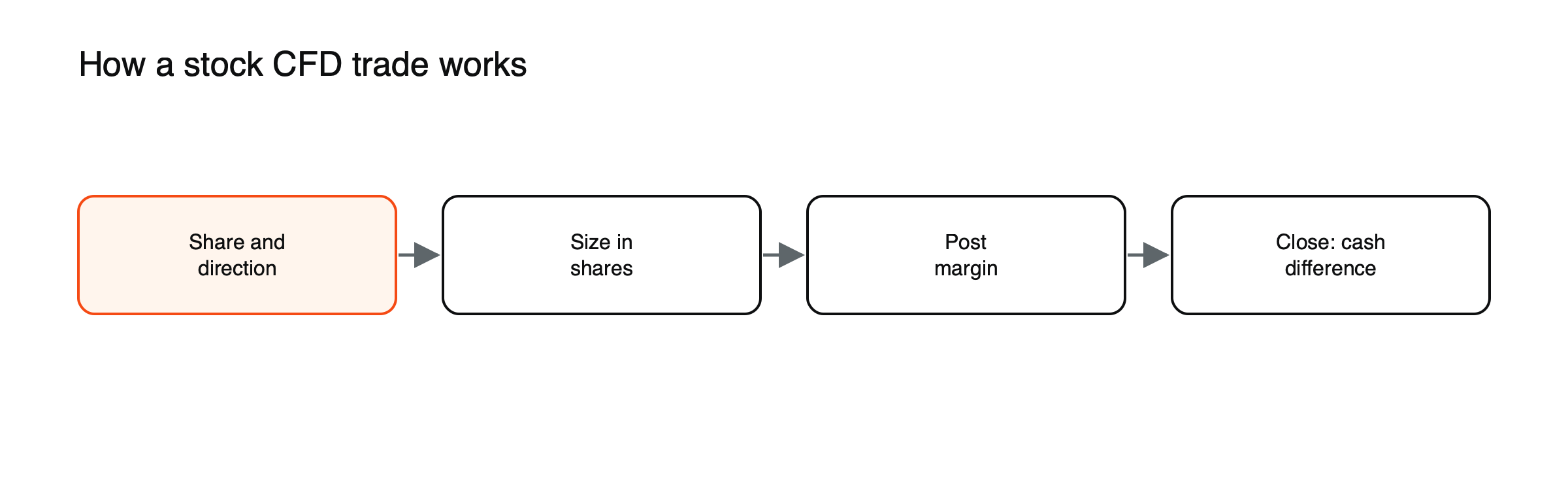
Figure: A stock CFD trade, step by step.
Example: buy 50 CFD shares at $200 = $10,000 position; at 5:1, margin is $2,000. A 1% rise earns $100. See how to calculate your exposure on a stock CFD.
Which shares can be traded
Providers typically offer CFDs on large companies listed on major exchanges in the United States, Europe and Asia, and sometimes on smaller companies. The range varies widely, and some shares are available only for long positions because borrowing them for shorts is difficult. Each CFD follows the price of the underlying share on its home exchange and trades during that exchange’s hours.
A long trade, worked through
A trader buys 100 CFD shares of a company at $50, a position worth $5,000. At the 5:1 retail limit, margin is $1,000. The share rises to $54 after strong results, and the trader closes for a gross gain of $400, 40% of the margin, before costs. Had the share fallen to $46, the loss would have been the same $400. (Illustrative figures.)
A short trade, worked through
A trader expects a company’s shares to fall and sells 100 CFD shares at $80, an $8,000 position with $1,600 of margin. The share drops to $74, and the trader buys back for a gross gain of $600. While open, the short position paid financing and, for some shares, a borrowing charge; if a dividend had gone ex during the trade, the short would also have paid it. If the share had instead risen to $90, the loss would have been $1,000, more than half the margin. Shorts have no ceiling on how far the price can rise. See how short selling works with CFDs.
What differs from owning shares
- No ownership or votes.
- Dividends arrive as cash adjustments; short positions pay them. See what happens to a stock CFD on ex-dividend day.
- Financing applies to positions held overnight. See how overnight financing works.
- Corporate actions such as splits are applied to your position. See how stock splits affect a CFD position.
The costs of a stock CFD
| Cost | How it usually works |
|---|---|
| Commission | Often charged per trade as a percentage of value, with a minimum |
| Spread | The gap between buy and sell prices, often tight on large shares |
| Overnight financing | A benchmark rate plus a markup on long positions; shorts may receive or pay |
| Borrowing charge | An extra cost on shorts in hard-to-borrow shares |
| Currency conversion | Applied when the share is priced in another currency |
Many providers charge commissions on share CFDs rather than relying only on the spread, as they do for currencies.
Financing, worked through
Suppose a long position of $10,000 is held overnight, the benchmark rate is 4.3% and the provider adds 2.5%. The annual rate is 6.8%, so one night costs about $1.86. Over a month, that is about $56, and over a year about $680, which is why stock CFDs are usually better suited to positions held for days or weeks than to long-term investing. See how CFD overnight financing works.
Market hours and gaps
Stock CFDs trade only while the underlying exchange is open, sometimes with limited pre-market or after-hours trading. Company news often arrives outside those hours, especially earnings results, which are usually published before the open or after the close. Shares can therefore open far from their previous close, and stops fill at the opening price rather than their set level. A 10% gap on a 5:1 position is half the margin. See how earnings reports move stock prices.
Corporate actions
Splits, rights issues, special dividends, mergers and spin-offs change the underlying share, and providers adjust CFD positions to reflect them, so that the economic value of the position is preserved as far as possible. A takeover can close a position at the offer price; a delisting can leave a position closed at the last traded price. See how corporate actions affect stock CFDs.
Key risks
- Earnings and news gaps: shares can open far from the previous close.
- Leverage: a 20% fall wipes out 5:1 margin.
- Short-specific risks: borrowing charges, recalls and short squeezes.
See CFD trading vs owning the underlying asset and what a CFD is.
Stock CFDs compared
| Stock CFD | Owning the shares | Equity options | |
|---|---|---|---|
| Ownership and votes | No | Yes | No |
| Leverage | Up to 5:1 for retail in the EU | None unless borrowing | Built into the option |
| Short selling | Straightforward | Requires borrowing shares | Through puts |
| Holding costs | Daily financing | None beyond fees | Time value decays |
| Maximum loss on a long | Can exceed margin | Amount invested | Premium paid |
In some countries, CFDs are also treated differently for tax and transaction duties than shares; for example, CFDs on UK shares are not subject to the stamp duty charged on share purchases. Tax rules vary and change, so it is worth checking local rules.
Margin calls on share positions
Because a 20% fall uses up the entire margin on a 5:1 long, shares that drop sharply on bad news can trigger margin calls quickly, and EU rules close positions when equity falls to half the required margin. Holding several positions in the same sector multiplies the risk, because sector-wide news hits them together. See how to calculate your exposure on a stock CFD and what margin calls and stop-outs are.
A checklist before a stock CFD trade
- When are the company’s next results, and will you hold through them?
- Is an ex-dividend date coming up?
- What will financing cost for your planned holding period?
- For a short, is the share easy to borrow, and is there a borrowing charge?
- Is the position sized from the stop and a fixed risk, not from available margin?
Using stock CFDs to hedge
Investors who own shares sometimes use CFDs to hedge them temporarily, for example by shorting a CFD on a share they hold before an uncertain event, without selling the shares and triggering tax or transaction costs. A short CFD on an index can hedge a broader portfolio. The hedge costs financing and spreads, and it removes the upside as well as the downside while it is in place, so it suits short periods of specific risk rather than permanent protection.
Single shares or indices?
A single-share CFD carries the company’s own risks, such as earnings surprises, management changes or legal problems, on top of market moves. An index CFD spreads that risk across many companies and carries higher leverage limits for retail clients, 20:1 for major indices against 5:1 for individual shares. Traders with a view on the market as a whole often prefer indices; those with a view on one company accept its specific risks. See how stock index CFDs work.
Choosing where to trade
Providers differ in the range of shares offered, commission rates, financing markups, the availability of shorts and how they handle corporate actions. Some route orders to the underlying exchange, so CFD prices match the share’s order book; others quote their own prices based on the market. Comparing total costs for the kind of trades you plan, and reading the provider’s terms on dividends and corporate actions, matters more than headline commission rates.
Planning around earnings season
Four times a year, most large companies report results within a few weeks of each other. Shares can move 5% to 10% or more on the day of results, and sector peers often move in sympathy. Many traders reduce or close positions before results, or size them for a gap rather than a normal day’s move. Others trade only after results, once the reaction is known. See common earnings season mistakes.
Short squeezes
Shares that many investors have sold short can rise sharply if good news forces shorts to buy back, pushing the price higher still. CFD shorts are exposed to these squeezes like any other short position, and providers may raise margins or restrict new shorts in heavily shorted shares. The 2021 surge in GameStop, when the share rose many times over within weeks, is the best-known recent example. See what happened in the GameStop short squeeze.
Common mistakes with stock CFDs
The most frequent are holding full-size positions through earnings, sizing by available margin rather than risk, forgetting financing on positions held for months, concentrating several positions in one sector and shorting popular shares without considering squeeze risk. Each is easy to avoid with a written plan and a quick check before every trade. See how to research a stock before trading it.
Stock CFDs and long-term investing
Because financing accumulates every night, stock CFDs are rarely the cheapest way to hold shares for years. Investors building long-term portfolios usually prefer owning shares or funds directly, while CFDs suit shorter-term views, hedges and short positions that would be harder to take otherwise. Matching the instrument to your holding period keeps total costs noticeably lower. Short-term tools work best for short-term ideas. Long-term holdings usually deserve long-term instruments too.
Frequently asked questions
Do I receive dividends on a long stock CFD?
You usually receive a cash adjustment roughly equal to the dividend, sometimes reduced to reflect withholding tax. Short positions pay an equivalent amount.
Can I vote at shareholder meetings with stock CFDs?
No. A CFD gives exposure to the price, not ownership, so there are no voting rights.
Why is leverage on shares lower than on currencies?
Because individual shares are much more volatile than major currency pairs and can gap sharply on company news. EU retail rules cap individual shares at 5:1, compared with 30:1 for major currency pairs.
Leverage, margin and cost figures in this article are example values for illustration. Actual terms depend on the provider, the instrument and the rules in your country.
This article is educational content and does not constitute financial, investment, legal or tax advice. Digital assets are volatile and you may lose the amount you invest.