
How Stop-Loss Orders Work and Why They Can Slip
A stop-loss closes a trade at your level but fills at the next available price, which can be far worse in a gap. How stops work, slippage and guaranteed stops.
A stop-loss order closes a position once the price reaches your level, limiting how much a trade can lose. When triggered, it becomes a market order and fills at the next available price: close to your level normally, but far away in a gap, as in the Swiss franc’s 30% jump in 2015. Guaranteed stops avoid this for a fee.
How a stop-loss works
- Long position: a sell stop below the current price.
- Short position: a buy stop above the current price.
- Once the market trades at your level, the stop is triggered and sent for execution.
Why stops slip
Gaps: if a market closes at 100 and reopens at 95, a stop at 98 fills near 95. See why prices gap over weekends.
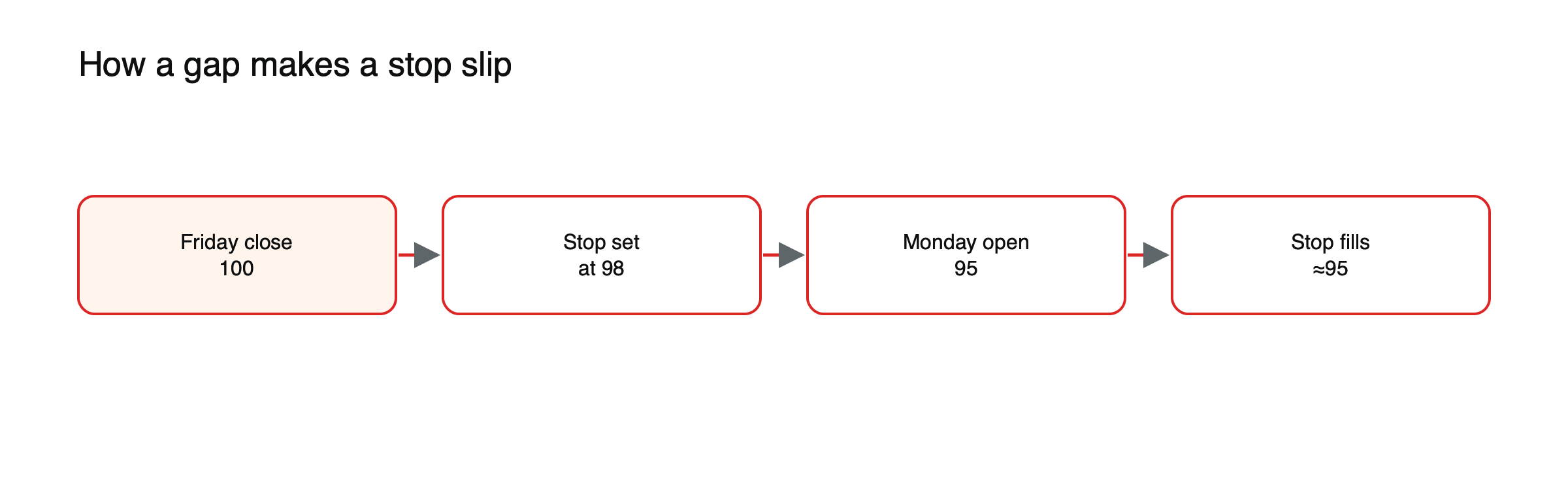
Figure: A gap can fill a stop far from its level (example values).
Fast markets: around major news, prices can jump through levels with few trades in between.
Thin liquidity: in January 2015, when the Swiss National Bank removed its euro floor, there were almost no executable prices for minutes; many stops filled hundreds or thousands of points away.
Guaranteed stops. Some providers offer guaranteed stop-loss orders that close at exactly your level, regardless of gaps, in exchange for a premium charged if the stop is triggered. They may have minimum distances from the current price.
Worked example: a normal fill and a gap fill
You buy 100 shares in a share CFD at $50 and place a stop at $47, risking $300. (Example values.)
- Normal market: the price drifts down to $47 during trading hours, the stop triggers and fills at about $47. The loss is about $300 plus costs.
- Gap: the company reports bad results after the close, and the shares open the next morning at $42. The stop triggers at the open but fills at about $42. The loss is about $800, more than two and a half times the plan.
The stop did its job in both cases: it closed the position. What it could not do was choose the price in the gap.
Guaranteed stops
Some providers offer guaranteed stop-loss orders that fill at exactly your level, even in a gap. In return, they charge a premium, usually only if the stop is triggered, and may require the stop to be set a minimum distance from the current price. For positions held through earnings reports, weekends or major announcements, the premium can be worth paying; for short intraday trades in liquid markets, ordinary stops are usually enough.
Where to place a stop
At the level where your trade idea is wrong, not at an arbitrary percentage, and far enough from normal price noise. Then size the position so that hitting the stop costs only what you can accept. See how to size a CFD position using risk per trade and what a trailing stop is.
Four common ways to choose the level
- Below structure: just beyond a support or resistance zone that would invalidate the idea if broken. See what support and resistance are.
- By volatility: a multiple of the market’s average daily range, so normal noise does not trigger it.
- By time: closing a trade that has not worked within a set period, whatever the price.
- By percentage: a fixed share of the entry price, simple but blind to the market’s actual behavior.
Most experienced traders combine the first two: a level that means the idea is wrong, checked against the market’s normal swings.
Stop distance and position size together
The stop sets the loss per unit; position size sets how many units. With a $10,000 account and a 1% risk limit, you can lose $100. If your stop is $3 from entry on a share CFD, you can hold about 33 shares; if it is $1 away, about 100. A wider stop does not mean more risk, as long as the position is smaller. See how to size a CFD position using risk per trade.
Moving a stop
Moving a stop closer to lock in gains is reasonable; moving it further away to avoid being stopped out turns a planned loss into an unplanned one. Many traders set a firm rule: stops can only move in the direction of the trade.
For order basics, see market, limit and stop orders and what a CFD is.
Stops in different markets
How a stop behaves depends on the market. Major currency pairs trade almost around the clock with deep liquidity, so stops usually fill close to their level except around major announcements and at the weekly open. Share CFDs follow their exchange’s hours, so overnight news often produces gaps at the open, as in the example above. Index CFDs may trade outside the underlying market’s hours but with thinner liquidity. Commodity CFDs react sharply to supply news and inventory data. Crypto CFDs track markets that never close, but providers may price them differently at weekends. Knowing when a market is likely to gap tells you when a stop is least reliable.
Mental stops
Some traders keep a stop level in mind rather than placing an order, planning to close the trade manually. It hides the level from the market but relies on being present and disciplined at the worst moment. In practice, mental stops are often moved or ignored when the price approaches them, which is exactly when they are needed.
What a stop cannot do
A stop cannot choose the price in a gap, cannot stop a platform outage from delaying execution and cannot make an oversized position safe. It is one layer of protection, which works best combined with sensible position size and moderate leverage.
Stops and leverage
Leverage changes what a stop protects. On a highly leveraged position, the distance between your stop and the provider’s stop-out level can be small, so a modest gap can carry the price past both at once. Lower leverage widens that buffer, which gives the stop room to work as intended. A stop is most reliable when the position is small enough that a bad fill would leave the account intact.
Frequently asked questions
Can other traders see my stop-loss?
Not individually on most platforms. But stops tend to cluster at obvious levels, such as just below round numbers or recent lows, and sharp moves through those areas are common. Placing stops at less obvious points helps.
Is a stop-loss guaranteed to limit my loss?
Only a guaranteed stop fills at its exact level. An ordinary stop limits the loss in normal conditions but can fill at a worse price in gaps and fast markets.
This article is educational content and does not constitute financial, investment, legal or tax advice. Digital assets are volatile and you may lose the amount you invest.