
What Past Tech Investment Booms Suggest About AI Spending
The 1990s IT boom raised productivity but also left excess capacity. Today’s AI buildout can create real economic value while still producing overinvestment.
Past technology booms suggest two things can be true at once: the technology can transform productivity, and investors can still fund too much capacity too quickly. The late-1990s IT boom produced real gains in computing and productivity, yet it also left an overhang of fiber and equipment after the bubble broke. Today’s AI spending boom may face the same tension.
1995–2000: investment surged because the technology was genuinely useful
The late 1990s were not built entirely on imagination. Businesses invested heavily in computers, software and communications equipment, and productivity growth accelerated.
Federal Reserve economists Stephen Oliner and Daniel Sichel estimated in 2000 that the use and production of information technology accounted for about two-thirds of the one-percentage-point acceleration in US productivity growth between the first and second halves of the 1990s.
That matters for the AI comparison. A market boom does not become “fake” simply because valuations overshoot. A technology can create real economic value while the financing cycle around it becomes excessive.
1999–2001: falling technology costs encouraged constant replacement
Computer equipment improved quickly and became cheaper relative to its performance. That changed investment behavior. Firms replaced equipment faster, and investment became more sensitive to the cost of capital.
The boom fed on a rational idea: if the next generation of hardware could materially improve productivity, delaying investment had a cost.
AI infrastructure has a similar feature. New chips, networking equipment and data-center designs can make previous systems economically obsolete before they physically wear out. The faster performance improves, the stronger the incentive to keep spending.
2001–2003: useful infrastructure still became an overhang
The lesson from the dot-com bust is not that the internet or fiber-optic networks were pointless. It is that capacity was built ahead of demand.
In a 2006 review of the productivity cycle, Federal Reserve Governor Susan Bies described a “massive overhang of IT capital” after the late-1990s rush, pointing specifically to underused fiber-optic cable. Firms had bought technology before fully learning how to reorganize business processes around it.
The infrastructure eventually became useful. The owners of that infrastructure did not all earn good returns.
That is the distinction investors often blur during technology booms: economic usefulness and investment profitability are different questions.
2023–2025: AI capex moved from software story to physical buildout
The current AI cycle is unusually capital-intensive. Training and serving large models require advanced semiconductors, networking equipment, data centers, power infrastructure and cooling.
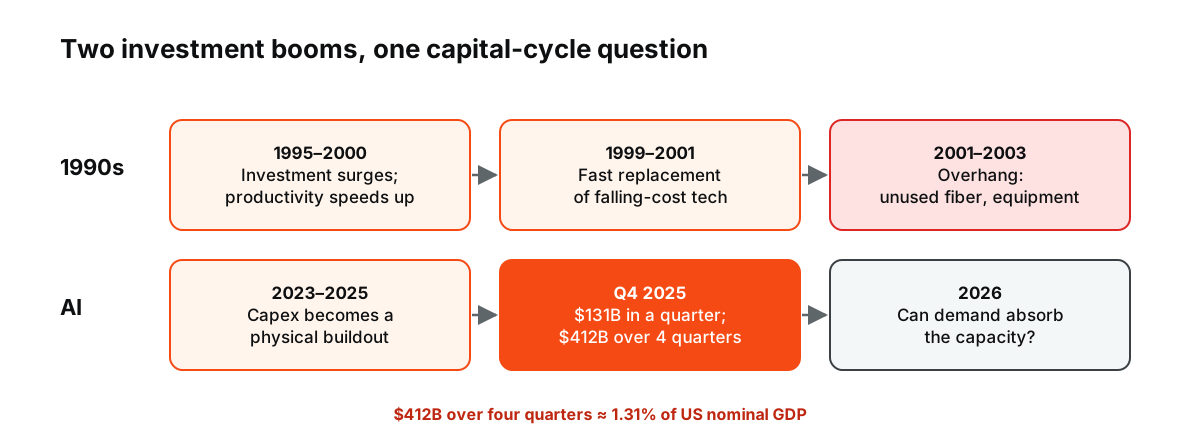
Figure: The two investment cycles side by side. AI capex figures: Federal Reserve research, April 2026 (Amazon, Google, Meta, Microsoft, Oracle).
Federal Reserve research published in April 2026 estimated that aggregate quarterly capital expenditure by Amazon, Google, Meta, Microsoft and Oracle reached $131 billion in the fourth quarter of 2025. Over the four quarters ending then, the total was $412 billion, about 1.31% of US nominal GDP.
Those numbers make the AI cycle more than a software valuation story. It is an infrastructure cycle with real effects on equipment imports, electricity demand, construction and corporate financing.
2026: policymakers are already asking whether demand can absorb the capacity
Federal Reserve Governor Michael Barr noted in February 2026 that some observers were comparing the AI buildout with overinvestment in the dot-com era. His point was not that AI would fail. One scenario was that improvements in AI capabilities or adoption could slow while large amounts of infrastructure had already been financed.
A July 2026 Federal Reserve note added another dimension: the US AI buildout depends heavily on imported high-technology capital goods, with a large share sourced from East Asia. That means the investment boom also affects trade flows, input prices and the current account.
The physical constraints are different from the 1990s, but the capital-cycle logic is familiar.
What the old boom says about the new one
The technology can work even if valuations do not
The internet changed the economy after the dot-com bubble. Many dot-com stocks still failed.
AI can produce measurable productivity gains without validating every valuation or every data-center project.
Infrastructure can be early rather than useless
Excess fiber capacity looked wasteful immediately after the telecom bust. Later, cheap bandwidth became part of the foundation for cloud computing, streaming and mobile services.
AI infrastructure could follow a similar path if capacity is built before business demand catches up.
Complementary change matters
Buying faster hardware is not enough. The 1990s productivity literature emphasized that firms had to redesign processes to use technology effectively.
For AI, the equivalent is workflow redesign, data quality, model integration, training and governance. A company can spend heavily on compute without creating a proportional productivity gain.
Financing structure changes who survives
A cash-rich platform financing data centers internally has a different risk profile from a highly indebted infrastructure operator that depends on high utilization from day one.
The technology can be the same while the investment outcome is completely different.
A simple framework for reading AI capex
Instead of asking whether AI spending is “a bubble,” track four ratios over time:
- Capex growth versus revenue growth: is infrastructure spending outrunning monetization?
- Utilization: are data centers and accelerators actually being used at planned levels?
- Unit economics: is the cost per useful inference or workflow falling fast enough?
- Financing burden: who owns the debt and how long can they wait for demand?
Those questions are more informative than comparing a chart of AI stocks with the Nasdaq in 2000.
The historical lesson is uncomfortable because it is not binary
Technology investment booms are easiest to understand after they end. During the boom, genuine productivity gains, competitive fear and speculative excess can all exist together.
The late 1990s produced both a productivity resurgence and excess infrastructure. AI spending can do the same. The useful task is not to decide whether the technology is “real.” It is to separate durable demand from capacity built on assumptions that have not yet been tested.
The railway mania
In the 1840s, British investors poured money into railway companies, and thousands of miles of track were approved within a few years. Many companies failed and shareholders lost heavily when the bubble burst, yet the railways that were built transformed transport and trade for a century. The episode is often cited alongside the late-1990s technology boom as an example of transformative infrastructure financed by an investment bubble.
Who pays for the buildout
Much of today’s AI investment is funded from the large cash flows of the biggest technology companies, rather than by heavily indebted start-ups, which differs from the fiber-optic boom of the late 1990s. Increasingly, though, data centers and power projects are also financed with debt and outside partners. The mix of funding matters: companies spending their own surplus cash can slow down if returns disappoint, while heavily indebted builders may be forced into distress.
Power and data centers
AI requires large data centers, specialized chips and vast amounts of electricity. That has spread the effects of the boom beyond software into chipmakers, utilities, construction, cooling equipment and energy. If demand for AI services grows more slowly than capacity, the overhang could appear in these physical assets, much as unused fiber did after 2001.
Signs of overinvestment to watch
- Spending growing much faster than revenue from AI services.
- Falling prices for computing capacity.
- Rising debt used to fund data centers.
- Customers delaying or cancelling orders for chips and equipment.
What it means for index traders
Because the companies leading AI investment carry very large weights in US indices, the AI cycle has become an index-level story. Strong spending and results lift the S&P 500 and Nasdaq 100; any sign of a slowdown can hit them sharply. See why a handful of stocks can drive an entire index, what the Nasdaq 100 is and what the dot-com crash taught investors.
How markets priced the boom
Share prices of the companies most linked to AI rose sharply from 2023, as investors anticipated years of growth in chips, cloud computing and software. Much of the gain reflected expectations about future earnings rather than profits already earned. When expectations run ahead of results, even strong reports can disappoint, and share prices can fall sharply if spending plans slow. That pattern, rather than the technology’s usefulness, is what investors watch for in assessing whether a boom has become a bubble. See what moves stock prices. Comparing capital spending plans with revenue from AI services each quarter, and watching closely how chipmakers’ order books evolve, gives investors an early read on whether the buildout is running ahead of demand or still catching up, which matters greatly for index traders.
Frequently asked questions
Is AI spending a bubble?
History shows that a technology can be transformative and still attract too much investment too quickly. Whether today’s spending is excessive will depend on how fast revenue from AI services grows.
What happened after the late-1990s boom?
Spending fell sharply, many companies failed and technology shares collapsed, but much of the infrastructure built was later used productively.
This article is educational content and does not constitute financial, investment, legal or tax advice. Digital assets are volatile and you may lose the amount you invest.
Sources
- The Resurgence of Growth in the Late 1990s: Is Information Technology the Story? — Federal Reserve Board, April 2000
- Productivity and Economic Outlook — Federal Reserve Board, January 2006
- Monitoring AI Adoption in the US Economy — Federal Reserve Board, April 2026
- Technology Shocks, the AI Boom, and the U.S. Current Account — Federal Reserve Board, July 2026
- Speech on Artificial Intelligence and the Labor Market — Federal Reserve Board, February 2026