
How the ECB and the Fed Differ in Moving Markets
The Fed has a dual mandate for one economy; the ECB targets price stability for many countries with separate bond markets. How the difference shows in markets.
The key difference in ECB vs Fed policy is scope. The Federal Reserve sets rates for one economy with a dual mandate of maximum employment and stable prices. The European Central Bank’s primary mandate is price stability, but it sets one rate for many countries with their own bonds, so it must also manage gaps between their yields.
Side by side
| Federal Reserve | European Central Bank | |
|---|---|---|
| Economy | United States | Euro area countries |
| Mandate | Maximum employment and stable prices | Price stability first |
| Bond market | One government bond market | Separate bonds for each country |
| Special tools | QE, emergency lending | QE, plus the Transmission Protection Instrument (2022) |
| Global reach | Sets the price of the world’s main currency | Large regional influence |
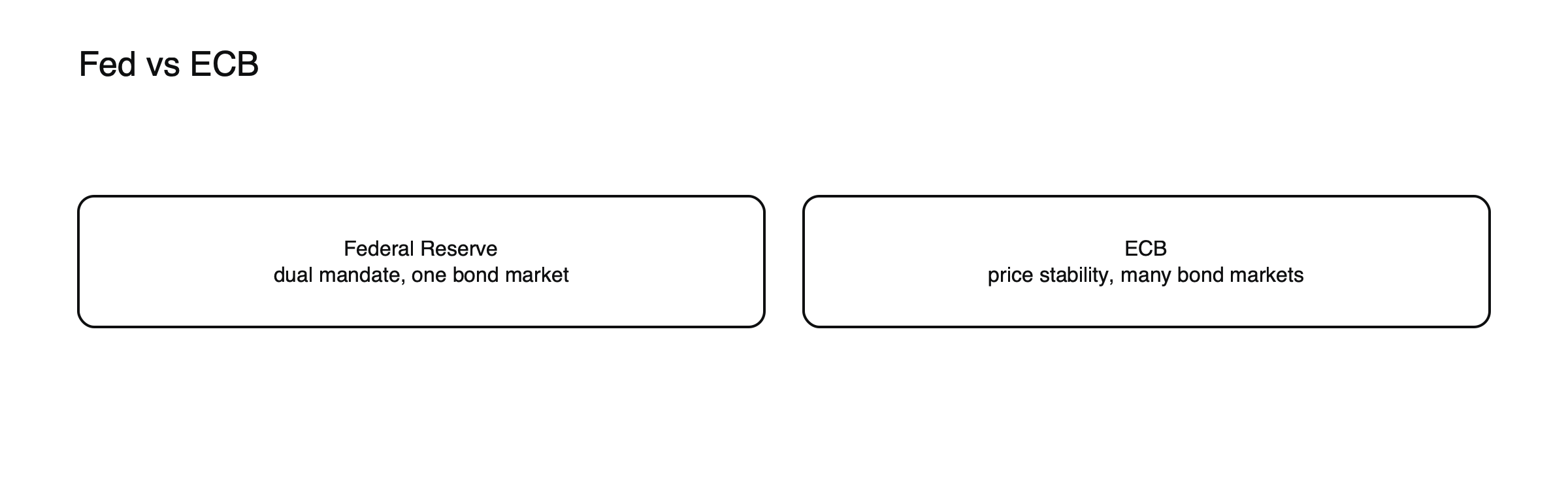
Figure: One economy vs many.
The fragmentation problem
When the ECB raises rates, weaker countries’ borrowing costs can rise much faster than Germany’s, splitting financial conditions inside one currency area. On July 21, 2022, the ECB raised rates by half a point, its first hike in 11 years, and launched the Transmission Protection Instrument, an unlimited, conditional bond-buying tool to counter “disorderly” spread widening. Italian-German spreads still widened toward about 2.4% at the time.
Spreads inside the euro, illustrated
Suppose the ECB raises rates by 1 percentage point. (Illustrative scenario.) German 10-year yields rise from 1.5% to 2.2%, while Italian yields jump from 3.5% to 4.8%, widening the gap between them from 2.0 to 2.6 points. Italian borrowers, including the government, face a much larger rise in costs than German ones, even though both share the same policy rate. That uneven effect is what the ECB calls fragmentation, and why it built tools to limit it.
A history of crisis tools
The ECB has had to invent tools that the Fed does not need. During the euro-area debt crisis, it pledged in 2012 to do whatever was necessary to preserve the euro, calming bond markets without immediately buying. It later launched large-scale bond purchases in 2015 and a pandemic program in 2020, and in 2022 created the Transmission Protection Instrument. Each tool aimed to keep one monetary policy working across very different economies.
Why the Fed moves more markets
The dollar is the main currency for global trade, debt and reserves, so Fed decisions ripple through emerging markets, commodities and crypto. See how a strong dollar hits commodities, emerging markets and crypto.
Different paths since 2022
Both central banks raised rates sharply from 2022 to fight inflation. The ECB raised its deposit rate ten times from July 2022, reaching 4% in September 2023. It then moved first on cuts, lowering the deposit rate to 3.75% on June 6, 2024, its first cut since 2019, while the Fed waited until September 2024. That divergence widened the rate gap in the dollar’s favor for a time, weighing on the euro. See what happens to currencies when a central bank pivots.
Negative rates
From 2014 until 2022, the ECB held its deposit rate below zero, reaching −0.50% in 2019, to fight very low inflation. The Fed never adopted negative rates. Negative rates squeezed European bank profits and pushed investors into riskier assets in search of yield, a different policy experience that still shapes European markets.
Where the usual answer flips
When the ECB and Fed diverge, the ECB can drive the euro and European assets more than the Fed does. Rate gaps between them are a major driver of EUR/USD.
See what markets listen for in a central bank meeting and what happens to currencies when a central bank pivots.
Communication styles
The Fed publishes officials’ rate projections four times a year and holds a press conference after every meeting. The ECB holds a press conference after each decision but does not publish individual projections, and its Governing Council includes the heads of each member country’s central bank, which can produce public disagreements that move markets. Traders watch speeches by national central bank heads for hints of the next move.
Effects on EUR/USD
The expected gap between US and euro-area rates is one of the main drivers of EUR/USD. When markets expect the Fed to cut faster than the ECB, the euro tends to rise; when they expect the ECB to cut faster, it tends to fall. Growth differences, risk sentiment and energy prices also matter, especially for the euro area, which imports most of its energy. See what moves EUR/USD.
Effects on European shares and bonds
ECB decisions affect European bank shares strongly, because banks’ lending margins depend on the rate level and curve shape. Government bond spreads, especially Italy’s over Germany’s, react to any hint about the ECB’s willingness to support weaker members. European share indices with heavy bank weights often move sharply on ECB days.
Energy and the euro area
The euro area imports most of its energy, so energy shocks hit it harder than the United States, which is a net energy exporter. In 2022, soaring gas prices pushed euro-area inflation up and weakened the euro, which fell below parity with the dollar, complicating the ECB’s task. Energy prices are therefore a bigger factor in ECB decisions than in the Fed’s. See how energy shocks travel through inflation, rates and currencies.
The mandate in practice
The ECB targets inflation of 2% over the medium term and considers growth and employment only insofar as they affect price stability. The Fed weighs employment and inflation equally. In practice, both respond to growth and inflation, but the difference can matter when the two goals conflict, such as when inflation is high while unemployment rises.
The Bank of England and others
The Bank of England, Swiss National Bank and Bank of Japan also move markets, especially their own currencies. The Swiss National Bank became the first major central bank to cut in March 2024, ahead of both the ECB and the Fed.
Common misreadings
- Assuming the ECB always follows the Fed.
- Ignoring bond spreads within the euro area.
A checklist for ECB days
- What do markets price for the decision?
- Are new staff projections due?
- Any comments on bond spreads or fragmentation?
- How do national central bank heads react afterward?
How the TPI works
The Transmission Protection Instrument allows the ECB to buy bonds of a member country whose borrowing costs rise in a way it judges unjustified by fundamentals. Purchases are potentially unlimited but conditional on the country following sound fiscal policies. The tool has acted mainly as a deterrent: its existence has helped limit spread widening without large purchases.
Growth differences
In the years after 2022, the US economy generally grew faster than the euro area, supported by government spending, energy independence and strong technology investment. Faster US growth tended to keep US rates higher for longer and to support the dollar against the euro. Changes in the growth gap often show up quickly in EUR/USD.
Rate gaps and capital flows
When euro-area yields rise relative to US yields, European investors have less reason to buy US bonds, and some money flows back into euro assets, supporting the euro. When the gap widens in the dollar’s favor, the reverse happens. These flows are one reason the expected path of each central bank matters so much for EUR/USD.
Euro-area inflation data
The euro area publishes a flash estimate of inflation at the end of each month, often preceded by national releases from Germany, France, Italy and Spain. Markets react to these early national figures, so much of the surprise can be priced before the euro-area number arrives.
Trading EUR/USD on ECB days
Spreads can widen and prices can jump around ECB decisions and press conferences. Many traders reduce position size beforehand and wait for the press conference, because the president’s answers often move the euro more than the decision itself. Watching German and Italian bond yields during the press conference shows how markets read the ECB’s commitment to limiting spreads.
Frequently asked questions
Which central bank matters more for global markets?
Usually the Fed, because of the dollar’s global role, but the ECB can dominate euro-area assets and EUR/USD.
Why does the ECB worry about bond spreads?
Because a single policy rate must work across many countries; if borrowing costs diverge too much, policy affects members very unevenly.
This article is educational content and does not constitute financial, investment, legal or tax advice. Digital assets are volatile and you may lose the amount you invest.
Sources
- The ECB’s TPI (announced July 21, 2022; unlimited, conditional; counters disorderly dynamics; Italy-Germany spreads) — Model Diplomat
- ECB’s crisis plan fails to convince bond traders (first hike in 11 years, 50 basis points) — Bloomberg Opinion, July 2022
- ECB’s new instrument to fight bond spreads (Italian-German spreads near 2.4%) — Validus Risk Management, August 2022
- ECB Eco Week (TPI to deliver on the price stability mandate) — BNP Paribas, July 2022
- ECB kicks off rate-cutting cycle (June 6, 2024: first cut since September 2019, when the deposit rate fell to −0.50%; deposit rate from 4% to 3.75%; ahead of the Fed and the Bank of England) — KBC, June 2024
- ECB cuts rates as expected (first deposit rate cut in five years after 10 hikes since July 2022; Swiss National Bank first major central bank to cut, in March 2024) — Morningstar, June 2024
- Austerity follows Russian audacity (euro fell below parity with the dollar in 2022) — PKF Malta, September 2022