
Emerging Market vs Developed Market Stocks
Emerging market stocks outperformed in the 2000s, lagged for most of the 2010s and rebounded in 2025. Compare growth, risks, the role of the dollar and China.
In the emerging vs developed market stocks comparison, leadership has swung in long cycles tied closely to the US dollar. Emerging markets strongly outperformed developed markets from 2000 to 2010, then lagged for most of the following decade and a half as the dollar strengthened. In 2025 they rose about 34% in dollars, well ahead of developed markets.
Side by side
| Emerging markets | Developed markets | |
|---|---|---|
| Examples | China, India, Taiwan, Brazil | US, Europe, Japan |
| Share of world population | Over 85% | Under 15% |
| Typical sensitivity | High to the dollar, commodities and China | Lower |
| Valuation | Usually at a discount | Usually at a premium |
| 2000–2010 | Strongly outperformed | Lagged |
| 2011–2024 | Lagged | Outperformed |
| 2025 | About +34% | About +22% |
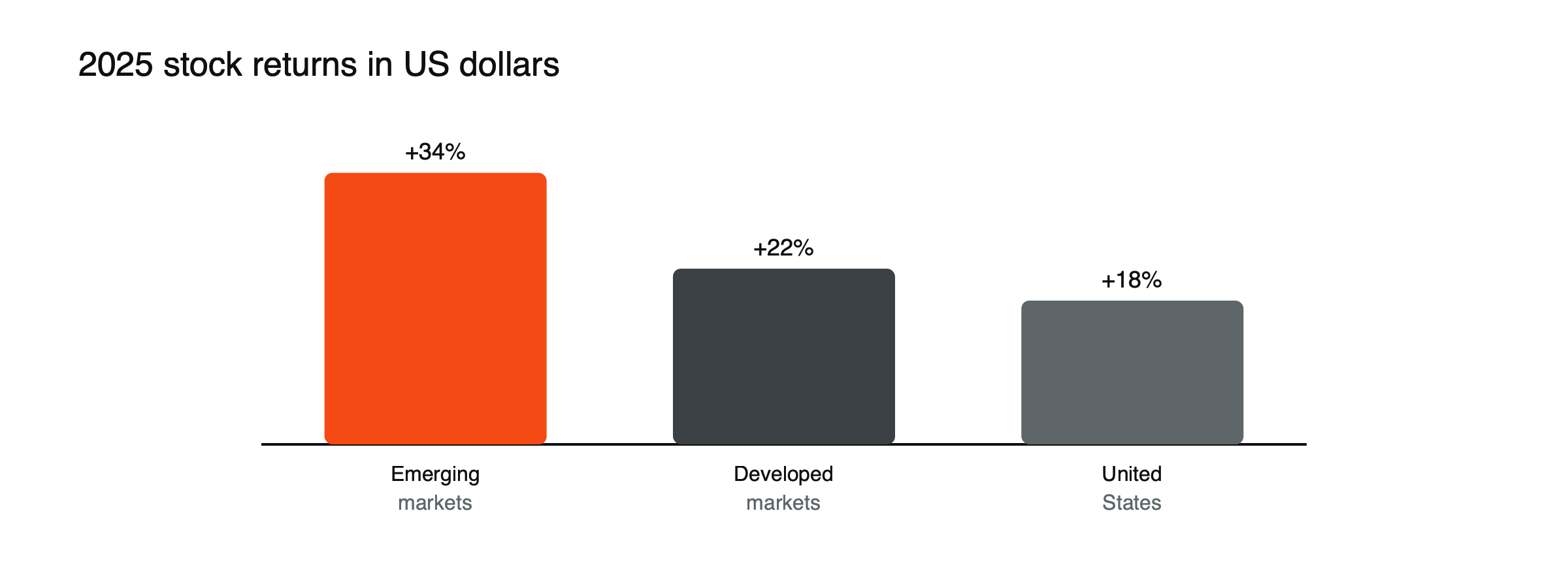
Figure: 2025 returns by region. Source: Carmignac.
The 2025 rebound
In 2025, emerging markets rose about 34% in dollar terms, against about 22% for developed markets and about 18% for US shares, one of their strongest years relative to developed markets in over a decade. A weaker dollar, stronger performance in several large markets and lower starting valuations all contributed. Whether the rebound marks the start of a new cycle of outperformance, like 2000 to 2010, depends partly on the dollar’s path.
Why the dollar matters so much
A weaker dollar lowers the cost of dollar debt for emerging-market borrowers and makes their exports and inputs easier to manage; a stronger dollar does the opposite. Both of emerging markets’ big winning and losing stretches lined up with dollar trends. See how a strong dollar hits commodities, emerging markets and crypto.
The China factor
China has been the largest weight in emerging-market indexes, so its slowdown weighed on the whole group after 2010. Excluding China, emerging markets did noticeably better in some periods.
Country differences
Emerging markets are far from uniform. Taiwan and South Korea are dominated by technology and semiconductor companies, India by financials and consumer firms with high valuations, Brazil and South Africa by commodities and banks, and China by internet and consumer companies alongside state-owned enterprises. A single emerging market index blends very different economies, and returns between countries often diverge widely in the same year.
Valuation gap
Emerging market shares have usually traded at a discount to developed markets, reflecting higher risks, more state influence and weaker shareholder protections in some countries. The discount widened through much of the 2010s as US shares rallied. A large discount can support future returns if risks ease, but cheap markets can stay cheap for years.
Where the usual answer flips
«Emerging markets grow faster, so their stocks should do better» does not hold: fast economic growth has not reliably turned into higher returns for shareholders, because of dilution, state influence and currency moves.
What to consider
Emerging markets add diversification but also currency, political and concentration risk. Performance differs widely between countries. For the wider picture, read stocks, bonds and commodities across the rate cycle and market leadership by decade.
The 2013 taper tantrum
When US yields jumped in 2013 on expectations of slower Fed bond buying, emerging market currencies and shares fell sharply, especially in countries reliant on foreign funding. The episode showed how sensitive emerging markets are to US interest rates as well as the dollar. See what the 2013 taper tantrum was.
Currency risk, illustrated
Suppose an emerging market index rises 10% in local currency over a year while the local currency falls 8% against the dollar. (Illustrative figures.) A dollar-based investor earns only about 1.2%. If the currency instead rises 8%, the dollar return is about 18.8%. Currency moves can add to or wipe out local market gains, which is why the dollar’s direction matters so much for foreign investors.
Ways to gain exposure
Investors can use broad emerging market funds, regional or single-country funds, or funds excluding China. Index CFDs on major emerging market indices, or on individual markets, offer leveraged exposure but add the usual risks of leverage and wider spreads. See what an ETF is.
Interest rates and inflation
Many emerging market central banks raised rates early and aggressively when inflation surged in 2021 and 2022, ahead of the Federal Reserve. That gave some of them room to cut earlier as inflation fell, supporting their markets. Higher local interest rates can attract foreign investors, but they also signal higher inflation risk, which investors weigh against the potential returns.
Politics and governance
Political events, from elections to sudden policy changes, can move emerging markets more than developed ones. State-owned companies, capital controls and regulatory crackdowns can hurt minority shareholders. China’s crackdown on technology and education companies from 2020 to 2022 showed how quickly government action can erase large amounts of shareholder value.
Commodity cycles
Many emerging economies export commodities, so their markets tend to rise with commodity prices and fall with them. The 2000s commodity boom, driven by Chinese demand, was a major reason for emerging markets’ outperformance in that decade; the commodity slump from 2011 contributed to their lag afterward.
Index composition shifts
The makeup of emerging market indices changes over time. China’s weight rose sharply in the late 2010s as its domestic shares were added, then fell as its market weakened, while India and Taiwan gained weight. Such shifts change what a broad emerging market fund actually holds, and investors should check current weights rather than relying on old assumptions.
Common misreadings
- Treating emerging markets as one market.
- Assuming cheap valuations guarantee higher returns.
Growth does not equal returns, illustrated
Suppose an emerging economy grows 6% a year while its companies issue new shares each year to fund expansion, diluting existing shareholders by 3% a year, and its currency falls 2% a year against the dollar. (Illustrative figures.) Even if company profits grow with the economy, a dollar-based shareholder captures only a fraction of that growth. Dilution and currency weakness explain why fast-growing economies have not always produced strong returns for foreign investors.
Bonds and shares
Emerging market bonds, issued in dollars or local currencies, offer another way to invest. Dollar bonds carry credit risk but little currency risk for dollar investors; local currency bonds add currency exposure. Emerging market bonds and shares often fall together in risk-off periods, limiting their value as diversifiers for each other.
Frontier markets
Beyond emerging markets lie frontier markets, smaller and less developed economies with even less liquid share markets. They can offer diversification because their markets are less connected to global flows, but they carry higher political, liquidity and currency risks.
Watching the dollar cycle
Because emerging market performance has tracked the dollar so closely, many investors watch the dollar’s long-term trend when deciding how much to hold. A sustained weakening, driven by narrowing US rate advantages or stronger growth elsewhere, has historically favored emerging markets; a sustained strengthening has favored developed markets. The dollar’s turn is hard to time, but its direction over several years has mattered more than almost any other factor.
Concentration, illustrated
Suppose a broad emerging market fund holds about a quarter in China, a fifth in India, a fifth in Taiwan and smaller amounts in dozens of other countries. (Illustrative weights.) Three markets then drive most of its returns, and a few large companies, especially in technology, can dominate. Investors who think they own a diversified slice of the developing world may in fact hold a concentrated bet on a handful of economies and sectors.
A checklist
- What is the dollar’s trend?
- How large is China’s weight in the fund?
- How do valuations compare with developed markets?
- What are commodity prices doing?
Emerging markets in a portfolio, illustrated
Suppose a global share portfolio holds about 10% in emerging markets, roughly in line with global indices. (Illustrative weight.) In a year like 2025, when emerging markets rose about 34% against about 22% for developed markets, the allocation would have added a little over one percentage point to returns compared with holding developed markets alone. In a year when emerging markets lag badly, it would subtract a similar amount. The allocation really matters at the margin, which is why sizing it to one’s views and risk tolerance is often more important than the simple decision to hold it at all.
Frequently asked questions
Should emerging markets be part of a portfolio?
Many global indices include them at around a tenth of their weight. How much more or less to hold depends on risk tolerance and views on the dollar.
Why did China weigh on emerging markets?
China is the largest weight in most emerging market indices, so its slowdown and regulatory crackdowns dragged on the whole group.
This article is educational content and does not constitute financial, investment, legal or tax advice. Digital assets are volatile and you may lose the amount you invest.
Sources
- Emerging Markets: Why and Where (over 85% of world population; EM outperformed 2000–2010 and underperformed since) — Dodge & Cox, May 2024
- Emerging markets: the big return (2025: EM +34% in dollars vs US +18% and developed +22%; 2000–2010 cumulative gain over 300%) — Carmignac
- A tidal turn on horizon for emerging markets (performance periods matched dollar weakness and strength) — Business Day, November 2023
- Equity markets: emerging markets or industrialized countries? (EM ex China performed better) — M.M. Warburg, May 2024