
How Fiscal Deficits Affect Rates, Currencies and Stocks
Large deficits can push up bond yields, weaken a currency and unsettle stocks when markets doubt a government's plans. The UK in 2022 and US downgrades.
Fiscal deficits affect markets mainly through bonds: more borrowing means more bonds to sell, and if investors doubt the plan, they demand higher yields, which can weaken the currency and hit stocks. The UK’s September 2022 mini-budget showed how fast: gilt yields jumped, the pound hit a record low and the Bank of England stepped in.
How deficits reach markets
Governments fund deficits by selling bonds. If buyers worry about inflation, repayment or policy credibility, they demand higher yields, which raises borrowing costs across the economy and can push money out of the currency.
Supply and yields, illustrated
Suppose a government needs to sell an extra $500 billion of bonds a year because its deficit has widened, while its central bank is no longer buying. (Illustrative scenario.) Private investors must absorb that supply. If they believe the borrowing is temporary and inflation is under control, yields may barely move. If they doubt the plan or fear inflation, they may demand an extra 0.5 points of yield on long bonds, which on a 10-year bond with a duration of about 8 means a price fall of roughly 4%. Higher yields then raise borrowing costs for households and companies.
The UK in September 2022
On September 23, 2022, the UK government announced the largest tax cuts in 50 years without an independent cost estimate. The pound fell 3.6% that day and hit a record low near $1.035 the following Monday. The 30-year gilt yield rose above 5%, a two-decade high, and pension funds using leverage faced margin calls. The Bank of England launched a £65 billion emergency bond-buying program; most of the measures were later reversed.
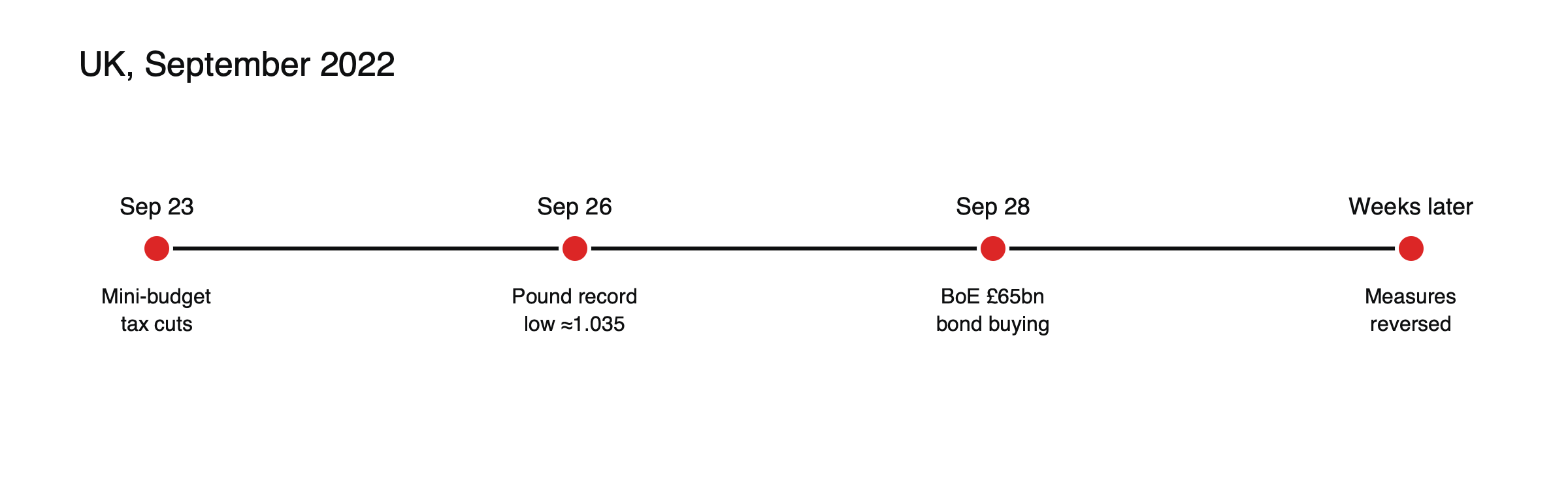
Figure: How a fiscal shock became a bond market crisis in five days.
The US and its credit ratings
The US lost its top rating from S&P in August 2011, from Fitch in August 2023 and from Moody’s in May 2025, each citing deficits and political difficulty managing debt. Moody’s projected US debt rising from about 100% of GDP in 2025 to about 130% by 2035.
Interest costs and the debt spiral concern
As debt grows and interest rates rise, governments spend more on interest, which can widen deficits further. Investors worry about a spiral in which higher debt pushes up yields, which raises interest costs, which adds to debt. The concern is greatest when interest rates exceed the economy’s growth rate for long periods. Most large economies are far from a crisis, but the arithmetic explains why markets watch interest costs closely.
Why Treasuries still rallied
Yet Treasuries often rallied after downgrades, because they remain the main safe asset. In 2011, the 10-year yield fell from 2.56% to 2.32% in a day as the S&P 500 dropped 6.7%. See how debt ceiling fights have affected markets.
Deficits and currencies
Large deficits can weaken a currency if investors fear inflation or lose confidence in policy, as with sterling in 2022. But they can also strengthen it in the short term if they push up interest rates and attract capital, especially for a reserve currency like the dollar. The reaction depends on whether markets see the borrowing as credible and sustainable.
Deficits and shares
Deficit spending can support shares by boosting demand and company profits, as after 2020. But if it pushes long-term yields higher, it raises the rate used to value future profits, weighing on richly valued shares. In 2026, a renewed rise in yields hit bond and share markets, though higher starting income cushioned bonds more than in 2022, according to Vanguard.
What decides the reaction
- Credibility: markets punish plans that look unfunded or bypass fiscal watchdogs.
- Who holds the debt: domestic savers and reserve-currency status cushion the US more than smaller economies.
- Inflation: deficits feel riskier when inflation is already high.
Limits
Deficits can persist for years without a crisis; the trigger is usually a sudden loss of confidence. See why central bank independence matters to markets and why global markets watch Japan’s bond market.
Bond vigilantes
Investors who sell government bonds to protest fiscal policy are sometimes called bond vigilantes. Their influence was famously felt in the US in the early 1990s, when rising yields encouraged deficit reduction, and in the UK in 2022, when a sharp sell-off forced a reversal of tax cuts within weeks. Governments with large debts are particularly exposed to these swings in confidence. See what happened in the UK gilt crisis.
Japan and Italy
Japan’s government debt is more than twice the size of its economy, but most of it is held at home, which has helped keep yields low and stable for decades. Italy’s high debt, by contrast, has periodically pushed its bond spreads over Germany’s sharply higher, especially during political disputes over budgets, requiring support from the European Central Bank. The comparison shows that who owns the debt and which central bank stands behind it matter as much as the debt level. See how the ECB and the Fed differ in moving markets.
What to watch
- Deficit projections and changes to tax and spending plans
- Treasury issuance announcements, especially for long bonds
- Auction demand for government bonds
- Long-term yields and the term premium
- Rating agency outlooks
Deficits in good times and bad
Deficits usually widen in recessions, as tax revenues fall and support payments rise, and narrow in expansions. Markets generally accept larger deficits during downturns, when bond yields tend to fall anyway. Concern rises when deficits stay large during good times, because that suggests a structural gap between spending and revenue rather than a temporary response to weakness. See how recession signals have performed historically.
Fiscal rules and watchdogs
Many governments adopt rules limiting deficits or debt and rely on independent bodies to assess their plans. In the UK, the Office for Budget Responsibility publishes forecasts alongside budgets; the 2022 mini-budget’s lack of such a forecast deepened market doubts. Credible rules and watchdogs can lower borrowing costs by reassuring investors that deficits will be controlled.
Deficits and inflation
Large deficits can add to inflation when the economy is already running near capacity, because extra government spending competes with private demand. That can force central banks to keep rates higher for longer, raising bond yields. In a downturn with spare capacity, deficits are less likely to fuel inflation.
Common misreadings
- Assuming any deficit increase will trigger a bond crisis.
- Ignoring who owns the debt and in which currency.
The long-run arithmetic, illustrated
Suppose a government’s debt equals 100% of its economy, it runs a deficit of 3% of GDP before interest and pays an average interest rate of 4%, while the economy grows 3% a year in money terms. (Illustrative figures.) After ten years, debt reaches about 141% of GDP. If instead the interest rate were 3% and growth 4%, the same deficits would leave debt at about 120%. The gap between interest rates and growth matters as much as the deficit itself, which is why rising yields worry investors in highly indebted countries.
Trading fiscal events
Budget announcements, rating decisions and debt-limit deadlines can move bonds, currencies and share indices sharply. Traders often reduce position sizes before major fiscal events and watch long-term yields and the currency for the first reaction. A rise in long yields combined with a falling currency, as in the UK in 2022, is the clearest sign of a loss of confidence.
Deficits and the term premium
Large, persistent deficits can raise the term premium, the extra yield investors demand for holding long-term bonds, because they increase supply and uncertainty about future inflation and policy. A rising term premium steepens the yield curve from the long end. See why yield curve steepening can mean very different things.
Emerging markets
Emerging market governments face tighter limits, because much of their debt may be in foreign currencies and investors can leave quickly. Fiscal slippage can trigger currency falls and capital outflows much faster than in large developed economies.
Fiscal news and the dollar
For the US, fiscal worries have sometimes weakened the dollar even as Treasuries rallied, a sign that investors were questioning policy rather than the basic safety of the bonds themselves. Such divergences deserve attention.
Frequently asked questions
Do deficits always raise interest rates?
No. In recessions, deficits often rise while yields fall. The effect depends on inflation, credibility and investor demand.
Why can the US run large deficits with little market reaction?
Because the dollar is the main reserve currency and Treasuries are the world’s main safe asset, giving the US unusual borrowing capacity.
This article is educational content and does not constitute financial, investment, legal or tax advice. Digital assets are volatile and you may lose the amount you invest.
Sources
- GBP/USD jumps after BoE intervention (pound −3.6% on the Friday; record low 1.0359) — MarketPulse, September 2022
- Markets on edge despite Bank of England intervention (no OBR oversight; £65bn bond buying; 30-year gilt above 5%) — Federated Hermes, September 2022
- Low risk funds for a UK economic crisis (biggest tax cuts in 50 years; pension schemes) — Money to the Masses
- Jim Cramer recalls 2011’s market decline after US debt downgrade (Moody’s projection of debt to about 130% of GDP by 2035) — Benzinga, May 2025
- US Downgrade Then and Now (2011, 2023 and 2025 downgrades; Treasuries rallied in 2011) — Cumberland Advisors, May 2025
- How 2026 may set the table for stronger bond returns (2026 rate shock cushioned by higher income than in 2022) — Vanguard, September 2026
- Putting out the NBFIre (30-year gilt yield up about 140 bp in three days; about £37 billion of gilt sales) — SUERF